The Five Best $2 Cards

Disclaimer: Dominion does a really great job of balancing its Kingdom cards.  Pretty much every card has some situations where it shines, and some situations where it doesn’t.  Nevertheless, some cards just end up being flat-out better than others, either because they are more useful more often, or just ridiculously good when they are useful.  Don’t expect this list to be very scientific.
Pawn

Dominion: Intrigue

5. Pawn

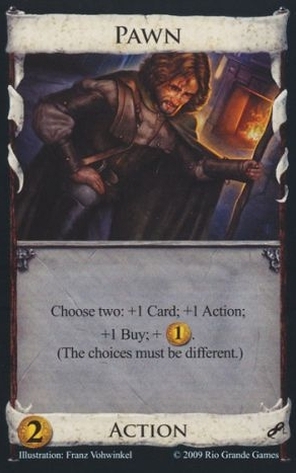
Yes, I know I just put it on the Worst $2 Cards, but honestly, this is one of the most all-around useful cards in the game.  It’s great early when you can afford to blind draw, it’s an easy way to get a non-terminal Buy, it’s ridiculously cheap, it’s a great disappearing source of money (good for Library, Minion, Grand Market), and yes, if all else fails, it’s +1 Action / +1 Card…


Native Village

Dominion: Seaside

4. Native Village

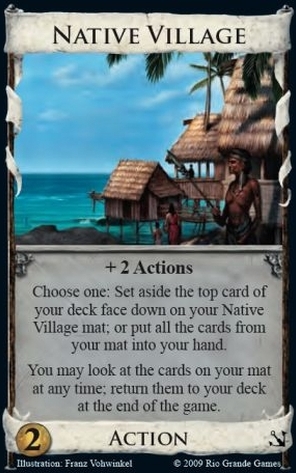
Being able to tuck away cards is really nice.  It works as a pseudo-“trash the top card of your deck”, if you can commit to never drawing from the mat, or alternatively a mini-Tactician, if you change your mind.  And it also happens to be the cheapest source of +Actions in the game.  Loses a point, though, for the possibility of self-inflicted rage (“Nooo, not my Platinum!”) matched only by Lookout.


Courtyard

Dominion: Intrigue

3. Courtyard

I considered placing this above Haven, but ended up ranking it just below.  It’s decent (but not great) in a +Actions/+Cards chain (as befitting a $2 card), but it’s really nice even when you don’t have any +Actions.  Placing a card back on top is like a mini-Haven, and it saves you from drawing dead Actions, the biggest drawback to +Cards in the absence of +Actions.  But it ranks below Haven simply because it doesn’t feed on itself well: you can’t play multiple Courtyards since it’s terminal, and even if you have +Actions, playing multiple Courtyards on top of each other is not that great.


Haven

Dominion: Seaside

2. Haven

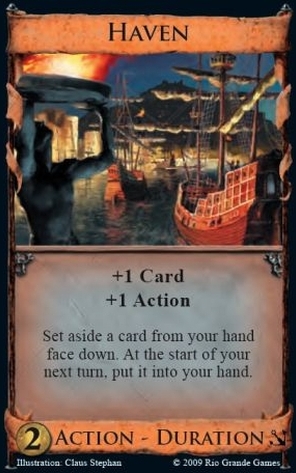
I really, really like this card.  Probably more than it deserves.  But it’s saved my bacon many times: literally any combination of cards benefits from a Haven, making those lovely massive Action chains that much easier to put together.  In particular, it gets rid of those situations when you draw your King’s Court all by itself, even though you have like a million other Actions in the deck, but your stupid opponent lucked into his stupid King’s Court with his stupid Mountebank and now you’re pretty much dead on arrival because of a random number generator.

In other words, Haven is great.


Chapel

Dominion

1. Chapel

The obvious choice, and one I strained against making, but you simply can’t put the closest thing Dominion has to a must-buy anywhere but #1.  Indeed, I think Chapel is probably the strongest card that will ever be included in a Dominion set: what other card could possibly be such a first-turn must-buy and not be horribly overpowered?  Moneylender and Ambassador come closest out of the existing sets, but neither defend nearly as well against attacks.  Chapel is the gold standard of Dominion openers, and I suspect it will remain as such for a very long time.

Posted in Rankings | Tagged , , , , | 10 Comments

The Five Worst $2 Cards

Disclaimer: Dominion does a really great job of balancing its Kingdom cards.  Pretty much every card has some situations where it shines, and some situations where it doesn’t.  Nevertheless, some cards just end up being flat-out better than others, either because they are more useful more often, or just ridiculously good when they are useful.  Don’t expect this list to be very scientific.

Pawn

Dominion: Intrigue

5. Pawn

I put this on here for one reason and one reason only: because 90% of the players who buy this never use it for anything other than +1 Action / +1 Card, but only after about a minute or so of thinking.  One of the worst AP culprits, made worse by the fact that there really shouldn’t be much AP over this in the first place.


Cellar

Dominion

4. Cellar

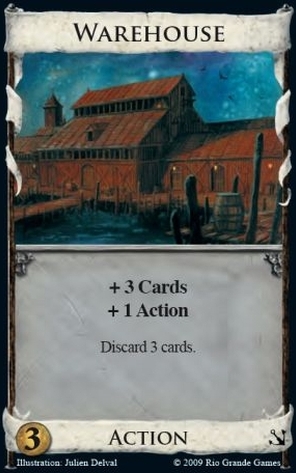
By no means is this a bad card.  It’s just a lot less special than it used to be.  In base Dominion, this was an absolutely critical card for Laboratory and Village/Smithy chains, since if you drew into your Victory cards and didn’t have a Cellar you were pretty much dead on arrival.  But with the advent of Warehouse, Cellar’s main selling point is now that it’s slightly cheaper, and honestly, you’re almost never going to need a Cellar but unable to afford the Warehouse.  Theoretically, Cellar can cycle more cards than Warehouse, but it’s just so much worse with small hand sizes that it’s not worth the effort.  Add in the fact that Vault / Secret Chamber provide other options for disposing of unwanted cards, and Cellar becomes relegated to a card only to buy if its superior alternatives are not available.


Moat

Dominion

3. Moat

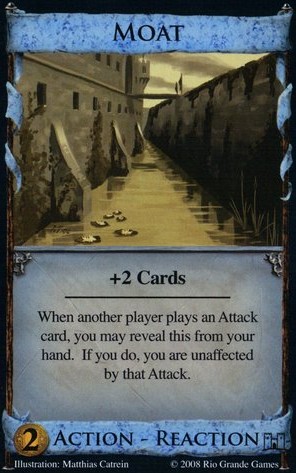
A tough call, putting a Reaction card on this list, since if you’re under fire from Mountebanks and Witches, you are pretty happy to have one of these in your hand.  Among Reaction cards, Moat has the best Reaction ability—but in exchange for having the worst non-Reaction ability.  The problem is that you rarely need such all-around protection.  Secret Chamber works just as well (possibly better) against deck-inspection attacks; Watchtower does better than Moat against Curse-givers by eliminating their “ammo”.  The only attack that only Moat is effective against is Militia/Goons, and unless you have +Actions to burn, every time you draw it, you’ve given up one slot in your hand to possibly avoid giving up two.  Not a great trade.

Most telling, though, is that if there is no attack in the game, then no one buys Moat.  (The +2 Cards is so pathetically weak that you should probably just not bother building a +Actions/+Cards engine around it.)  The same is not true of Watchtower or Secret Chamber.


Herbalist

Dominion: Alchemy

2. Herbalist

This works best with Alchemist and Hoard.  Other than that, this is a classic “Actions to burn” buy; there’s no point to it unless you have more Actions than you know what to do with, or if you desperately need +Buy.


Pearl Diver

Dominion: Seaside

1. Pearl Diver

The first time you buy it, you conjure up all these images of the great cards buried on the bottom of your deck, to be brought back to the living by Pearl Diver.  But then you hit an Estate on the bottom, and you start to realize, hey, this card is basically useless as soon as you hit a bad card.  Sure, there are certain situations where you might want to bring Victory cards to the top, but even when you’re bringing good cards up, it’s not really a net positive unless you can draw it immediately.  And oh yeah, it’s self-replacing, except that it’ll trigger reshuffles, which can be a royal pain.  Pearl Diver subscribes to the “out-sit rather than out-play your opponent” school of winning.  Even the Village Idiot at least gets extra Actions; all Pearl Diver offers is a dreadful amount of AP.  About the best thing that can be said for this card is that it can feed into a (very) poor man’s Conspirator chain.  God help you.

Coming tomorrow: the five best $2 cards …

Posted in Rankings | Tagged , , , , | 27 Comments

Prosperity: Venture

Venture

Dominion: Prosperity

Venture is one of those $5 “Silver-plus” cards: it’s guaranteed to be at least worth $2, but usually provides a little extra.  It does best in high-quality Treasure decks, and therefore works well with Hoard, Platinum, Mint, Moneylender, and Mine.  Even Loan trashing is normally good enough to justify buying Ventures.  But even with high-value Treasures, Venture really depends on some kind of early trashing to get going: without it, it’s hard to justify buying Venture when so much other good stuff is at $5.  Mine can sometimes be enough to make Ventures the best $5 buy, as can Venture/Bank.  But in general, the card is too weak if you have too many Coppers in your deck.

Assuming you can get the trashing, Venture’s best feature is its chain reaction ability: if you can get to 5 or 6 Ventures and little other Treasure in your deck (a setup most likely achieved via Mint), then playing any Venture will net you at least $5, and probably singlehandedly get you a Province.

Decks that work well with Venture will also benefit strongly from an Adventurer, but in most cases, Venture is probably going to be superior.  Although it draws only one Treasure instead of two, Adventurer requires an Action to play and it doesn’t chain onto itself.  That being said, Adventurer is more helpful early on, when you don’t have enough Ventures in your deck to reliably chain them together.  In addition, Adventurer can be Throned or Kinged (to great effect), but Venture cannot.

Venture doesn’t play particularly well with Alchemy and Potion.  You’ll rarely want your Ventures to be hitting Potions, since Potion has little place in the kind of Big Money deck that Venture is best in.  Although it can be good for Potion-grabbing if you’re desperate to keep your Alchemist chain going, Alchemist/Herbalist is a more reliable way to keep the Potions on your deck.

Finally, Venture’s deck-cycling power is usually a good one.  When you’re improving your deck, you want your cards reshuffled as soon as possible.  It’s a bit weaker when you start buying Victory cards (since reshuffling your deck starts to dilute it), but Venture is still helping you find your Treasures amidst the sea of green cards.  And it can help you against attacks like Ghost Ship or Bureaucrat: just dump your Victory cards on your deck and use Venture to power through them.

Works with:

  • Strong early trashing
  • High-quality Treasure decks (Hoard, Mint, Mine, Platinum, Moneylender)
  • Opponents’ Ghost Ship or Bureaucrat
  • Adventurer

Conflicts with:

  • Grand Market, only in the sense that it might draw an unwanted Copper
  • Contraband, if you didn’t want to draw it
  • Opponents’ Copper-giving attacks (Mountebank, Ambassador)

Sample Game

This game is an example of how good Ventures can be if there isn’t another option at $5.  There’s no good way to trash Coppers other than Salvager, so any other good $5 would have been able to beat the Venture stack.  Instead, because Venture is the only $5, it’s easy to pile up a big stack of them, and with Platinums in play, they trigger for a ton of money.

Sample Game #2

A straightforward Chapel -> Venture setup.  Mountebank is problematic, but Upgrade/Chapel is enough to take care of the Coppers.  See especially the turns toward the end, where my Ventures go five levels deep.

Sample Game #3

Steward and Venture lead to a very fast Province rush, since buying Provinces doesn’t slow down a Venture deck very much.  Here, trashing Coppers with the Steward is more important than trashing Estates, which can be used as the tiebreaker.

Posted in Prosperity | Tagged | 12 Comments

Prosperity: Goons

Goons

Dominion: Prosperity

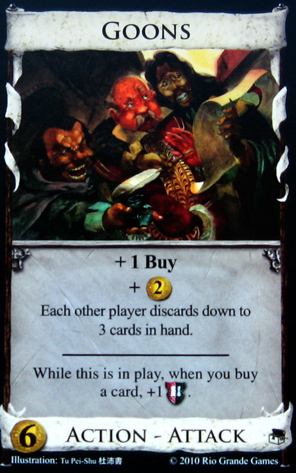
Buy phase synergy is ordinarily a product of three factors: +Buy, cost reduction (e.g., Quarry), and buy duplication (Talisman).  Increasing a single factor provides negligible benefits; no matter how cheap Peddler is, if you have only one Buy, it might as well cost you all the money in your hand.  Increasing multiple factors, on the other hand, leads to explosive results.  (See, e.g., Quarry/Talisman).

The reason Goons is so powerful is because it adds a fourth factor: VP per buy.  So on its own, Goons is a decent card, a combination of Militia and Monument.  But with other Buy phase synergy factors, Goons becomes a devastatingly effective card for churning VP.  When building a Goons deck, you don’t need to bother with Victory cards: you’re looking to make the game drag on as long as possible, because you’re spending each turn buying more Actions to boost your Goons engine.  As your deck gets stronger and stronger, you will earn more and more VPs every turn.  Because of this, you should try to avoid buying Coppers too early, because it needlessly gums up your deck (and you’ll probably earn more VP for it later).  If the support cards are present, aim for a massive final turn where you buy out the piles while collecting a ton of VPs (50+) from Victory cards and Copper buys.

Goons decks depend heavily on +Actions, and ideally, +Cards as well.  Without the ability to play multiple Goons per turn, you’ll usually only be able get multiple VP chips by buying Coppers.  In addition, your Goons buys might end up actively hurting your deck unless you can find a way to play all the Actions you are buying.  City works especially well for this: it provides you both with +Actions and has an excellent chance of leveling up and providing you the card draw you probably need to play all your Goons.  In the alternative, if there just aren’t good non-terminals left for you to buy, trash-for-benefit cards like Salvager and Apprentice are a good way to clear out some of the junk you’ll find yourself buying.

Finally, Goons/Watchtower is a brutal combo if and only if the above conditions are met.  Watchtower alone cannot turn Goons into a viable card, but it can turn Goons from a viable card into a devastating one.

Works with:

  • +Actions (especially Fishing Village and City)
  • Other Buy phase synergies
    • +Buy (especially City and Bridge)
    • Cost reducers (e.g., Quarry, Bridge, and Peddler)
  • Non-terminal Actions to soak up the +Buys
  • Watchtower
  • Council Room
  • Masquerade

Conflicts with:

  • Opponent’s Library
  • Lack of +Actions, or terminal Actions in general
  • Gardens and Duke/Duchy decks: not only is the attack nullified by their Victory cards, they’ll look to end the game on piles before your engine reaches top speed
Posted in Prosperity | Tagged | 28 Comments

Holiday Hiatus

The Dominion Strategy Blog will be on a limited posting schedule during the holidays. We will resume regular publication in the new year.

Happy holidays and merry Dominioning!

Posted in Uncategorized | 4 Comments

Seaside: Ambassador

This article is intended as an introduction to Ambassador. For a more recently updated and advanced article on Ambassador, click here.

Ambassador

Dominion: Seaside

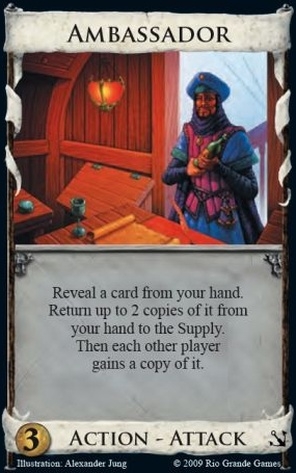
This is the card that a $5/$2 player hates seeing on the board more than any other.  Along with Chapel, Ambassador is one of Dominion’s two best openers.  The first couple of turns are critical: if you fall behind in “Estate tennis”, your deck will quickly crash and burn.

The most common Ambassador dilemma early on is drawing it with 3 Copper + 1 Estate.  Contrary to popular practice, Ambassadoring 2 Coppers (rather than 1 Estate) is the best play; deck-thinning is, at this point, more important than a marginal increase in your attack.  Moreover, Ambassadoring the Coppers decreases the chance your opponent will Ambassador you two Estates while increasing your own chances for the same.  Of course, it’s not a great move if you or your opponent are also relying on Moneylender/Coppersmith, but the point remains that you should almost always try to Ambassador two cards at a time in the early game.

In the midgame, you can start Ambassadoring early cards that have outstayed their welcome: your opponent will likely have little use for a late game Loan, Moneylender, or Chapel. If you have strong enough deck-drawing (perhaps your opponent foolishly passed up on buying an Ambassador), consider buying a Curse and using the Ambassador as a pseudo-Witch.

Like almost all attacks, Ambassador is great with Throne Room/King’s Court: just be sure not to give away all the copies of the card you are Ambassadoring! In addition, Ambassador is the rare attack that does not conflict with other attacks.  No matter when you play it, it is always dealing damage to your opponents.  Of course, you will draw hands where you don’t want to play the Ambassador, but it’s nice to have an attack that amplifies other attacks rather than cancelling them. It is especially powerful with Pirate Ship.

Ambassador is also a great defense, especially against opponents that opened with Mountebank, Witch, or Torturer.  That doesn’t mean that those cards aren’t important if Ambassador is available (if you’re Ambassadoring a Curse, you aren’t Ambassadoring something else), but it’s certainly a better defense than getting a Moat and crossing your fingers.

Keep an eye out for Ambassador’s unique game-ending ability: it’s often to your advantage to gift your opponent a Province or Colony in order to force the game to end on your turn.  (See, e.g., this game, where I win by gifting my opponent the last Colony instead of allowing him the chance to win with a lucky Tactician.)

Perhaps Ambassador’s greatest weakness is the dreaded Possessed Ambassador.  But even then, opening Ambassador isn’t dangerous so long as you have a way to get rid of your Ambassador (Remodel, Salvager, an opponent’s Bishop).  Indeed, stuffing your opponent with crap will probably keep him from Possessions and let you get first crack at them.

Works with:

  • Throne Room / King’s Court
  • Curse (sometimes)
  • Opponents’ Curse-giving attacks
  • Pirate Ship

Conflicts with:

  • Opponent’s Possession
  • Opponent’s Militia (somewhat, but not as much as with Chapel)
  • Chapel (somewhat; it’s viable to open Ambassador/Chapel, but probably not better than Silver/Chapel)
  • Gardens decks
Posted in Seaside | Tagged | 14 Comments

Prosperity: Mint

Mint

Dominion: Prosperity

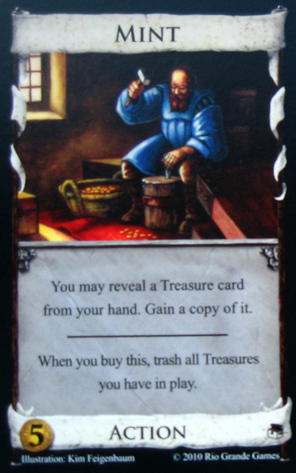
Mint is a card with two very different abilities that synergize well with each other.

First, Mint’s “trash-all-Treasures” ability is a considerable asset in the early game when you need to get rid of your Coppers (or Loan).  It’s less useful if you have good trashing through Chapel or Steward, but without other options (and especially with good card draw) it can considerably streamline your deck.  (Keep in mind that you can selectively play Treasures; if you draw a Gold and 7 Coppers, you can play only the Coppers and use the Mint buy to trash all 7 of them.  Indeed, with 4 Coppers and a Silver, it’s usually worth trashing the Silver to trash the 4 Coppers with it.)  But buying a second (or third) Mint for the trashing is usually not that helpful; there are better terminal Actions, and unless you can Remodel/Salvage/Expand the extra Mints, it’ll probably end up getting wasted.

Occasionally, with a $5/$2, you’ll see people open with Mint to trash 5 Coppers.  Personally, I don’t think it’s a great idea; you’re really set back by the loss of all those Coppers, and unless you have a $2 like Lighthouse, Embargo, or Pawn, it’ll be tough to get to and Mint Silvers quickly enough.  It’s a viable option if there are no other $5’s, but probably not otherwise.

Of course, if you gain Mint (through Expand, Remodel, Smugglers, etc.), this ability doesn’t trigger.  This is useful if good trashing has already thinned your deck into high quality Treasures.

Mint’s minting ability is more straightforward.  It tends to avalanche; the more Golds you Mint, the more likely you are to draw Gold with Mint.  Try to avoid using it on Silvers unless you have no other choice; bloating your deck with Silvers nullifies the whole point of Mint, which is essentially to run Big Money on steroids.  Naturally, Mint works really well with Platinum; it also does well with other cards that benefit from high-quality Treasure decks (Adventurer, Venture, Grand Market) or lead to high-quality Treasure decks (Mine, Hoard). In the late game, when you can’t really count on the reshuffle, Mint is usually too slow (exception: Harem and Watchtower); look to Salvage or Remodel it instead.

Works with:

  • Platinum games
  • Harem
  • Hoard
  • In the absence of other trashing, can be a good way to get rid of Coppers
  • High-quality Treasure decks (e.g., Mine/Adventurer/Venture)
  • Treasure Map (trashing to activate them, Minting for additional Golds)
  • Watchtower (which turns Mint into something like a Mine)
  • Grand Market
  • Loan/Talisman/possibly Quarry, if you have no need for them past early game

Conflicts with:

  • Low-quality Treasure decks
  • Very big decks that take a while to reshuffle
  • Coppersmith, Counting House (although theoretically you could use Counting House to trash dozens of Coppers at once …)
Posted in Prosperity | Tagged | 11 Comments

Combo of the Day #21: Mine/Potion

Not a combo, strictly speaking, but Mine addresses the biggest problem with Potion: its inflexibility.  The Potion costs roughly the same as a Silver, but its non-fungibility imposes an additional premium.  Drawing $7◉ is useless for getting a Province, while drawing $5, though ordinarily a good thing, can really set you back if you need to get in on the Familiars or Alchemists.

Mine helps alleviate this problem (provided Potions or Silvers are in hand) by allowing you to seamlessly transition between the two.  Caught in an Alchemist race, but drew 3 Coppers + Silver + Mine?  Mine your Silver into a Potion to get the Alchemist this turn.  Played all five of your Alchemists, but your damn Potion is stuck at the bottom of your deck?  Mine a Silver into a Potion so you can keep your chain going next turn.  Late game, when your Potions are useless and you need all the buying power you can muster, you can Mine them into Golds (or better yet, Harems) for a significant money boost.

The biggest drawback to this is that there are other $5’s that may prove more important even in Alchemy games.  (Mountebank, for instance, if Familiar is not present.)  Mine is usually one of the weaker $5’s, but it is significantly bolstered by the presence of non-traditional Treasures.  With Potion, it gets an added bonus of introducing flexibility into an otherwise risky investment.  It’s worth picking up as part of a $5/$2, or if there’s no top-tier $5 otherwise.

Posted in Combo of the Day | Tagged , | 4 Comments

Intrigue: Harem

Harem

Dominion: Intrigue

Harem is a curiously underrated card.  Bedazzled by the allure of Gold, many players pass on them entirely until the late game, treating them as consolation prizes for missing out on Provinces.  Nothing could be further from the truth: in a Province game, the general rule for Harem is to buy it over Gold when you would buy a Province over a Gold.

There are, of course, countervailing considerations: for starters, in Colony/Platinum games, Harems become less important, since their VPs matter less and getting to $11 requires much stronger buying power than Harem can provide.  Moreover, attacks tend to hurt Harems more than Gold.  This is especially true with Militia and other handsize reduction attacks: because Harems are worth only $2, Harems alone cannot get you to Provinces if you’ve been Militia’d.  Unlike Harem, Golds are not affected by an opponent’s Bureaucrat.  And with Remodel on the board, you would probably rather purchase Golds (to help you get Provinces earlier) and Remodel them into Victory points.

But these exceptions aside, Harems generally become preferable to Gold far sooner than most players think.  The point at which you should take a Province over a Gold depends on the nature of your deck, but as a general rule, unless you find yourself at $8 unexpectedly early, or you don’t anticipate ever reaching $8 again (and would rather buy Duchies), you should almost never pass up a Province for a Gold in a non-Colony game.  Likewise, in solitaire Province games, simulations demonstrate that strictly buying Harems (and never Golds) does considerably better than strictly buying Golds (and never Harems), and the optimal transition point for Golds to Harems is extremely early on.  Of course, these simulations don’t take into account attacks or the value of $5 cards (all of which counsel in favor of Golds), but as a general rule, you should probably be buying Harems before you think you need to.

Harems become obscenely good buys when playing Hoard.  They interact well with Mine, since not only can you upgrade your Silvers into Harems, you can “downgrade” Golds into Harems in the late-game.  Late-game Mints also become meaningful with Harems in play, since you don’t have to wait for the reshuffle to experience the benefit.  And like all mixed Victory cards, a high concentration of Harems synergizes very well with Scout.

Finally, Harem makes for … rather odd (some might say distasteful) thematic interactions.  It’s amusing to imagine how, exactly, Thieves can come in and rob you of an entire Harem, or how a Mine can turn Silver into a group of women.  You’d also think that the Harem would cost you money, but apparently it provides a source of income instead …

Works with:

  • Hoard
  • Mine
  • Scout
  • Mint

Conflicts with:

  • Colony/Platinum games
  • Handsize-reduction attacks
  • Bureaucrat
  • Opponents’ Tributes
  • Opponents’ Thieves (for the same reason that Harem makes late-game Mints useful)
  • Remodel
Posted in Intrigue | Tagged | 11 Comments

Counter of the Day #7: Militia v. Warehouse

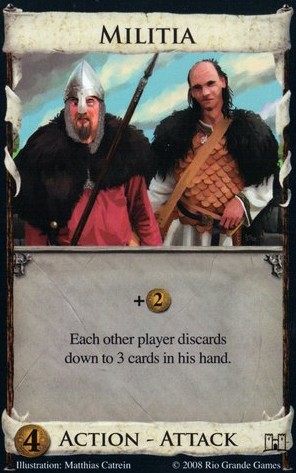
One of the easiest ways to shut down someone relying on Warehouses is to play Militia (or any other handsize-lowering attack like Goons or Torturer).  Militia punishes every card that depends on a large hand size (Vault, Forge, Bank), but most of all an opponent that depends on Warehouse’s draw-and-discard ability to get through his deck.  Warehouses are increasingly ineffective as your hand size decreases, and after Militia, are often more of a liability than a benefit.  Drawing 3 Golds just to discard them is like playing Rabble on yourself.

Similarly, Militia hurts Haven quite a bit.  Playing Militia’d Havens is essentially equivalent to playing a less-effective Tactician, since you’d be cannibalizing your current hand.  And Militia is most devastating against Cellar (which basically becomes useless when Militia’d), but no one really builds decks around Cellar.

Posted in Counter of the Day | Tagged , , , , , | 1 Comment