
Seaside: Sea Hag

Sea Hag

Dominion: Seaside

Sea Hag is a powerful card, and one you should almost always open with.  As far as the Cursing attacks go, it doesn’t get any more direct than this.  No need to wait for the reshuffle for Familiar and Witch to start having an impact; no, just drop a Curse on top of your opponent’s deck and guarantee that they’ll draw a dead card next turn.

Does this mean that Sea Hag is superior to Witch?  Probably not—the fact that you spend an Action doing nothing is a huge drawback.  So certainly Witch is the better choice if you open $5/$2.  But Sea Hag is strong enough that I would probably buy it with a $4/$3 instead of waiting for Witch.

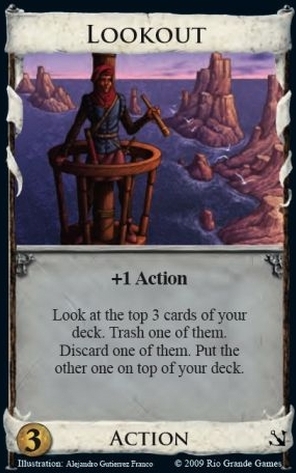
The exception is with certain counters that directly benefit from having a Curse on top instead of in the discard (Lookout, Upgrade, Masquerade, and Native Village chief among them); even a +1 Action/+1 Card Action and a trasher in hand means the Sea Hag Curse goes away pretty quickly.  In those situations, you should probably delay getting the Sea Hag and hope to jump to Witches instead.  (Note that in multiplayer games, multiple Sea Hags make Lookout a far less desirable counter, since it’s quite likely your Curse on top will get discarded for another Curse.)  If Witches aren’t available, consider delaying your Sea Hag purchase until later in the game; delayed Cursing attacks can be quite helpful because your opponent will typically have diluted his trashing ability with other cards, and possibly even Remodeled his trashers away.

Note that this does not apply to generalized early trashing: there is no reason not to open Sea Hag/Chapel, since your Cursing significantly slows down his ability to trash.  This is a general principle applicable to all Cursing attacks, but especially Sea Hag, since it’s available from the very first turn and is therefore guaranteed to hit your opponent before he is able to trim his deck.

After the Curses are gone, you should almost never play Sea Hag, not unless you know your opponent has a good card on her deck.  Either she’s been buying Victory cards, in which case you don’t want to discard one of them, or she’s buying good cards, in which case discarding will let him cycle her new purchases in slightly faster.  Try to get rid of the Sea Hag as fast as possible, even trashing it to the Chapel if you can.

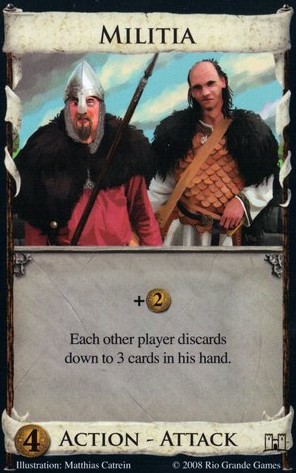
On a side note: along with Militia, Sea Hag is one of those massively-benefits-first-player cards; if you’re lucky enough to hit another player’s Sea Hag in the early game, that’s basically GG.  The card could probably be reworded in a less variancy way, but its current form is probably an implicit concession to the limitations of the physical card size.

Works with:

  • Trash-for-benefit cards (e.g., Remodel, Bishop, Salvager, Apprentice)
  • Council Room/Vault, since they’ll be drawing a dead card
  • Throne Room / King’s Court (even though the benefit doesn’t strictly stack, all the Cursing attacks hurt much more when Throned or Kinged)

Conflicts with:

  • Lookout, Upgrade, Masquerade
  • Native Village
  • The non-terminal +1 Action/+1 Card Actions, combined with trashing
  • Reaction cards
  • Other cursing attacks
  • Your handsize-reducing attacks
Posted in Seaside | Tagged | 26 Comments

Counter of the Day #9: Lookout v. Sea Hag

Lookout isn’t the best trasher, but it’s an extremely good counter to Sea Hag, one of the best attacks in the game.  It turns Sea Hag’s leave-on-deck power—ordinarily a pain—into a boon for your Lookout, and simultaneously eliminates the possibility of an unlucky trashing.

Lookout also counters early to midgame Spies, since if the Spy leaves an Estate or Copper on your deck, you can trash it immediately.  But it’s not a reliable counter in the late game, when opponents will leave Provinces on your deck, and you really can’t afford to take that chance.

Posted in Counter of the Day | Tagged , , | 7 Comments

Intrigue: Mining Village

Mining Village

Dominion: Intrigue

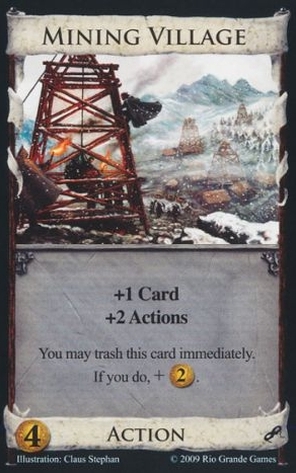
Mining Village is best thought of as a one-shot Conspirator/Grand Market.  Its ability makes it one of the best $4 openers: by trashing it, you can slingshot to $5, $6, or possibly even $7 much faster than you otherwise would be able to with a Silver.  But to use it effectively, you have to commit to trashing it quickly; otherwise, you’ve used a critical opening buy on a useless card.

In the midgame, Mining Village is one of the most useful $4 non-terminals; it’s good to stock up on them so you can cash them in all at once for a mega-turn to end the game.

The fact that Mining Village provides +Actions is really just a bonus.  For pure Actions, you’re better off with the other special Villages (Native, Worker’s, Fishing), since Mining Village’s special ability isn’t as helpful in an Action-oriented strategy (if you’re trashing the Mining Villages, you can’t count on them for Actions).  But it’s a good foundation for a +Actions/+Cards chain if you remember to start scrapping them for cash near the end of the game.

Works with:

  • Bridge (save up the Mining Villages until you can draw enough Bridges together, then trash them all for a game-ending turn)
  • “Mega-turn” strategies in general
  • Ironworks/Workshop for grabbing Mining Villages
  • +Buy
  • Good terminals, including +Cards
  • Conspirator
  • Grand Market
  • Sets where you need to get to $6 as quickly as possible

Conflicts with:

  • The other slingshot $4 cards (Baron, Moneylender)
  • Throne Room/King’s Court (since the benefit doesn’t get doubled/tripled)
  • Good $3/$4 cards that you’d form your strategy around
Posted in Intrigue | Tagged | 4 Comments

Counter of the Day #8: Counting House v. Militia

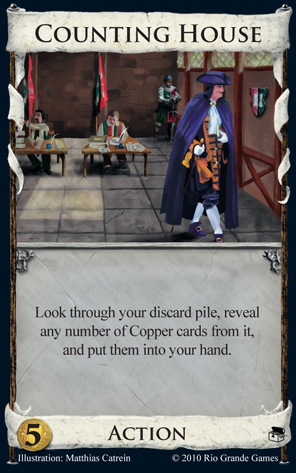
While Library compensates for the loss of handsize by letting you draw back to 7, Counting House lets you discard your Coppers knowing you can safely draw them back into your hand.  This is especially valuable in situations where you might want to save a Curse or other bad card in your hand in case you are then hit by Mountebank (to discard it) or Bishop (to trash it).

Of course, this works just as well against Goons, and possibly even better against Torturer (allowing you to discard up to 4 Coppers if you have the Counting House in hand).  But it gets completely wrecked by Ghost Ship, unless you’re willing to put your Counting House back on the deck.

Posted in Counter of the Day | Tagged , , , | 1 Comment

Beyond Silver

SilverAbout two years ago, Stormparkiet wrote an influential review of base Dominion outlining the “Silver test”: is the card you’re about to purchase really better than a Silver?  If it isn’t, you should just stick to buying a Silver.  At its core, the review suggested that all you really had to do to succeed in Dominion was to blindly purchase Silvers and Golds.

Regrettably, this now-outdated heuristic continues to exert an undue influence on modern Dominion.  While Gold remains a cornerstone of most successful Dominion decks, Silver has silently turned into a liability rather than an asset in most modern decks.  Much of Silver’s original appeal stemmed from the fact that base Dominion strongly favored Big Money engines or slight variations thereof, and Big Money engines always benefit from more Silvers.  But subsequent expansions have radically upended traditional strategical thinking; Big Money engines (and Silver) are no longer nearly as relevant as they were before, for two reasons:

  1. With the advent of Colonies, a deck that can churn $8 per turn for 4-5 turns is no longer sufficient.  It’s considerably harder for Big Money to maintain a consistent $11 per turn than $8 per turn; the whole premise of Big Money was that the constant Silvers can keep resupplying your Golds so you can keep getting to $8.  But getting to a constant stream of Golds to resupply your Platinums is just too slow, primarily because:
  2. Action combinations are much stronger than before (partially due to widespread early trashing cards), and certain combos are so game-warpingly powerful that their benefits dwarf the tempo cost of setting up the combo.  (See, e.g., City/Goons/Quarry.)  Even in the absence of Colonies, they are simply too fast and too strong for Big Money to stand a chance.

What this means is that the ideal deck is no longer made up of just Golds and Silvers with one Smithy thrown in.  Instead, it is often a mix of Actions that are good on their own but much more than the sum of their parts when played together.  They churn out the Golds and Provinces; they’re what win you the game.  As a result, the worth of drawing these cards together now far outweigh the marginal deck benefit of a Silver.  A Big Money deck needed Silvers because it had no other way to get to $8; in an Action-driven deck, after you’ve got your combo set up, all Silver does is interfere.  What good is its $2 if it stops you from executing a Caravan/Vault combo that would net you $10+?

Silver still serves a purpose: to get you to $5 and $6.  Silver-based decks can consistently hit that number, but unless you’re shooting for a Duchy/Duke strategy, that’s just not enough to get into the big leagues.  A long-term strategy really lives and dies by its Golds; Silvers are just a way of getting to them.  Ideally, in fact, you’d jump to Gold without ever needing to buy a Silver (e.g., drawing Moneylender-Copper-Copper-Copper-Copper on your third turn); otherwise, you use an opening Silver or two (or three) to get you to Golds, and then buy no more.

Of course, if you’re being brutalized by Curses and attacks, then Silvers play a critical role in your deck even deep into the midgame, since you aren’t yet capable of reaching $5 and $6 without them.  And Silvers remain important in the increasingly rare sets where Big Money is the dominant strategy.  But in a typical game, after you have your first Gold and a $5 or two, buying Silver will often just weigh you down.  This is the time when those “useless” $2 and $3 non-terminals really shine.  It’s too slow in the early game to buy Great Halls and Wishing Wells when you need to get to $5’s and Golds, but once you get those $5’s and Golds, additional Silvers don’t help you on your next objective, which is to get to $8.  Better instead to get the non-terminals, netting a token benefit while simultaneously aiding you in setting up your real rainmakers: your Action combos, $5’s, and Golds.  (Yes, I would probably take even Pearl Diver over a Silver given appropriate circumstances.)  If no non-terminals are available, then even buying nothing is often better than buying the Silver.

You could interpret this evolution as a sign of power creep, but I think that’s an unfair characterization.  Base Dominion took relatively little skill to play optimally, since you really couldn’t hope to do that much better than the Silver baseline.  Since then, however, Dominion has become a much deeper and more complex game.  Merely meeting the baseline is no longer good enough; with skillful play, you can now reach much greater heights.  Like a set of training wheels, Silver provides you with what you need to get going, but to really succeed, you have to learn when to move on.

Posted in Articles | Tagged | 11 Comments

The Five Best $3 Cards

Disclaimer: Dominion does a really great job of balancing its Kingdom cards. Pretty much every card has some situations where it shines, and some situations where it doesn’t. Nevertheless, some cards just end up being flat-out better than others, either because they are more useful more often, or just ridiculously good when they are useful. Don’t expect this list to be very scientific.

Watchtower

Dominion: Prosperity

5. Watchtower

There were a ton of candidates for this slot.  There’s the sadistic pleasure of Masquerade; the infuriating attack of Swindler; the rage-inducing chanciness of Smugglers; I even briefly considered the criminally underrated Loan.

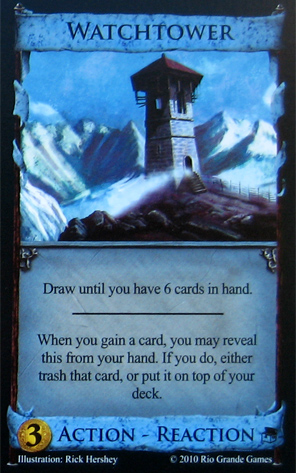
In the end, I went with Watchtower simply because it’s the most versatile card (and the best Reaction) in the game. Against Curse-givers, it depletes their ammo. As a Goons player, it massively increases your VP earning potential while indirectly defending against opposing Goons.  With Talisman and Treasure Map, it’s an absurdly powerful combo.  And it even works as a Royal Seal if you draw it dead.


Warehouse

Dominion: Seaside

4. Warehouse

I hinted at the utility of this card when discussing Cellar in the Worst $2 Cards: this card so out-classes Cellar it’s not even funny.  Not only are you rarely going to be Cellaring more than 3 cards at a time, the ability to view what you draw before you discard makes Cellar a better card only when you’re going to be discarding 5+ cards at a time.  (This is why Treasure Map/Cellar doesn’t work nearly as well as Treasure Map/Warehouse.)

Warehouse is best in the endgame, when you have a lot of Victory cards to discard, but it’s also a solid opening paired with another Action: I’ve already mentioned Treasure Map/Warehouse, but Baron/Warehouse, Salvager/Warehouse, Feast/Warehouse, and even Chapel/Warehouse all work nicely as ways to cut your variance.  It’s a good way to guarantee you draw your Action with a given other card, or to accelerate the reshuffle to get a critical $5 card into your hand faster.


Steward

Dominion: Intrigue

3. Steward

After Chapel and Moneylender, the most effective early trasher.  The trash-for-benefit cards don’t work very well on Coppers, and tend to be too slow anyway; Lookout is too chancy; Trading Post and Forge are ordinarily too late.  More importantly, Steward is the one of the few early trashers that has any use in the late game.  It’s not the best card for any of its roles, but its flexibility often makes it more prized than all its superior alternatives.  And it works especially well with Throne Room and King’s Court.

Of course, it’s completely useless when Chapel is around, but that’s true for quite a few cards, and Steward takes up the mantle admirably in Chapel’s absence.


Fishing Village

Dominion: Seaside

2. Fishing Village

Heavy Action chainers must have thought they died and went to heaven when they saw this card.  +2 Actions this turn and the next?  And money to boot?  With good terminals, this is one of the few cards you’ll see people double up on on the first two turns, just to make sure they grab their share before it runs out.

If there aren’t good terminals, this card becomes quite useless; it’s essentially a Copper this turn and an extra Copper the next.  But its sheer power in the presence of +Cards, Goons, Bridge, or any other good terminal makes it far and away the best +Actions card in the game.  You feel almost guilty using it: it lets you indulge in massively over-investing in terminal Actions like we did when we first got the game and Big Money was a Wheel of Fortune catchphrase rather than a fun-destroying heuristic.  Action chains are the most fun part about Dominion, and Fishing Village is all about accepting that fact.  It is so wrong, and yet at the same time it is so very, very right.


Ambassador

Dominion: Seaside

1. Ambassador

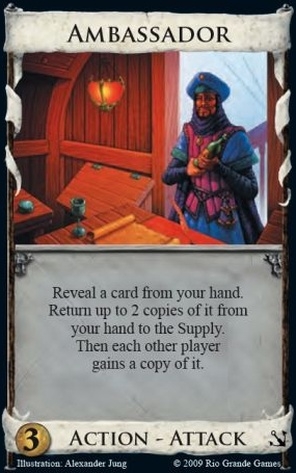
How good is this card?  So good that with 5/2, I’d often rather open Ambassador/nothing than fall behind in Estate tennis.  It “trashes” like a Steward, it attacks like a Mountebank Jr., and for the low low cost of $3!  About the only time you won’t want to buy this is if your opponent is going Gardens, or if he’s cheating and somehow started with a Possession in his deck.  Otherwise, the fact of the matter is: if you don’t buy it, your opponent will, and getting your own Ambassador is pretty much the only effective response.  Plus, if you trim your deck enough, you can turn Ambassador into a Witch by buying a Curse (the “I win if I lose just a little less” strategy).  It’s one of the most brutal attacks in the game; the fact that it’s available on the very first turn dramatically alters the strategy space of any game it’s in.

Posted in Rankings | Tagged , , , , | 22 Comments

The Five Worst $3 Cards

Disclaimer: Dominion does a really great job of balancing its Kingdom cards. Pretty much every card has some situations where it shines, and some situations where it doesn’t. Nevertheless, some cards just end up being flat-out better than others, either because they are more useful more often, or just ridiculously good when they are useful. Don’t expect this list to be very scientific.

Village

Dominion

5. Village

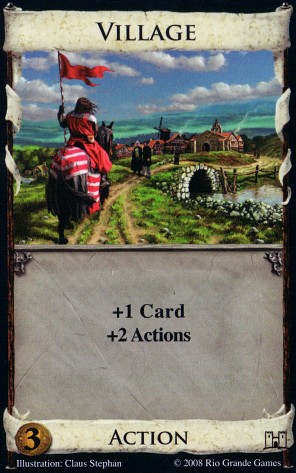
Village earns its place on this list solely due to its notorious misuse by beginning players, an epidemic that carries its own insulting nickname. Many a tale is told by grizzled BSW veterans, in the days before Isotropic, of the endless Village chains they were forced to endure, usually culminating in the Village Idiot buying yet more Villages, never increasing their buying power. And yet it remains an inexplicably popular first-turn buy, despite the fact that players who buy it on one of the first two turns score well under 40% against players who don’t.  (For reference, this is about two percentage points better on average than opening with Copper.)


Wishing Well

Dominion: Intrigue

4. Wishing Well

There’s definitely uses for this card.  There’s a whole article on how to use it.  Problem is, when you’re only scrounging up $3 per hand, you really can’t waste time buying a card that’s usually like buying nothing at all.  If for whatever reason you find yourself with $3 in the midgame, it’s a worthwhile non-terminal if you don’t want to weigh your deck down with Silvers, but the $4 non-terminals are so much better it’s not even funny.  It can’t really do any harm, but it can’t do that much good either, and so it’s #4 on the list.


Workshop

Dominion

3. Workshop

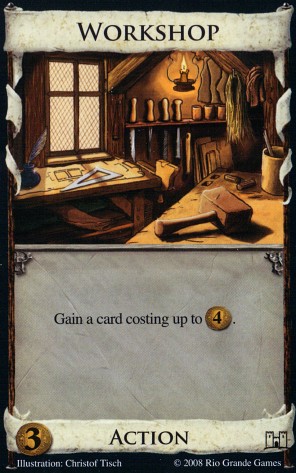
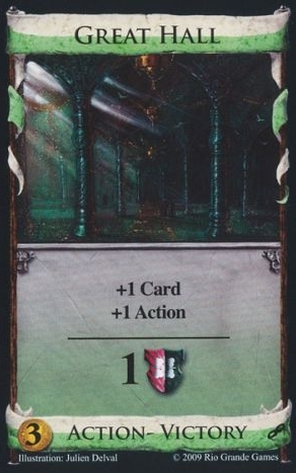
University is amazing, Workshop isn’t.  The difference?  $5 Actions are actually useful, to the point where you probably want as many of them as you can in your deck because of how much they boost your deck quality.  That just doesn’t hold true for $3 and $4 Actions.  Most of them are terminal and intended strictly for early-game use.  And few of the non-terminals actually improve your deck in a meaningful way.  About its best use is for Great Halls and Caravans, but even then, it’s far outclassed by Ironworks.

Of course, it’s good for Gardens, and if in a Cursy game, or in a game overflowing with Actions but without +Buy, Workshop might be worth it to pick up some Caravans or Great Halls if Ironworks isn’t around.  But that’s a lot of if’s.  90% of the time, it’s far more important to ramp up your engine instead of dilly-dallying at the $3/$4 level.  Even if you gain every Great Hall and every Spy with your Workshop, you still haven’t made any progress whatsoever towards reaching $8, or even $6 per hand.


Woodcutter

Dominion

2. Woodcutter

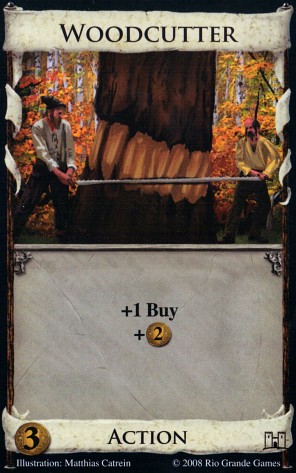
No one purchases a Woodcutter unless they have no other choice.  If you’re very prescient, I can see the appeal of opening with Woodcutter if you know you’ll be setting up long Laboratory chains.  But you’re never happy to do it, and there better be basically no other terminal on the board to justify such a move.

Woodcutter ranks worse than Workshop because it’s not even the best card in the one situation where Woodcutter shines.  (Though I concede this is a debatable point.)  Plus, the Woodcutters in the picture aren’t even sawing correctly.  I mean, come on!  What’s the point of making such an inefficiently wide (not to mention crooked) cut?


Chancellor

Dominion

1. Chancellor

Most players’ first impression of Chancellor is that it’s crap.  Then you start second-guessing yourself; you wonder whether or not you’re giving it short shrift.  Maybe this is one of those “expert-level” cards that only good players can appreciate, you think to yourself.  You start trying it out, faithfully trying to manipulate deck variance in your favor.  Then you realize it’s still crap.

Nevertheless, Chancellor holds the unique title of “most overrated underrated card”.  That is, you will continue to see people extolling its virtues, coming up with exotic scenarios that justify using a terminal Action on deck reshuffling.

The long and short of it is that although Chancellor offers a benefit, it’s a marginal and uncertain one.  If you really want, you can get most of its benefit (and then some) from Watchtower/Royal Seal/Navigator anyway.  And unlike just about every other card, there is never a board where you need a Chancellor in order to succeed.  Yeah, it works nicely with Stash, but the fact that Chancellor’s best combo involves investing in another mediocre card (a promotional one, to boot) really should end up counting against it.

Posted in Rankings | Tagged , , , , | 45 Comments

Combo of the Day #23: Vault/Philosopher’s Stone

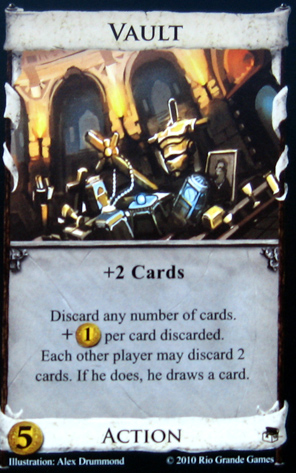
Philosopher’s Stone doesn’t work very well with large handsizes, which is unfortunate because it’s otherwise always a good thing to improve your average handsize.  Enter Vault: by allowing you to discard Victory cards and Coppers for $1 each, you can essentially make those cards count twice (once for Vault, and once more for Philosopher’s Stone). This allows you to continue using Tactician, Caravan, and Laboratory without worrying about any adverse effects on your cashflow.

If you don’t have a large hand, or if your cards are too valuable to be discarded to the Vault, then this trick isn’t worth very much.  However, if you keep careful track of how many cards are in your discard and draw, you can selectively use Vault’s ability to squeeze out an extra $1 from the Philosopher’s Stone.

An extra benefit is that Vault plays well with Potions, because it can always convert them into $1 each if you have no need for an Alchemy card.

Posted in Combo of the Day | Tagged , | 4 Comments

Combo of the Day #22: Ironworks/Scout/Great Hall

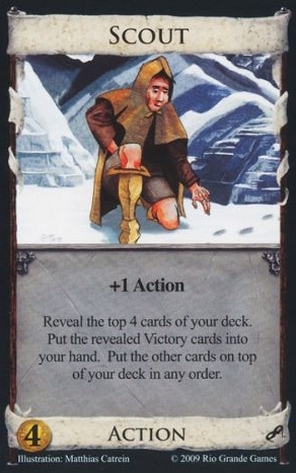
Both Ironworks and Scout work nicely with Great Hall.  Ironworks is normally not that great a card: you can freely get a $3 or $4 Action, but it has to be a good non-terminal, and few non-terminal $3 or $4 Actions are worth piling up on at the expense of scaling up your deck.  Using Ironworks on Great Halls, however, means that you aren’t playing with a reduced hand; you get to replace the Ironworks in your hand with another card, and you get another Action to boot.  After you run out of Great Halls, though, the Ironworks tend to be useless; look for a way to Salvage or Remodel them.

Likewise, Scout is usually a waste of a card slot early on.  But with Great Halls on the board, you can temporarily forsake the typical buildup to focus instead on Great Halls.  You won’t have tons of money, but you only need enough to consistently hit $3/$4, and soon your Scouts will start pulling in enough Great Halls to give you 5- or 6-card hands, enough to jump to Gold.  You’ll probably want to start off with a Silver and avoid too heavy a focus on Scouts.  It also doesn’t do quite as well with strong trashing, though, since you’ll want to leapfrog up to Golds much more quickly.

You don’t need both Ironworks and Scout to pull this off, but it’s nice to have all three.

Sample game

The Shanty Town is a strong addition, since all my Actions are non-terminal (meaning the only times I can’t play the Shanty Town for 2 cards is when I draw it with another Shanty Town).  Note also that the Scout allows me to jump to Provinces much more quickly than I ordinarily would.

Posted in Combo of the Day | Tagged , , | 13 Comments

Seaside: Native Village

Native Village

Dominion: Seaside

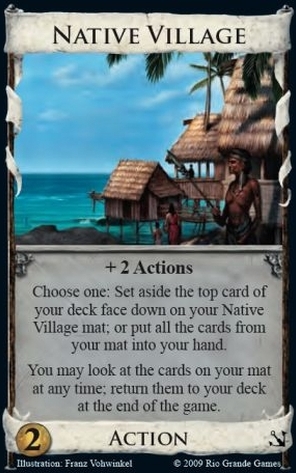
The +Actions isn’t what makes this card so interesting—if all you’re looking for is more Actions, any other Village is superior. (The exception is if you have Libraries or Watchtowers and want to take advantage of its handsize-lowering effect.)

Rather, Native Village is nice for its ability to tuck away cards: it can “trash” unwanted cards, hide cards from Pirate Ships/Saboteurs, or just build up for a mega-turn.  Conducting deck-inspection is quite helpful in order to guarantee what you’re drawing; similarly, Native Village is a good soft counter to Ghost Ships, Bureaucrats, and Spies, since the Victory cards they leave on your deck can be tucked away.  In addition, if you can draw your entire deck, you can use Cellar/Warehouse to selectively discard Victory cards such that only Victory cards are left in your draw deck, prime targets for your Native Village to gobble up.

Nevertheless, Native Village’s “trashing” ability is pretty much the worst way to go about deck-thinning.  It’s too slow when you need to single-mindedly focus on trashing, and in a thin-deck monster, Native Village’s drawing ability can more harm than good if you’ll mostly be drawing good cards.  It’s useful as late game storage for Provinces/Colonies, but the chance of drawing a critical Platinum is too much of a risk.

Even without trashing, Native Village is only really viable when there’s also a way to make use of its +Actions (usually +Cards); when there isn’t, Native Village’s pseudo-trash-the-top-card ability is probably too chancy and slow to be worth buying.

If you’re pursuing Native Villages, you’ll need quite a few of them in order to recover from drawing good cards onto the Native Village mat.  This means that a source of +Buy is critical for Native Village, so that you don’t repeatedly overpay for its ability.

Works with:

  • Deck-inspection (Pearl Diver, Wishing Well, Spy, Navigator), including opponents’ Spies
  • Library/Watchtower
  • Pirate Ship wars (both to play your own Pirate Ships, and to hide your Coppers from opponents)
  • Cards that benefit from large handsizes: Bank, Coppersmith, Secret Chamber
  • Opponents’ Ghost Ships/Bureaucrats
  • Opponents’ Saboteurs
  • Good terminals, usually +Cards
  • +Buy

Conflicts with:

  • Strong early trashing/Ambassador
  • Philosopher’s Stone
  • Counting House
  • Embargo (on the Native Villages)
Posted in Seaside | Tagged | 24 Comments