
Combo of the Day #11: Black Market/Tactician

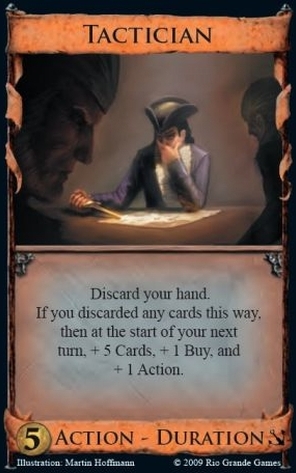
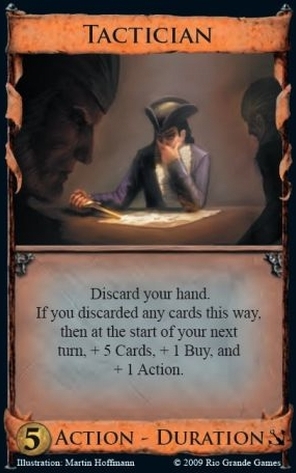
Tactician can be an annoying card.  Playing it means forgoing your current turn for a doubly-good next turn.  This is good when you have a bad hand, or a reduced hand, but not good when you draw the Tactician with all your Platinums.

Black Market provides an interesting (and devastatingly powerful) way out of this dilemma, as a hugely easy way to implement the Double Tactician engine..  Play Black Market and use it to play your Treasures.  Whether or not you buy from the Black Market, your Treasures are now available for the subsequent Buy phase.  So long as you have at least one additional card remaining in your hand to be discarded, you can now play the Tactician, have a normal Buy phase with your Treasures, and still have a mega-turn next turn.

Black Market essentially eliminates the primary drawback of Tactician and turns it into a juggernaut. Provided you can consistently draw the Black Market and Tactician, you can have 10-card hands every turn.  And although it might seem that you need a +Actions card to be able to play Black Market and then Tactician afterwards, in practice, the extra Action from Tactician fills this need perfectly.

There are several other combos that make use of this Black Market ability: if you use Black Market to play a Quarry or Royal Seal, then the Treasure’s effect can be used on gaining Action cards.  For example, playing a Quarry with Black Market lets you then play an Ironworks to gain an Action card costing up to $6.  Even better, play a Royal Seal with Black Market, then Ironworks two Treasure Maps onto the top of your deck.  But Black Market / Tactician is probably the most powerful combo, and easiest to pull off.

Sample Game

I was lucky to have drawn a Cellar and Bank from the Black Market, which made it a lot easier.  The set was pretty convenient, since it contained Colonies/Platinums as well as a good $4 buy (Mining Villages).

Sample Game

A more archetypal example, with Crossroads support
Posted in Combo of the Day | Tagged , , , | 23 Comments

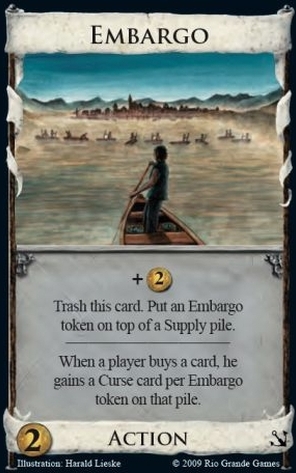
Seaside: Embargo

Embargo

Dominion: Seaside

The guiding principle behind effective use of Embargo is Embargoing cards that your opponents need more than you.  It is always worthwhile to hurt your own deck so long as you hurt your opponents’ more.

For example, if you have an early lead in Golds, placing the Embargo token on the Golds will lead to a long, brutal, and unpleasant game where you will have a decided advantage.  Likewise, Embargoing the Victory cards when you are in the lead (or plan on going for VP tokens) helps you win by lowering the overall number of Victory Points available.

Unlike most cards, there’s no particular set of cards that Embargo works best with.  Rather, Embargo is especially powerful whenever an opponent is going for a specialized strategy that requires certain cards.  For instance, if your opponent opens double Woodcutter with an eye towards the Gardens, Embargoes on the Gardens, Estates, and Woodcutters will be ruinous.  (Note that this doesn’t work nearly as well if he goes Gardens with Workshops instead.)  Against a Goons player, an Embargo on the Coppers stops him from “free” buys.  A well-timed Embargo on the Dukes cripples players who over-invested in Duchies.  Even a strategy as simple as Village/Smithy can be stopped in its tracks.  And if you are concerned about your opponent rushing a 3-pile ending, Embargo can slow the game down enough for you to grab some VP.

A less strategic but equally valid concern is using Embargo on cards you simply don’t like.  Goodbye, Pirate Ship!  A meaner variant of this is Embargoing the Reaction cards (after you’ve picked some up, of course) so your Pirate Ships can ravage your opponents’ decks with impunity.  Mwahaha!

Naturally, Embargo loses much of its effectiveness when Curse-giving attacks are present.  However, opening with a $5 attack and Embargo can be deadly; for instance, if you Embargo the Witches before your opponent can get one, the Curses are almost guaranteed to split at least 7/3 or 8/2 even if he buys a Witch at the first opportunity.

As alluded to earlier, Embargo is also weak against Actions that gain cards.  A truly desperate player can even use Talismans to at least receive fewer Curses.  And of course, opponents with Watchtowers have nothing to fear from your Embargoes.

Works with:

  • Any set that encourages your opponent to adopt a predictable buying pattern

Conflicts with:

  • Cards that gain cards (e.g., Hoard, Workshop, Feast, Remodel, Expand, Smugglers, Ironworks, Black Market, Mine, Upgrade, Treasure Map)
  • Curse-giving attacks
  • Watchtower

Sample Game

Because I draw my Embargo with 4 Coppers, I know that I can buy Gold and effectively leapfrog Silver.  So by Embargoing the Silvers, I slow him down dramatically if he can’t also get to an early $6 like me (and he doesn’t).  Later on, I Embargo the Golds once I have a Gold advantage.  These Embargo tokens end up slowing him down just enough for me to squeeze out a victory.  (Note that because I trashed one fewer Estate, I can safely buy the second-to-last Province because I hold the tiebreaker.)

Posted in Seaside | Tagged | 19 Comments

Prosperity: Watchtower

Watchtower

Dominion: Prosperity

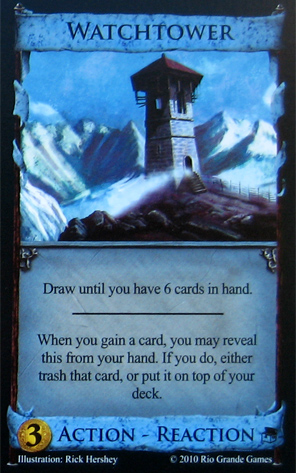
At $3, Watchtower is the most expensive Reaction thus far, but well worth the price.  It is one of the most versatile cards in the game, and the only Action thus far that provides a benefit even without playing it.

First, and most obviously, Watchtower is a devastating defense card against Curse-givers.  Not only does it block the Curse from entering your deck, it actually trashes the Curse, meaning that an attack-heavy opponent will soon find himself running out of Curses to give.  (Compare to Moat, which, against a Witch-heavy player, only delays the inevitable.)  Although it provides no defense against “deck-inspection” attacks (e.g. Spy, Thief, Pirate Ship, Rabble), it does subtly defend against handsize-reduction attacks by allowing you to draw back up to 6.

Second, if you’re willing to hold onto Watchtower and not play it, it works as a mini-Royal Seal, minus the $2.  There are some ridiculous ways to take advantage of this; most powerful is probably playing a Talisman, buying a Treasure Map, gaining another one, and putting them both on the deck!  More commonly, you can buy something like Village/Smithy or Throne Room/[some other action] and ensure that you draw them together next turn.  Even when you just have one buy, Watchtower can make sure you play important attack cards before your opponent gets a chance to.

Third, and this is a very specialized use, Watchtower greatly increases the power of Goons.  Ordinarily, Goons-heavy players will avoid buying too many Coppers for VP tokens for fear of weighing down their deck.  Watchtower solves this problem by trashing the Coppers as they come in, while still collecting the VP tokens.

Finally, Watchtower can form part of a good card-drawing engine.  Although Library is superior (both because it draws more cards, and also because it can discard unwanted Actions), Watchtower is much cheaper and fulfills other roles as well.  In addition, drawing a dead Watchtower (either because you have no Actions left, or because your hand size is very large already) is much less of a liability than a dead Library because of its other uses, as noted above.  It is especially useful with Vault.

Works with:

Conflicts with:

  • Cards that increase hand size (e.g., Laboratory/Alchemist, Caravan/Wharf, Tactician)
  • Attacks that it does not defend against (Pirate Ship being the most important)
  • Royal Seal, since the benefit becomes a bit redundant
  • Library, since Watchtower is an inferior engine card
Posted in Prosperity | Tagged | 15 Comments

Prosperity: Trade Route

Trade Route

Dominion: Prosperity

Depending on which way you look at it, Trade Route is either a useful card throughout the whole game, or a card that anti-synergizes with itself.  The forced trashing ability is quite valuable early but a pain in the late game.  But it doesn’t provide any money until the late game, and the +Buy is equally useless unless you have enough money to make it worthwhile.

In general, Silvers are preferable to Trade Route if there are other sources of card-trashing: Chapel and Steward are much faster, and Bishop and Remodel can provide bigger benefits early on.  But deck-thinning is important enough that Trade Route is probably worth buying if there are no other ways to do so.

Naturally, Trade Route is most powerful when there are Victory cards in the Kingdom set, because those are usually popular enough that you can get at least some money off of the Trade Route early on.  The presence of Hoard also greatly incentivizes players to pick up Duchies and Estates in order to gain Golds.

Trade Route is also useful in a hybrid Gardens strategy, taking the place of Woodcutter or Workshop.  Even though it requires a card to be trashed, thus lowering your deck size, the +Buy helps make up for it.  More importantly, a Gardens deck that concentrates on Gardens and Estates can guarantee at least +$2 on the Trade Route, and often $3 or $4 if Great Halls or Nobles are present.  Opponents are also forced to buy Victory cards earlier than they would otherwise in Gardens games, further increasing the value of your Trade Route.

Works with:

  • Hoard
  • Nobles, Gardens, Harems, Vineyards, and Great Halls

Conflicts with:

  • Treasury, since people will be discouraged from buying Victory cards
  • Chapel/Steward, since they are better deck-thinners, and Trade Route’s forced trashing is more likely to be a liability
Posted in Prosperity | Tagged | 17 Comments

Prosperity: Loan

Loan

Dominion: Prosperity

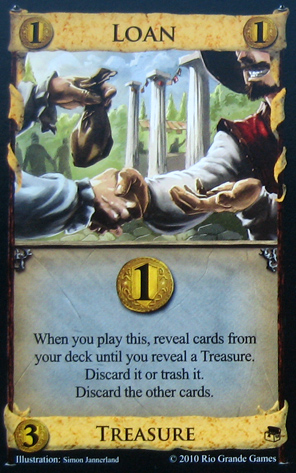
Loan is a much-maligned card.  In the mid- to late-game, Loans do more harm than good, bypassing your good Actions only to discard your Platinums or Golds.  Effective use of the Loan is very situational.

First, Loan is a good defensive card.  Loans can clear out the Coppers that Mountebanks add to your deck.  Attacks that give you Curses are blunted when you can use the Loan to skip over worthless cards.  If you plan to gain money through Actions to defend from Pirate Ships, then Loans can also quickly clear your deck of Pirate Ship targets.  And if you are being attacked by Ghost Ship, then you can dump useless cards onto your deck in anticipation of using Loan to discard it.

Second, Loan is useful when there are ways to turn it into something else, e.g., Remodel, Bishop, Salvager, or Apprentice.  Those cards are generally too inefficient at deck-thinning because trashing Coppers provides little to no benefit for them.  Here, Loan can clear out the Coppers quickly before getting out of the way and turning into a useful $5 Action, giving 1 VP token, adding $3, or drawing 3 cards.  Mines can also turn unwanted Loans into Gold, though Loan sort of anti-synergizes with a Mined deck.

Third, as alluded to earlier, Loan is helpful in godawful decks burdened with useless cards, where having to discard a Treasure is well worth being able to skip all the Curses and Victory Cards before it.  Of course, this can backfire; in a deck with only one Gold, it can really sting to have to discard it.  But in, say, a Goons deck, where you are buying up Coppers for VP tokens, Loan can help get rid of the junk.  Alternatively, Loan is quite useful in no-treasure strategies like Minion.

Fourth, if Venture is the only good $5, and you anticipate buying several of them, Loans can be indispensable in clearing out your Coppers.  The problem is that you might trigger the Loan with the Venture … which then forces you to discard another Venture.

EDIT: As noted below in the comments, this isn’t totally accurate; Loan is good in bad Treasure decks, not necessarily in bad Action decks

The real problem with Loan is that it’s only a card to buy if no viable alternatives are available.  In every respect it is out-classed by something else: Reaction cards are better at dealing with attacks; Chapel is better for deck-cleansing; Ventures are a better option for getting through the deck; Watchtowers are better for Goons.  And unless Loans are the only source of deck-thinning in the game, even the simple Silver is probably preferable.

The one aspect that Loan uniquely excels at is the no-Treasure deck.  This might be because you are paranoid about Pirate Ships, but more likely it is because you are running Loan/Minion.

Works with:

  • Remodel, Salvager, Apprentice, Bishop
  • Minion
  • Attack cards (as a defense)
  • Venture (only if there aren’t other trashing options)

Conflicts with:

Posted in Prosperity | Tagged | 23 Comments

Combo of the Day #10: Vault/Library

As noted earlier, effective use of the Library requires reduced hand size.  One way to do this is to rely on your opponents; another is to play +Actions cards that don’t replenish your hand.

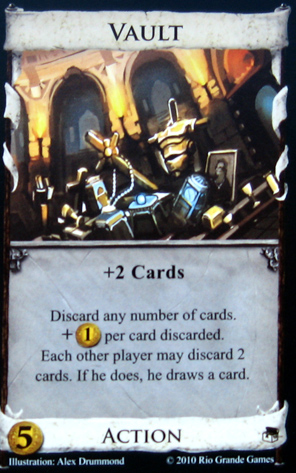
The third way is using the Vault’s ability to discard your cards for money.  Play your +Actions cards, Vault your hand, then draw back up to 7 with the Library.  Repeat as necessary.  It’s a nifty strategy that can result in obscene amounts of money, though it does require quite a bit of +Actions to work effectively.  It’s best in untrimmed decks with Coppers and Estates; in a Chapel deck, your average card is likely to be so valuable it’ll make little sense to feed it to the Vault for just $1.

Naturally, Watchtower can be substituted for the Library, and Secret Chamber can be substituted for the Vault.  Additional Buys will likely be necessary as well, meaning Festivals and Worker’s Villages are probably the best sources for the +Actions for this combo.

Sample Game

This game also illustrates the Vault / Secret Chamber’s ability to get to Grand Markets very easily.

Sample Game #2

This game shows how this combo is also a great defense against Pirate Ship.

Posted in Combo of the Day | Tagged , , , | 7 Comments

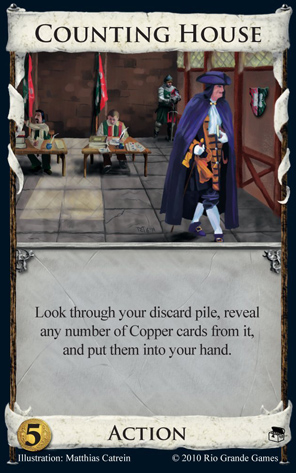
Combo of the Day #9: Counting House/Coppersmith

This is an obvious combination that is nevertheless difficult to pull off.  Counting Houses are notoriously unreliable, being one of the few cards you hate drawing early in the deck.  The Coppersmiths are otherwise worthless if you can’t get enough Coppers into your hand.  Worst of all, both Actions are terminal, meaning you must draw them together and with +Actions in order to pull it off.

Having said that, the combination of Counting House and Coppersmith is quite powerful.  In an ordinary game, Counting Houses can bring in up to $7, and each Coppersmith is worth another $7.  (A Gardens deck can bring in even more, as can an opponent’s Mountebank.  In both those situations, however, the deck is so diluted the likelihood of drawing into this combo is slim to none.)  Actions providing +Buy are probably needed in order to make full use of the money, particularly if the Coppersmiths are Throned or Kinged.

Posted in Combo of the Day | Tagged , | 2 Comments

Dominion: Cellar

Dominion (Base)

Like most other $2 Actions, Cellar is a versatile card.  Early game, it cycles through your deck so you can quickly play your newly-bought cards.  Mid-game, it fixes unlucky draws in order to set up your engine.  Late-game, it helps you avoid your Victory cards to scrounge together enough money to end the game.

The efficacy of the card is directly tied to your hand size.  Cellars are best with large handsizes; for instance, a Laboratory/Alchemist chain or a +Actions/+Cards engine. In games with smaller handsizes (e.g., Militia-/Goons-heavy games), Cellars are more of a liability than a benefit.

Note that you need not actually discard any cards to the Cellar; this can be useful to lower the price of the Peddler or to activate a Conspirator chain.

One of Cellar’s best features is its ability to control reshuffles.  Suppose you draw a hand of 4 Victory cards and a Cellar, and you have no more cards left in your draw deck.  Instead of Cellaring all 4 Victory cards, you can instead Cellar exactly 1 Victory Card, thus triggering the reshuffle, and then end your turn and discard your hand (which will hopefully still be junk).  The quality of your draw deck is thus improved because you have kept a hand full of Victory cards out of the reshuffle.

Players that draw two or more Cellars in a single hand often face a decision of whether or not to Cellar the other Cellar.  The answer depends on your deck composition and how many other cards you are Cellaring.  Cellaring the other Cellar allows you an extra card in your hand, but saving the other Cellar allows you a second chance to draw.  Generally speaking, if you are Cellaring more than two other cards, you should almost always save the other Cellar; if you are Cellaring only one other card, you should probably Cellar the other Cellar as well.

Cellars are also useful in crappy decks that have been Witched or Mountebanked.  It’s completely worth giving up one slot in your hand in order to be able to cycle through your bad cards.

The biggest drawback to Cellar is that it’s been largely outclassed by Warehouse, whose ability to draw 3 cards and look at them before discarding means that Cellar is superior only if you’re discarding 5 or more cards at once.

Works with:

  • Cards that increase hand size: e.g., Laboratory/Alchemist, Caravan/Wharf, Tactician
  • A 5/2 split, because it lets you cycle through your deck faster to play your $5 Action again
  • Libraries, which weed out unwanted Actions but not unwanted Treasures or Victory cards.  Cellars can alleviate the problem of a late-game Library drawing nothing but Victory cards.
  • Curse-based attacks

Conflicts with:

  • “Dense” decks, e.g., Market-based decks, where the lowered hand size hurts
  • Opponents’ handsize-lowering attacks (Militia, Goons, Torturer, Minion, Ghost Ship)
  • Warehouse
Posted in Dominion | Tagged | 8 Comments

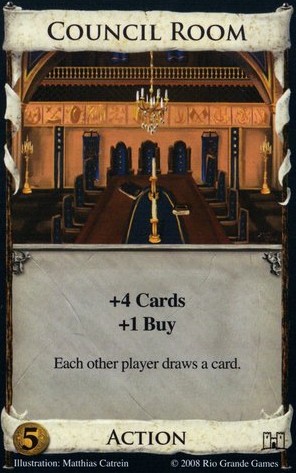
Combo of the Day #8: Council Room/Goons

As part of a +Action/+Cards engine, Council Room has a great ability, being the only +4 Cards in the game.  The +Buy is an additional benefit, since you’ll probably be drawing enough money to need it and it saves you from needing to buy a dinky Woodcutter to get your +Buy.

Unfortunately, the card’s strength is tempered by the fact that it lets all your opponents draw a card for free.  It’s still, on balance, worth it, but there are several ways to avoid helping your opponents.

One is to play Spies before the Council Room, so you can at least ensure that they draw a Victory card instead of a useful card. But this isn’t fully effective; by drawing a Victory card, they’re improving their next hand, and besides, Cellars, Vaults, and Remodels can still make use of a Victory card.

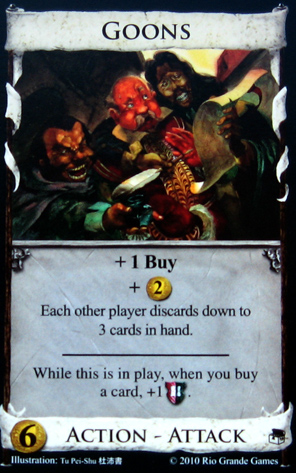
The better approach is to play a Goons after the Council Room, thus knocking them down to 3 cards. (Note that Torturer does not work, since it only involves discarding two cards, not discarding down to 3.)  This can frequently wreck an opponent’s plans by forcing him to draw and discard cards he would otherwise prefer to leave on the deck.

Ideally, you would play a Goons first, then the Council Rooms, then another Goons, but this requires a ton of +Actions.

Of course, Militia also works in place of Goons, and is much cheaper as well. However, the +Buy of Council Room works nicely with Goons’ VP chip ability.  Ghost Ship can also substitute for the Militia/Goons, but it’s more likely to inadvertently help your opponent by allowing him to rearrange his hands.  (For instance, if the opponent has a hand of Golds, and the Council Room draws him more Golds, Militia/Goons is devastating.  Ghost Ship, on the other hand, just ensures him two consecutive Province buys.)

Posted in Combo of the Day | Tagged , , , | 4 Comments

Counter of the Day #4: Tactician v. Ghost Ship

Ordinarily, Ghost Ship is a pain to deal with.  Do you wreck your current hand, or do you sandbag your next one and hope to get something out of this one?

Tactician changes things.  Put your good cards back on the deck (to be drawn later), then discard the bad cards with your Tactician.  Tactician helps against every attack that cuts hand size, but because Ghost Ship places cards back on the deck instead of discarding them, it’s the only attack that ends up helping Tacticians rather than hurting them.

Sample Game: hausdorff’s turn 5 Ghost Ship lets rrenaud save his Bridge from turn 6 for turn 7. The Ghost Ship enables rrenaud to play two bridges on turn seven. Without the opponent’s Ghost Ship, rrenaud’s turn 6 would have been no better, and his seventh turn would have been significantly worse.

Posted in Counter of the Day | Tagged , | 2 Comments