Interview with Gardens Division champion: Obi Wan Bonogi

Obi Wan Bonogi
2012 DominionStrategy.com Championships Gardens Division champion

Final Four overview

Initial seed: 6
Round 1: def. (251) pianoboy21 4-0
Round 2: def. (123) RichardNixon 4-2
Round 3: def. (70) andwilk 4-3
Round 4: def. (27) eliegel34 4-1
Division semifinals: def. (86) easwaran 4-1
Division finals: def. (19) ednever 4-3

Obi Wan Bonogi will be facing off against (7) Mic Qsenoch in the second (American) semifinal.  We caught up with Obi Wan Bonogi and asked him a few questions.

Continue reading

Posted in DominionStrategy Championships | Leave a comment

The Five Fundamental Deck Types: The Slog

This is the third in a week-long series by WanderingWinder.  For the introduction and links to the other posts, click here.

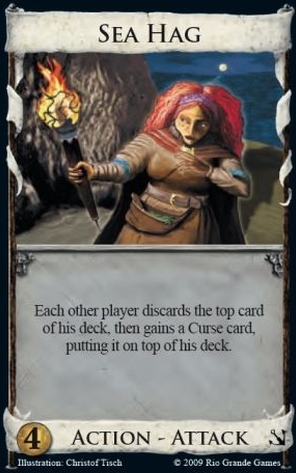
Sea Hag

Everyone always talks about there being two kinds of decks – Big Money and Engine. But I think there are really 5 general kinds of deck, and I want to talk about the 3rd most prevalent in this article – the Slog – which falls in place between Big Money and The Rush.

What characterizes the Slog?
There is no clear dividing line, but some rules of thumb are

  • you cycle very slowly
  • Copper is near- or above-average money density for most of the game
  • you generally expect, if the game is well played, to get more points from Duchies than from Provinces.

Slogs tend not to be many people’s ideas of fun (so it’s probably good that they aren’t good nearly so often as engines or Big Money), as you spend many turns doing not a whole lot but playing 3 to 4ish cards a turn (including treasure!) and buying one thing. Now, this may sound a lot like Big Money to you, but for what I’d really call a slog, it’s more like “small money” – in a Big Money deck, your average hand cash generally goes up past $6; in a slog, it wouldn’t.

Why play a Slog?
Usually it’s because your opponent sort of forces you into it. The number one reason to play a slog is because your opponent is playing junking attacks on you – Cursers, particularly Ill Gotten Gains, Sea Hag, and Mountebank, or Ambassador (looters MAY have a similar effect, but I haven’t played enough Dark Ages to be sure). Noble Brigand can work similarly by giving you Copper and disincentivizing you from buying more expensive treasures. Now, these don’t necessarily doom you to a slog, particularly if there’s trashing (an Ambassador *war* isn’t a slog… until you lose or give up), a super-strong engine, or some way of dealing with the Curses. Or just enough money sitting around with something productive to do (a la Jack of All Trades, Trader, Watchtower).

The reason you’ll voluntarily go for a slog, usually, is certain alternate VP cards – namely, Gardens, Duke, and Silk Road. For each of these, if you can just load up on lots of stuff, even junky stuff like Copper, and just wait and drag the game on, you can actually have really good chances to rack up lots of points. Now, it’s important not to get this confused with a rush, like a Workshop/Gardens rush, which is more about getting three piles gone quickly. Slogs want the game to last many turns, in order to reap their long, large, slow benefits.

Fairgrounds can sort of reach into this category, but usually for Fairgrounds, you start out as at least a money deck, and you generally want at least one Province, and 6 for a long time, which is usually a bit more than ‘pure’ slogs can really muster.

Philosopher’s Stone, of course, also pushes you to a slog more or less all the time, but it is just not that good very often; with the right deck, though (say, against Mountebank in some situations, after Familiars trade Curses, or of course with Herbalist), it can really shine and say ‘slog it up’!

What’s good for Slogs?
Well, aside from the alternate victory cards and P-Stone mentioned above, the biggest things are cards that let you discard for benefit (like Vault, Horse Traders, Cellar), because if half your hand is junk anyway you may as well discard it and get some use out of it.  Sifters (a la Cartographer and Warehouse) are strong for largely the same reason. VP Chip cards like Monument are good, too, but they almost always help engines more if ever there’s a choice for one, and they can often help Big Money more as well. Cards giving +buy or gaining something are also useful, since at the very least you can use them to grab Coppers.  Thus, Silver-gainers are really great for this kind of deck – if Copper tends to be good, then we can imagine what Silver can do for you.

General interaction with opponents
Opponents’ hand-size attacks don’t hurt as much as with say a Big Money deck, because you usually have very pitch-able cards. And one might guess that penalties from opponents’ cards will often help, too – opponents’ Vaults are brilliant for you, as are the free Silvers from Embassy. (Compare to Bishop, though, which becomes stronger for your opponent since you have little interest in the trashing.)  Cursing and junking attacks obviously still hurt (well, not if the junk is a Copper), but this is greatly mitigated in comparison with basically every other deck type – which is why they lead you to slogs in the first place. What really hurts a slog player, though, and this is in contrast to most every other deck type, is trashing attacks. Swindler, Saboteur, Pirate Ship, Thief, all very poor cards in general, really crush you by eating your economy, leaving you with a deck too swamped to do ANYTHING.

Matchups

Against Big Money
Against Big Money, slogs can really shine. This is the best match-up, in the general case, for a slog deck. You largely make them try to buy out all the Provinces, or enough to overcome whatever you can put together off of the cheaper green, and they often just don’t have the longevity to do it. If they try to build up for a long time in order to have that longevity, the Slog player should either look to build up an insurmountable lead (i.e. via having a matrix of Duchies with Gardens, Silk roads, or Dukes; sometimes just Gardens; don’t try this against Colonies) or to get a lead and then end on three piles (you see this more in cursing games, where you can pile out Duchy+Curse and some other convenient card before they get enough Provinces). If going for the VP matrix route, you should make sure to build up your economy enough to be able to complete the matrix before stalling out, though you have to balance this out against your opponent’s ability to block some of your key card and deny you.

Against Engines
Engine is a very difficult match-up for the Slog, assuming that the engine is very viable at all. If the engine is very slow to come together, then the Slog player can hope to win by accumulating a VP matrix, though he usually has less time to do this than he would against a Big Money opponent (BM may beat engines to 4 Provinces, but very rarely will engine not be able to get all 8 of them faster). But the main weapon against engine players is the three pile ending – you can cut out their ability to build the engine as large as they want, in some cases, by threatening to be able to do this if they make piles too low, and this can help you GREATLY. If they DO continue to build to far, of course, you need to be able to look at that and be willing to potentially pass up more victory cards in order to try to secure the piling out before they can catch up to you.

Against Slogs (mirror)
In the Mirror, you want to get to your key cards pretty fast – for Dukes, this is Duchy, for silk road or gardens, it is those cards – much faster than you would in other match-ups. Whereas you need to build up a bit against a Big Money deck, here it’s almost all about winning that key split, which means you want to start in pretty soon. You want to wait as long as you can before starting, so that you have the longevity to continue fighting for 5-cost VP cards after the main fight is over, but NOT at the expense of the split itself, in most every situation, as those extra points usually don’t make up for a 2-card swing of your key card (or worse!). If you win the split, look to get to the three-pile ending as efficiently as possible – most often this is by pushing for it yourself, so that your opponent doesn’t have time to rebuild and go after Provinces or something, but sometimes this means to play it slow yourself, so that your superiority in the key card (which likely cues off having more cards in your deck, either total or of a specific type) can come through. If you lose the split, you need to judge whether you can possibly re-build and get enough expensive VP cards before the game ends to overcome your deficit, or more often to try to rush smaller green cards as fast as you can, to try to three pile ending where some luck might save you.

Against the Rush
This is another tough match-up. If it’s a poor rush, you can just grab enough VP early enough for them not to be able to end the game, and then you’ve basically won. Alternatively, if they are going for the same alt-VP card as you, if you can manage to hold your own on the split, you’re often able to outlast them on secondary VP cards (i.e. against a player who is going for a gardens rush, if you can hold off the split well enough, you can hope to come out ahead by being able to get more Duchies). Generally, though, a viable rush is going to own a slog pretty badly.

Against Combo
As is basically always the case, it depends on the combo. But generally this match-up is similar to the matchup with engine, only it tends to be worse, since a combo is more likely to be able to power straight through, is generally less prone to stalling, can build up more, and usually doesn’t have to worry as much about three pile endings.

Posted in Articles | 5 Comments

Interview with Witch Division champion: Mic Qsenoch

Mic Qsenoch
2012 DominionStrategy.com Championships Witch Division champion

Final Four overview

Initial seed: 7
Round 1: def. (250) FluidSpace 4-1
Round 2: def. (122) Dubdubdubdub 4-0
Round 3: def. (58) greatexpectations 4-1
Round 4: def. (26) boloni 4-2
Division semifinals: def. (202) LordHedgie 4-1
Division finals: def. (15) WanderingWinder 4-3

Mic Qsenoch will be facing off against (6) Obi Wan Bonogi in the second (American) semifinal. We caught up with Mic Qsenoch and asked him a few questions.

Continue reading

Posted in DominionStrategy Championships | Leave a comment

Interview with Chapel Division champion: -Stef-

-Stef-
2012 DominionStrategy.com Championships Chapel Division champion

Final Four overview

Initial seed: 1
Round 1: def. (256) mstephans 4-2
Round 2: def. (128) trusty mead 4-1
Round 3: def. (64) DWetzel 4-0
Round 4: def. (32) Robz888 4-2
Division semifinals: def. (144) mith 4-0
Division finals: def. (41) dondon151 4-2

-Stef- will be facing off against (13) lespeutere in the first (European) semifinal. We caught up with -Stef- and asked him a few questions.

Continue reading

Posted in DominionStrategy Championships | Leave a comment

The Five Fundamental Deck Types: Big Money

This is the second in a week-long series by WanderingWinder.  For the introduction and links to the other posts, click here.

Silver

What characterizes Big Money?
Basically, it gets the bulk of its income from treasures bigger than copper, so silver, gold, platinum, fool’s gold, venture, etc. It also doesn’t cycle particularly quickly.

Why Big Money?
The type is pretty fast to get to a certain point. This is because it is extremely efficient. You don’t underbuy very significantly or very often, and your deck doesn’t have any ancillary or support cards. Everything is there directly to get you points or to be points.

How can I play Big Money?
Like Engines, there are a number of different types of Big Money deck.

Terminal Draw
https://dominionstrategy.com/2012/06/13/terminal-draw-big-money/

Terminal Non-draw
This is money and a few non-drawing terminal cards – more than you would get in a terminal draw Big Money deck, because they’re less likely to collide. The ancillary benefits the terminals provide improves on straight money, generally significantly enough at some point that you should buy a handful extra terminals, risking some collision. Particularly good cards here include Merchant Ship, Swindler, and Monument.

Engine Hybrid
You can start adding villages (typically you want them to be money-producing) to the terminal non-draw decks, and this doesn’t really make them an engine, without draw, but you end up playing a bunch of actions. Also, you will sometimes add a little nonterminal draw to the terminal non-draw money deck, and this can maintain a money feel. Do both, and you are creeping into engine territory. A weak dividing line is how often you will pass up gold for a cheaper component, though this isn’t foolproof.

Treasure Flood
Here, you gain a lot of treasure cards, usually silver via Jack of All Trades, Trader, Bureaucrat et al., but occasionally golds through treasure map, tunnel, or hoard.

General Considerations

  • The Keys to Big Money: Money Density and Opportunity Cost
  • Alternate VP is really bad for Big Money. It helps basically every other kind of deck more, largely by making the game longer.
  • Other than terminal draw (which despises them), these decks readily accept some useful cantrips. Particularly Peddler-types.
  • Other than treasure-flood-types, the biggest problem that these decks tend to run into is stalling – they run out of steam pretty readily. Courtyard, with its ability to smooth out draws, Embassy and Vault, with their ability to discard unneeded green without a problem (note that it’s the same group of cards that can shrug off terminal collision!) and wharf, because it’s wharf (and plays almost like an engine even in BM), are also decently resilient here – unsurprisingly, they also translate to Colony games decently well, which isn’t true of most any other BM variant. The on-gain ability of Mandarin is a big help against stalling as well.
  • Trashing helps money decks, but not by a lot – unless it gives you some other benefit, it’s not worth the opportunity cost
  • Scaling trash-for-benefit CAN do this, particularly if you can use it on Estate early. But the main point is that in the late game, it helps the stalling problem by for instance turning a Province into another Province (Remodel and Salvager can basically do this directly, Apprentice usually can as well).
  • Noble Brigand usually kills you dead
  • Handsize attacks are particularly brutal (especially against Silver-flooders) against Big Money, moreso than other deck types, as generally a money deck needs most of those cards. Ghost Ship is the biggest offender here.

Matchups

Against Slogs
Against a slog, you are generally going to have sustainability issues. Treasure-floods can do well, but otherwise you are going to need to get enough Provinces fast enough, and then contest their main VP source afterwards. This will meet with varying success based on the particular versions of each deck you’re playing, but in general it’s not so hot. On the plus side, this is one of the reasonably rare situations where all the VP chip cards really help you. Sometimes it’s also possible to plan ahead and just build a very sustainable deck to piledrive or gain a huge lead on Provinces quickly enough. But not often.

Against Rushes
Here, you need to get enough points out of your big VP card before they are able to end the game. This doesn’t happen all that often, but for some of the stronger BM versions, it certainly can. This is actually one of the better matchups for Big Money. If they green too early, they won’t be able to end, and you can amass enough points to overcome their max (typically this is 8 alt VP cards at 3-4 points each, so 4-5 Provinces most often, though with Estates, this will rise to 6 in a lot of cases – plan accordingly!). If you do this, you’re in good shape. Sometimes you can contest the last one or two of their alt-VP cards; if you can do this, it’s really good, as it cuts into their ability to win by hitting a new plateau or switching to slog. However, you need to be REALLY careful, because if you don’t have enough of a lead after doing this, you are helping them pile things out, which is their whole game plan.

Against Combo
Basically you usually have to either pre-empt their combo (a Province a turn is not so hot if you have the lead and they can’t buy Provinces because it will end the game) or end the game before it is set up. Whether you can do this is extremely game specific, but in general, it’s not a great shot. As always, also watch for three pile ending possibilities.

Against Engine
This is actually the best reason to go Big Money in a lot of cases. There are two main ways you can win.

One is to three pile them – know when you can apply pressure on this, and very often, go for it over smaller VP cards like Duchy or especially Estate. This is pretty rare if they know what they’re doing though, as you can’t gain stuff that quickly.

The primary way to win is by getting to 50% of the VP before they can. After this, you might really stall, but it won’t matter (unless they can attack it back out of you!). In practice, slightly below 50% is often fine, because you can cruise for the last point or two in a lot of cases, and sometimes even without 50%, they’re going to be unable to get enough without triggering a three pile ending first.

Of course, the major problems with this approach come when 50% is a LOT of points (or when they can slow you down a lot) – with Colonies, 50% is forever. Similarly with those alt-VP cards. Perhaps most important is the VP chips in Prosperity, which are either infinite or so close that it won’t matter. In these cases (and a few others), you are forced into pile-driving Provinces (or Colonies). If they are playing well, they WILL NOT HELP YOU unless absolutely forced to do so, so prepare to buy ALL of them from the start – the same is largely true when going for 50% of the VP, you want to plan your most efficient path to it from the start.

Against Big Money (mirror)
This is the part of Big Money which has best been studied, and which most of the stuff that’s out there covers. You need to have SOME trump on your opponent – in some cases, this is greater longevity (this is particularly true, for instance, in monument decks). In most cases, it turns into a rush for Provinces. It’s extremely difficult to get four more Duchies than your opponent and THEN get the last Province after that, so if you can get to five Provinces, you’re fairly well golden. The real trick can sometimes come in the race to four. In the mirror, you have to green fast, which means there isn’t a lot of longevity (excepting treasure floods), and not a ton of room to Duchy dance. But if you can get better longevity than your opponent and they can’t blitz out to a 5 Provinces early or anything, then you are good to go Duchy dancing, and try to win that way.

Posted in Articles | Leave a comment

The Five Fundamental Deck Types: Introduction

This is the first article in a week-long series by WanderingWinder, originally posted on the forum.

There are five fundamental deck types in Dominion.  Usually you see people paint it as a dichotomy between “Money” and “Engines”, defined by whether you use Treasures or Actions.  Which is fine as a high-level overview, but if you want to dig a little deeper, I believe that there are actually five different kinds of decks in Dominion:

Of course, every deck is different, and every particular kingdom is different. And there aren’t necessarily big bright dividing lines between all five deck types – indeed, I think every type fits fairly nicely ‘between’ two others, and at some point, the two can bleed into each other.  But the core concept still holds true: there are generally five big “ideas” from which good decks arise.

This introductory article provides a short introduction to each type, as well as how they fit together on a wheel. More detailed explanations of the different types, as well as what they like and dislike, and how they matchup against each other, will follow in the coming articles.

So let’s take you around the wheel, starting with Big Money, as that’s the first strategy that people tend to find and sometimes think of as a simple solution to the game.

Big Money decks are based on getting their economy from big treasures, typically heading very quickly to their share of Provinces. They are bounded by Slogs and Engines. What this means is that at one end of Big Money (I call it hybrids in the forthcoming article on the archetype), they start getting pretty similar to Engines – you are drawing some, and you are playing a decently high number of actions every turn. On the other end of Big Money, you are getting close to Slogs – the more time you spend buying little green cards, the more important ‘little’ treasures like copper are to your deck, the more like a Slog you are playing, and the quicker you are and more you are going off the bigger treasures, the more you are going BM.

Slogs are slower and generally lead to longer games. Treasures are generally bigger parts of your economy, but rarely do you build up to have any kind of consistency in being able to get something as expensive as a Province. They are between BM (as we’ve seen) and Rushes – this is because like a Rush, they want to get a big point load off of alternate Victory Cards (say, Gardens) a lot of the time. A Rush wants to get to that as soon as can be whereas Slogs want to make them as large as can be, but there is some middle-point where the distinction is not so clear.

Rushes seek to get the lead and end the game via three-pile ending as fast as possible. They are between Slogs and Combos – like many Combos, they are going for a quick run to winning the game off of their particular, highly specialized strategy, not paying tons of attention to what the opponent does other than watching out for three pile endings.

And Combos are based on some specific combination of cards which have specific and unique synergy, setting up to more or less just win the game once they are in place, if this happens quickly enough. They are between Rushes and Engines – like many Engines, a lot of combos look to have a massively massive hand of playing a bunch of cards and buying out everything to end the game, usually in come-from behind, very forceful and stylistic fashion.

Engines themselves are between Combo and Big Money, as we have seen. They look to cycle through their deck very quickly, playing a large portion of their cards with high frequency, using good cards to play roles, but generally in a modular fashion – i.e. there is something that lets you play extra actions, something that draws you cards, something to be a payload, etc.

I should make a quick note that by-and-large, this series is ignorant of Dark Ages, as I haven’t played with those cards very much (this shouldn’t change the typologies themselves, but it could provide good examples). It was also written basically with the 2-player version of the game expressly in mind. Adding in more players definitely changes the dynamics, and having only moderate experience there, I don’t feel like I have a ton of advice to give, though I will say that it tends to improve Big Money strategies across the board, can force you into Slogs more often, and ups the need for flexibility in general, amongst other differences.

Anyway, the first article in the series is on Big Money.

Posted in Articles | 6 Comments

2012 DominionStrategy.com Championships Final Four

The 2012 DominionStrategy.com Championships

256 entered
4 remain

How strong is this Final Four?  All four are members of the super-exclusive ten-member Level 50 Club.

Chapel Division: -Stef-
Not only is -Stef- the reigning number one on the Isotropic leaderboard, he’s doing so with the highest Isotropic ranking ever attained (Level 55!).  The top seed has never been pushed to a seventh game this tournament, winning his division with a 4-2 victory over 2012 US Champion dondon151.

Witch Division: Mic Qsenoch
A relative unknown this time last year, Mic Qsenoch has shot up the leaderboard to join the rarefied air of the Level 50+ gang, earning his place in the Final Four with a nailbiting 4-3 victory over WanderingWinder.

Gardens Division: Obi Wan Bonogi
A mainstay at the top of the leaderboard for almost two years, Obi Wan Bonogi has developed a reputation as one of the most feared players on Isotropic.  He won the Gardens Division with a 4-3 win over ednever.

Thief Division: lespeutere
Winner of the 2012 German Dominion Masters, lespeutere has played more games on Isotropic than any of the other players and won the Thief Division with a 4-2 win over HiveMindEmulator.

2012 DominionStrategy.com Championships Final Four

Over the next several days, we’ll publish interviews with each of the Final Four, to get their thoughts on the tournament, Dominion strategy advice, and their most feared opponents.  In the meantime, why not head over to the forum, and vote for who you think will win the tournament?

A huge thanks to jonts26 and greatexpectations, whose tireless efforts made this tournament possible.  Without them this tournament could not have gotten off the ground.

Posted in DominionStrategy Championships | Leave a comment

-Stef-‘s Dominion Academy

This is a guest article by -Stef-, the current #1 on the Isotropic leaderboard and the top seed in the 2012 DominionStrategy.com Championships.  It was originally posted on the forum, and this article incorporates further playtesting from the rest of the forum.

Welcome to the Dominion Academy, something new I’m trying out. The idea is that you look at the kingdom for a while and try to come up with an answer to the first question. Then compare to my answer and go on with the next question. How extensive your own answer is, is all up to you. My hope is to bring this beyond the actual game and more about the set.

Without further ado, this is the Kingdom for Game #1:

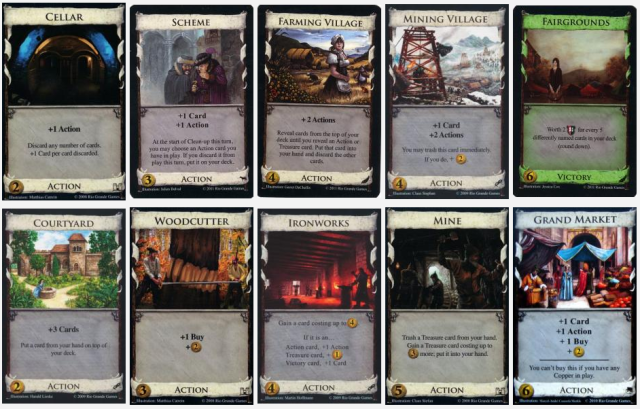
Cellar, Scheme, Farming Village, Mining Village, Fairgrounds
Courtyard, Woodcutter, Ironworks, Mine, Grand Market

Click for enlarged link dominiondeck.com

Click for enlarged link at dominiondeck.com

Remember, before looking at the answers to the questions, take some time to think through your own answer!

Question 1

Looking at these cards, two possible strategies come to mind: engine or BigMoney. Why would you play BigMoney and not engine?

Click for enlarged link dominiondeck.com

Click for enlarged link at dominiondeck.com

**ANSWER**

  1. Courtyard. Courtyard-BM is a very strong BM variant.
  2. The engine player may have some fancy cards, but nothing that hurts you, no attacks or even pseudo-attacks.
  3. No possibility to get rid of the initial 10 cards.
  4. Courtyard is the only card increasing handsize, netting only +1 card.

Question 2

Why would you play engine and not BigMoney?

Click for enlarged link dominiondeck.com

Click for enlarged link at dominiondeck.com

**ANSWER**

  1. Mine into Grand Market. It will take a while, but eventually this will have incredible power. This time is provided by:
  2. Fairgrounds. Fairgrounds implies you have time until they pick up province #8 in stead of #5, which should be about 7 extra turns. Really huge.
  3. Ironworks allows you to pick up components easily
  4. Scheme. Scheme is very helpful in ‘village/smithy’ variant draw decks (cheaper), opposed to ‘lab/lab’ variants (more expensive but reliable all by itself).
  5. Farming Village. Courtyard is lousy for draw in engines, but farming village compensates a little bit (put back your estate and continue with the village)
  6. Two piles of villages. You’ll need lots of villages, but because you have two piles you won’t have to get a pile dangerously low.
  7. Cellar. Handle with care, because this card can easily destroy you if you overbuy it. A single Cellar can be strong though.

Question 3

Which strategy do you expect to be better on this board?

Click for enlarged link dominiondeck.com

Click for enlarged link at dominiondeck.com

**ANSWER**

Courtyard-BM. It hurts a bit to say this, but the engine is probably too weak. No destruction and no attacks is really bad.  [Editor’s note: but see the forum thread.  This is probably a lot closer call than -Stef- indicates here.  In particular, a lot of tweaks you’ll want to make to the BigMoney deck makes it turn into a quasi-engine…]

Question 4

When playing Courtyard-BigMoney, are any other cards in the kingdom of interest? How does this depend on your opponents strategy?

Click for enlarged link dominiondeck.com

Click for enlarged link at dominiondeck.com

**ANSWER**

Yes. A single Ironworks is at the very least interesting. In the mirror it’s doubtful because the game will be very fast and getting early golds is important. The game against the engine will be longer and unless your start is very lucky it will be worth it for sure. If you draw it together with a Courtyard you can either gain another Courtyard or place the Ironworks back. Gaining a Silver still nets you $1. By the time you need to buy out the last (or two) provinces, maybe even a mining village is worth it for the sacrificing option.

Question 5

When playing the engine, how many Ironworks do you want? How many Mines? Does it depend on the opponents strategy?

Click for enlarged link dominiondeck.com

Click for enlarged link at dominiondeck.com

**ANSWER**

At the very least you want one of both, and you want them asap. In the mirror match I think I want a second Ironworks and stick with the single Mine. This game will be much shorter, piles will run out anyway, and I’d better make sure I have the majority share. In the matchup against BigMoney, I think I prefer only one Ironworks and a second Mine. My objective is quite the opposite: I need to prevent a 3-pile at all costs, and as long as I’m not too greedy myself I can do that. Instead I need to prepare for taking a lot of points in the endgame. If I can get to Grand Markets a little sooner this way, they will be at least as effective in picking up components as multiple Ironworks.

Question 6

So… the game starts and your opponent just bought a Silver for $3. You expect him to go BigMoney. What strategy do you choose? And what do you open with?

Click for enlarged link dominiondeck.com

Click for enlarged link at dominiondeck.com

**ANSWER**

No. No No No. You don’t have to choose now at all. I’d open Silver/Courtyard both in BigMoney and the engine. In BigMoney this should be obvious, getting $6 is your first priority and an early Ironworks doesn’t help that at all. But even in the engine I want the extra Silver. Because draw is so bad here, and I can’t destroy any cards, it will take a long time before I start drawing my deck anyway. Until then I’ll just have to do with some power cards. So getting a Mine quick is super important. Praying for $5 without buying any silvers is really asking for trouble. Plus delaying the choice on the strategy is very helpful. I may really want to play an engine, but secretly I also know courtyard-BM is probably better. If my turn 3 draws are much better then my opponents, I can still switch back to grabbing the gold and play Courtyard-BigMoney mirror. A year ago I would have opened Ironworks/Courtyard on boards like this for sure, and I can still respect that, but now I’m more into the metagame.

Question 7

You went first, opened Silver/Courtyard planning to go BigMoney, and get the perfect draw: $6 on turn 3 without even using the Courtyard. That’s a gold for sure. On turn 4 you play the Courtyard and draw all 3 Estates, 3 Coppers and your Silver. What do you put back? What do you buy?

Click for enlarged link dominiondeck.com

Click for enlarged link at dominiondeck.com

**ANSWER**

You put the silver back and buy another Courtyard. Don’t buy Silver or Ironworks now. At this point your deck contains only treasuries, so by putting back the Silver you’ll get at least $6 on turn 5 for another Gold.

Question 8

You started out playing Courtyard-BigMoney, and notices your opponent going engine. How do you respond? If you hit $6 or $7 without coppers, do you get a Grand Market? Do you contest Fairgrounds?

Click for enlarged link dominiondeck.com

Click for enlarged link at dominiondeck.com

**ANSWER**

If your opponent goes engine, you should realize you need to buy 8 provinces in stead of the usual 4 (5). So you continue getting golds quite a bit longer then usual. Maybe pick up 5-6 golds first, and I guess a Grand Market won’t hurt in this stage. Buying Fairgrounds or Duchies is pointless (in every but the literal meaning). The only thing you need to worry about is ending the game before the engine kicks into fifth gear, and your only hope to do so is depleting the Provinces. If you’re in time you win, if you’re not you lose.

Actual Game

In the actual game… my opponent got the perfect draw I described above. That also robbed (pun intended) me of all plans of playing Courtyard-BM myself. By turn 5 it was clear I went engine but “unfortunately” he didn’t adapt properly. He bought a Province on turn 5 in stead of a second Gold, an Ironworks on turn 6 in stead of a third Gold, and a Mining Village on turn 8 in stead of a fifth Gold. After that he didn’t focus on the Provinces, and by the time I decided it was time to green I was only 0-3 provinces behind. That didn’t take long to overcome. It requires a bit of discipline to follow the much simpler ‘lots of Golds into lots of Provinces’ plan, ignoring all the shiny engine parts. But that’s the kind of discipline that can make a great BigMoney player, and on these early draws I’m convinced it would have been winning.

Forum thoughts

After some further play by the community, the following points were agreed upon:

  • The engine is extremely vulnerable to three-pile endings, especially since it is so focused on Fairgrounds.  It is very easy for it to lose prematurely, before it builds up its Fairgrounds.
  • In reality, the best BigMoney strategy here tends to be closer to an engine than a pure money game.  You want Grand Markets, and though you can skimp on the Villages, the Schemes are good for your Grand Markets.
  • Especially in a “mirror match”, where both of you pursue similar strategies, the Grand Market split can often decide the winner.
Posted in Annotated Games | 13 Comments

Happy Holidays!

Hope you’re all enjoying this holiday season. We’ll return to regular posting in the new year. In the meantime, you can try out this Christmas-themed Kingdom.

And if you just got introduced to Dominion, check out our New to Dominion page.

Posted in Uncategorized | 1 Comment

Interview with Donald X. Vaccarino, Part III: Other Boardgames

This is Part III of a three-part interview with Donald X. Vaccarino, covering the future of Dominion, other boardgames, and Donald X. himself. Questions and answers are collected from this forum topic.

The Future of Dominion

Insomniac asks: “Any hints or tastes of what we can expect in Guilds?”

It’s a small expansion (150 cards). It’s the most complex expansion, and is more skill-based than the other expansions. Jay has the files and art is being made, so it’s on track for getting pushed back from early spring to late spring.

theory asks: “You’ve said many times before that Guilds is the last of the “standard” Dominion expansions. Have you given any thought to what you want to do with Dominion after Guilds?”

I would like to do spin-offs that have “Dominion” in the title. Not unrelated stuff like Cardcassonne, but clearly related games which nevertheless are different enough to not just be expansions.

For Dominion itself, probably there will be a promo or two, I think Jay would be interested if I handed him one now. Also probably an online-only promo that couldn’t exist irl. Some kind of “treasure chest” small expansion in the future, with 1-2 cards for each existing expansion, sounds more doable than any other new Dominion expansion, but has the issue that it would appeal to a smaller audience than a more normal expansion. Also it has the issue that Jay would note this. At one point I was considering doing a Seaside expansion in place of Guilds (not having come up with Guilds yet). And Jay was like, isn’t a new thing better than more of an old thing? And it was, it was better.

Other Boardgames

GendoIkari asks: “What is your favorite board game that you didn’t design?”

Magic: The Gathering, by a mile. If again it has to really have a board, then I’m not sure I have a clear favorite. I have more games by Knizia than anyone else, and like to single out Clash of Gladiators as a favorite that people don’t seem to know about, although probably I played Medisci more, but that doesn’t count because I made an expansion for it to give it variety.

DG asks: “What problems found in other games are you most happy to have avoided in Dominion?”

The most ubiquitous problem of other games that Dominion solves is politics. You generally can’t get rid of politics in interactive decision-based games, but you can dial it down, and Dominion does a good job of that. That’s just something normal for me though, I am always looking at that, and so Dominion doesn’t stand out in that way for me.

A way that Dominion does stand out is, it has a good solution to the tableau problem. You have a game where each turn you play a card, and they have abilities that do things for you. There are four players. After six turns there are 24 cards in play and it’s impossible to make sure everything happens that’s supposed to. Dominion solves this by hiding your abilities in a deck, so we only have to worry about a few things at a time. I am not sure if too many games are affected by this problem, but I have faced it a bunch, being fond of games where you get lots of abilities.

DG asks: “If a friend has a newly released game and puts it on the table, who’s name as the game designer would get you most eager to play?”

In the 90s, Reiner Knizia and Richard Garfield were the two I was most likely to buy new games from. These days I might pick Vlaada Chvatil; I do not have much experience with his games, so this isn’t due to that; but from reading the descriptions, they are the ones I am most interested in.

Tables asks: “Have you played any of the various other deckbuilder games (e.g. Ascension, Thunderstone, Legendary etc.) and if so, do you enjoy (m)any of them? Do any have mechanics that you’d have liked to use?”

I have not played any of the various Dominion-based games. I have zero interest in the clones. Of the actual new games, I would try Friday or A Few Acres of Snow sometime, if it came up. The only game that has stuff I might have done, or might still do, is Mage Knight. Dominion started as a solution to a problem in a game of building fantasy heroes and going on quests, and I still feel like I’d like to make that game someday. And the way I would handle hit points is the same as Mage Knight (iirc) – you just get Curses weighing you down, so you don’t have to track hit points separately.

theory asks: “If you wanted to brag — what do you think separates Dominion from other deckbuilders?”

Well you can mean this question two ways.

What separates Dominion from the Dominion clones? Man. They are clones. I haven’t played them so really this is a question for the people who have. In some cases the answer is just going to be, they aren’t balanced as well and different people get paid for them. For others it will be, that plus they added something bad or pointless. Some people will prefer them anyway though, just as I know of someone who intentionally saw the Asylum version of something.

What separates Dominion from the actual new deckbuilding games, such as A Few Acres of Snow and Eminent Domain? Well they are just different games. They are different in all the ways they are different.

We can make a special case for Ascension. When I typed up my original notes for Dominion, I was going to have multiple resources, and have a small number of cards available, where buying a card would cause it to be replaced. Ascension seems like a reasonable thing to try, but I liked my choices for Dominion better.

Piemaster asks: “In previous answers in this thread you have expressed a preference for fast games and also a dislike for games that eliminate players ‘with hours to play’. Are these two philosophies related?”

They aren’t.

Fast games are good because there are more opportunities to play them, players get more of a chance to win a game over the evening, and you get more variety of experiences over your evening.

Eliminating players with a substantial amount of game left is bad because you leave them with nothing to do. I guess it’s getting kind of late. Maybe I’ll just go home. It’s fine in an online game, where I can just go off and start another game somewhere; it’s awful for anything to be played at a kitchen table.

I obv. don’t think player elimination is always bad; I think it’s fine if there isn’t much game left. It’s entertaining seeing how things play out in Gauntlet of Fools, and doesn’t take long. And the threat of elimination can be a fun thing. In Risk though, well, thanks for having me over. I’ll see myself out.

Piemaster asks: “Are there any ‘long games’ out there that you think successfully walk the fine line between giving players meaningful strategic choices all through the game, while at the same time keeping as many players as possible ‘in contention’ until the later stages?”

Staying in contention isn’t an issue. It has to be fun to lose! And if it is then it’s okay not to be in contention. You can start a game of Scrabble knowing you have no chance of winning – the other player is just way better at anagramming than you. That doesn’t stop you from having fun anagramming though. That would be true even if Scrabble took twice as long (although, being so homogeneous, it’s just as well that it doesn’t).

Some people may make games faster as a way to avoid eliminating players while minimizing how much time you spend knowing you’ve lost. I just make fast games because I like fast games.

WanderingWinder asks: “What are your thoughts, if any, about “classic” board games (chess, go, or even things like risk, stratego, monopoly)?”

I will just cover those five.

Chess: Chess has two huge flaws. First, for new players, it’s hard to even see what the pieces can do. You have to remember how all the pieces move and then consider how they would all interact with any potential move. Second, you can potentially see many moves in advance, perfectly. Only, you personally, you cannot do that, because it’s too hard. You aren’t looking ten moves ahead and therefore you’re playing suboptimally. I guess you’re just stupid, Chess tells you. Chess magnifies this due to the way the game works; it’s not just perfect information, it’s perfect information and small differences can get blown up. At one point I made a game in the Chess family. People would ask me about Magic, and I would say, well suppose we were going to play Chess, only we each brought half of the board and pieces. You’ve got knights and pawns and so forth, but I’ve got archers and pikemen, and half of my board is under water. After using this analogy a few times, I thought, I should make that game. And I made a game and well, it was way too hard to even see what the pieces could do.

Go: Go is also perfect information but somehow does not seem as flawed in that way as chess, in addition of course to not making you remember how the pieces work and stuff. I’ve barely gotten to play it. It was interesting. I guess I’m more interested in it in terms of implications than as a game to play. It’s cool that like a piece in the middle of nowhere is doing good work for you.

Risk: Risk (the old version, not whatever goes by that name today) is perhaps the game I most often use as a bad example. In Risk, the better you’re doing, the more fun you get to have; the worse you’re doing, the less you get to do. It’s like if in Scrabble, the player in last place only got 3 letters to work with. In Risk all losers look identical – they all have nothing. No-one has any interest in seeing that position but the winner. Risk eliminates players with hours left in the game. It’s heavily political. Having a map of the world with armies in the countries is great, but that’s all it’s got.

Stratego: The premise is cute. I’ve played but don’t really remember it.

Monopoly: I think people take the wrong lesson away from Monopoly. Monopoly is a bad game, because it gives you pointless decisions and lasts a random huge amount of time and eliminates players with hours left in the game and is political. But Monopoly is also a successful game, perhaps because it’s filled with fun things – you roll dice and draw cards and see what you get, you get stuff that’s yours that goes in front of you, you build up your stuff. On anyone else’s turn you might get paid. People focused on cashing in on Monopoly by making more roll-and-move games (yes they predate Monopoly but don’t you think?), so that roll-and-move (a completely reasonable mechanic) has all these negative connotations now, when the real direction to go in was more games of building up your stuff. Settlers is more or less a fixed Monopoly – you roll dice and draw cards, you get stuff that’s yours, both on the board and in your hand, you build up your stuff, you trade, you get paid when it’s not your turn. But it’s fast and doesn’t eliminate players and isn’t full of pointless decisions. It’s still political of course.

The Person

HiveMindEmulator asks: “What are your interests besides board games?”

I am a big music fan. 2012 has not been a great year, but the Guided by Voices album Class Clown Spots a UFO and the Amanda Palmer album Theatre Is Evil were stand-outs.

I have written a bunch of very short stories and also some normal-length screenplays. I’ve written some songs but don’t really play an instrument. Wait, did you say board games? I also like video games. I made the best computer game ever, Dudes of Stuff and Things (my take on Heroes of Might and Magic III, which was the best computer game ever in its day).

werothegreat asks: “What’s your favorite color?”

Green. Since no-one would ask this question without thinking of Monty Python, I will mention that my favorite Monty Python member is Cleese, although, what, most people probably pick Cleese.

Powerman asks: “Do you consider yourself more of a BM-ish player or an engine player?

What’s your favorite type of pie?

How did you decide on the artists for the cards?”

Engines, apple. I don’t have any input into who does the art for what card. I do get to see some of the sketches sometimes, in which case I comment on them, but that’s about illustrating the correct thing (and not having anachronisms or what have you) rather than say quality of art.

Polk5440 asks: “How has your life changed now that you are rich and famous?”

I spend a lot more time reading about myself on the internet. I get to make games for a living, so that’s nice. I want a nicer house than I might have. It’s probably easier to get new games playtested.

The particular degree to which I’m famous is roughly this: a guy can show up to play games at a local game store, be standing in front of me holding his own copy of Dominion, be introduced to me as Donald X., and have no idea I’m anyone. The exception is German gamers, they recognize the name immediately.

theory asks: “If time and money were no concern, what would you most like to be doing right now?”

Well they aren’t really a concern, and here I am. Money hits these thresholds; if I had twice as much money I would get a nicer house but that might be the only change. I would like that nicer house, don’t get me wrong, but you know. I don’t like to travel, I don’t want a boat. There aren’t activities that are expensive that I want to do; there aren’t material possessions I want that I can’t have. At some level of wealth I might hire people; I dunno, that’s a job, interacting with those people.

theory asks: “Did you ever imagine an alternative career for yourself, outside of ability? Like becoming a rock star, or an astronaut, or football player?”

As a kid I wanted to be a writer; then I wanted to be someone who worked on D&D products. Then I wanted to design computer games. I seriously pursued screenwriting at one point, if it counts as serious if you don’t submit stuff anywhere, and I’ve written songs, although a whole rock star career, I dunno. Hunter / gatherer doesn’t sound so bad; the hours are short, and you can pee almost anywhere.

Polk5440 asks: “Sort of a follow up: What is your favorite charity or cause that you like to (financially) support? If there could be a Donald X Fund for X, what would the second X be and why?”

We donate some tiny amount to utterly conventional charities. My interaction with it is just recycling the junk mail they then send you. If one of them doesn’t mock your contribution by spending some of it on junk mail, I pick that one.

This isn’t the forum for political talk, so take it there if you must, but one cause I especially care about is uh well it might be called “voting reform,” although if you’re doing it right it’s not really “voting.” Voting is a poor way to get from “what people want” to “what they get.” “Choosing” is much better. [Consider 10 friends who get together once a month and eat out; how should they determine the restaurant?] Voting reform is top-level for me because so much other stuff that you might try to accomplish goes through governments. So I want to fix that system first.

^_^_^_^ asks: “Of the great multitude of questions you have answered throughout the wonderful Adventure Dominion has Tunnel ‘d you through, which was your favorite question about Dominion?”

Well, the first question in my first interview was “what question do you get asked the most often in interviews.”

Posted in Uncategorized | 8 Comments