Renaissance Previews #5: Fair, Silos, Citadel, Star Chart, Sewers, Innovation

The following is the fifth and final preview for the new Renaissance set from Donald X. Vaccarino:

Projects are abilities everyone can have. They go in your randomizer deck or special sideways deck, like Events and Landmarks. You only play with 2 max between these and Events and Landmarks, unless you prefer to have more, I can’t stop you. Each player gets two wooden cubes, that’s right we’ve at last moved into wood, and if you buy a Project – using a buy in your Buy phase – you put one of your unused cubes on it and then have that ability for the rest of the game. You only get two cubes, even if you preferred having more than two Projects out at once. Everyone can put a cube on the same Project, there’s room for all. There are twenty Projects. Here are six of them.

pAJj1uG

Silos lets you Cellar away Coppers at the start of your turn, could be a pip.

Citadel repeats your first Action each turn. You are going places once you have one of these.

Star Chart lets you pick your top card every time you shuffle. It seems like that could come in handy. Yes you get to look at the cards, you don’t have to pick from the backs.

Sewers means every trasher you have can trash an extra card. It also works when you play a one-shot like Acting Troupe, or lose a card to Swindler or something. It can be sneaky.

And finally Innovation makes your first bought/gained Action each turn leap into play and immediately do something. Not all things are useful to play in your Buy phase (and there isn’t always a Workshop available), but it turns out a lot of things are (and sometimes, there’s a Workshop).

That’s it for previews! You’ll be able to play with the previewed cards online all through the weekend; then they’ll vanish until the street date for the physical set. Which is when you’ll also get to see the rest of the cards. And when is that? Well the current guess is… late October. Very late October. So late in October that it’s almost not October. Man. A month away. But at least RGG has a lot of confidence in that estimate. The rulebook will show up online around then as usual, and once people have the cards I’ll post a Secret History.

Posted in Uncategorized | 2 Comments

Renaissance Previews #4: Flag Bearer, Swashbuckler, Treasurer

This is the fourth in a series of five preview posts by Donald X, each showing new cards and mechanics from the upcoming expansion, Dominion: Renaissance. These new cards are playable online during this week at dominion.games, so be sure to check them out!

Artifacts are abilities only one player can have. When you take the Flag, you take it from whoever had it, if someone had it. So, they go back and forth. They’re like Lost in the Woods (from Nocturne); hey could I do more with that kind of thing, I thought, and I could. There are five Artifacts total, and here are three of them and their parent cards.Flag Bearer comes with a Flag. If someone takes it away from you, just buy another one. How many Flag Bearers can your deck tolerate, anyway? Well you can also trash them to get the Flag, so that won’t always be an issue.

Swashbuckler is trickier. All that stuff after the colon only happens if you have cards in your discard pile – which is harder than it sounds. Part of it is, you draw the three cards before checking. The Coffers tokens don’t have to have come from Swashbuckler specifically, so sometimes that helps, but you still need a discard pile at least once to get the Treasure Chest.

Treasurer can put you down a Treasure, up a Treasure, or even on Treasures. And the Key is like a Treasury. So it’s sure to be a card you treasure.

Posted in Uncategorized | Leave a comment

Renaissance Previews #3: Villain, Ducat, Silk Merchant

This post by Donald X. is the third of five previews for the new Dominion expansion, Dominion: Renaissance.

Coffers are like Villagers but for coins. Bam. Also Coffers appeared already in Guilds, though it wasn’t called that until the later printing. It’s money you can save for later. You can only cash in the tokens before buying cards; they make +$1 each. Guilds originally said “take a coin token”; this set says “+1 Coffers.”Villain has +2 Coffers, there you go, it’s that easy. It makes the other players discard something good, except early on they’ll have Estates and later on Provinces. But you know, in the middle there, it demands a good card.

Ducat is the Coffers treasure. If you have a Copper in hand when you get it, it essentially upgrades the Copper into a kind of save-able Copper.

Silk Merchant spills out tokens both coming and going. You may even get use out of it in the middle.

Posted in Uncategorized | 1 Comment

Renaissance Previews #2: Acting Troupe, Sculptor, Recruiter

This is the second in a series of five preview posts by Donald X., each revealing some cards and mechanics from the upcoming Dominion expansion, Dominion: Renaissance.

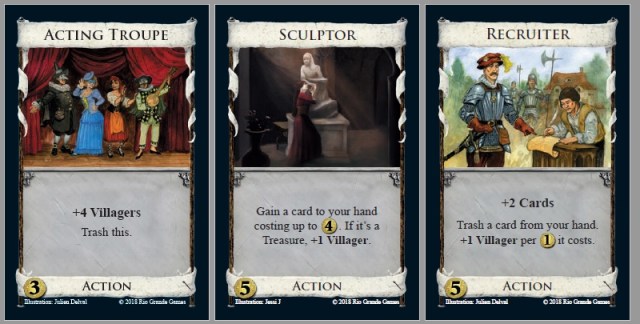
Villagers are like Coffers but for Actions. I guess that explanation would have been simpler tomorrow. +1 Villager means you add a token to the Villagers side of your Coffers / Villagers mat. You can remove the token for +1 Action in your Action phase. It’s a +1 Action you can save. The actual tokens are coins, but don’t be fooled, they do double duty. I will tell you now, it’s so nice just using one type of token. So anyway, Villagers.Acting Troupe gets right to the point: 4 tokens, it’s gone. How much of a village is that exactly; what decks are possible when this is the only village-like thing? As always I leave those questions to you.

Sculptor is that rare animal, a Workshop that gains cards directly to your hand. Watch out. If you gain an Action you won’t necessarily be able to play it that turn… but wait, you might have Villagers from previous plays of Sculptor. They thought of everything.

Recruiter can let you really go nuts getting Villagers. Don’t go too nuts; you don’t need a giant pile of Villagers sitting there.

If you missed yesterday’s preview, I am here to tell you that you can try these cards right now at dominion.games. If you did catch yesterday’s preview, I’m just wasting your time now.

Posted in Uncategorized | Leave a comment

Renaissance Previews #1:Mountain Village, Priest, Seer, Scholar, Experiment

Original preview article by Donald X. Vaccarino

Dominion, that’s what you’re trying to achieve. This time in the Renaissance!

Renaissance has four themes: Villagers, Coffers, Artifacts, Projects. And we’ll be seeing them in that order over the next 4 days. But in fact half the kingdom cards in the set don’t fit any of those themes. And today, here are some of those. Like last time we will have the preview cards playable at dominion.games, and to have plenty of variety there I’m previewing 5 cards today. You read them already, but this paragraph still has to pretend you haven’t, so, here they are:

T3UnoN9

Mountain Village gets back a card from your discard pile instead of drawing you a card. Or draws you a card if it can’t, you aren’t hurt there. It does some tricks; the first one you’ll see is, one Mountain Village in your hand gets back all the Mountain Villages in your discard pile.

Priest is a trasher, and rewards you for further trashing. Play Priest, get +$2, trash a Copper. Play a second Priest, get +$2, trash a Copper, get a +$2 bonus from the first Priest. Play a third Priest, get +$2, trash a Silver (you ran out of Coppers), get +$2 from the first Priest and +$2 from the second Priest. See how it goes? Try to have enough stuff to feed them.

Seer draws cards costing from $2 to $4. Those aren’t your best cards but hey, you could get three of them.

Scholar makes the cards go round. It’s a poster child for simplicity; this set goes the extra mile to be simpler than the previous few.

Experiment is a one-shot Lab, but you get two of them.

Again, dominion.games, you can try out the cards right now (yes unless you are reading this from the future). Click on the thing that looks like it will do that, and it will.

Posted in Uncategorized | 1 Comment

Dominion: Renaissance Teaser

This teaser was originally posted by Donald X. to the Dominion Strategy Forums. Next week, we will be posting Dominion: Renaissance previews each weekday, which will reveal various cards and mechanics from the new expansion. You will also be able to try out these new cards and mechanics for free, as they are revealed, on the Dominion Online client.

Prepare to be teased.

Renaissance has:

  • 25 kingdom cards, 25 sideways cards, 12 wooden cubes, 6 playmats, and 35 tokens
  • three Treasures, two Attacks, two Duration cards, and one Reaction
  • fifteen uses for tokens
  • sixteen uses of “trash”
  • a card with a word in quotation marks on it
  • a card with only 3 words on it; a card with only 4 words on it
  • three ways to play Actions in your Buy phase
  • a way to take a turn after the game would otherwise be over
  • a trasher you can’t turn off
  • something that cares about shuffling
Posted in Uncategorized | Leave a comment

Feodum

This article was written by werothegreat and edited in collaboration with the Dominion Strategy blog team. Be sure to check out the blog next week for previews of the upcoming Dominion expansion, Dominion: Renaissance!

Feodum, like its counting Victory card brethren, is a rather niche card.  In a few instances, it can be worth a staggering amount of VP, vastly outweighing Provinces; however, it is also often ignorable, and can sometimes be worth nothing at all.  There does exist a middle ground, though, where it can be treated like a pinata full of Silver, or where it can help add a few tie-breaking points in a sloggier game.

If Feodum is on the board, quickly run through this mental checklist:

  • Is there a way to gain Silver very quickly?
  • Is there a way to gain Silver more slowly?
  • Is there a way to trash Feodum?

Let’s look at each of these individually.

Feeding the Feoda

The time Feodum shines brighter than a supernova is when there is a powerful Silver gainer.  Masterpiece and Delve are the cream of the crop here, letting you buy multiple Silvers per turn.  Also noteworthy is Raid, which has the added benefit of hurting your opponent, though it does require you to gain a few Silvers the hard way first.  All of these are helped by any kind of strong draw: Masterpiece and Delve want as much $ as possible to spend on a Buy, while Raid wants you to get as many Silvers into play as you can.

If you find yourself in this optimal situation, your aim should be to empty out the Silver pile as quickly as possible, picking up Feoda along the way (assuming your opponent mirrors).  In this specific combo instance, winning the Silver split is more important than getting more Feoda (though if you don’t get any, you’re screwed); if you get 27 Silvers and 3 Feoda (27 VP total), that will beat an opponent with 13 Silvers and 5 Feoda (20 VP total).  If your opponent goes for Provinces instead, emptying the Silver pile isn’t strictly necessary; you just need enough to make sure your Feoda give more points than their Provinces, so make sure you actually grab Feoda before the game ends!

In a Masterpiece game, ideally you want to finish with a three pile ending: Silvers, Masterpieces, and Feoda.  However, if the Masterpieces don’t quite run out (or you’re using an Event gainer), your deck jammed full of Silver is perfect for buying Provinces, and can easily end the game conventionally.

If your opponent doesn’t try to mirror you, you’re looking at a maximum of 8 Feoda worth up to 13VP each – more than Colony!  In such a case, run down the Silver and Feodum piles as quick as you can while your opponent dawdles trying to get Provinces.  Do not buy any Provinces yourself until you’ve secured enough VP to trounce them.

The Middle Ground

Unfortunately, most Silver gainers are not as dramatic as those mentioned above.  However, that doesn’t mean Feodum is down for the count!  In a game with Bureaucrat or Squire, while emptying the Silver pile entirely is unrealistic, it’s perfectly reasonable to expect to have 10 or more Silvers by the end of the game.  In such cases, Feodum becomes a cheaper Duchy, and another option for three-piling.  While it’s no longer the star of the show, it can still be a nice supplement to your main VP from Provinces.

If you’re aiming to use Feodum in this way, try to get your Silver gainer early.  Not only do the Silvers help your Feoda, they also, as previously discussed, make buying Provinces easier.

Some Silver gainers can also trash.  Jack of All Trades, Hermit, and Amulet can also fill this middle ground role, but don’t mind if you get a Feodum early, just to trash for the Silvers inside.  Jack and Hermit are better for this, as they can trash and gain Silver at the same time.  In such cases, if you’re uncontested, the Feodum pile is unlikely to empty, so you’re not really losing any VP, as you can always just pick up another one, now worth 1VP more!

A word of warning, though: in a lot of these cases, there’s usually something better to do on the board than just slowly trickle Silvers into your deck, so keep an eye out for faster or more productive strategies.

Silver Slogs

In junking games, particularly with Cultist, the game can be extended significantly as players wade through Ruins or Curses.  In such cases, you might end up buying 12 or more Silvers throughout the course of the game, making Feodum particularly attractive as the game drags on.  In these cases, try to keep track of how many Silvers you think you’ll have by the end of the game; if it’s at least 9, start buying Feodum over Duchy, and keeping adding more Silver as you can.

Popping the Piñata

But what about trashers that don’t gain Silver?  Mass trashers like Chapel and Donate see Feodum as an early game boost; in this case, you don’t really care about the VP, but the 3 Silvers are very nice.  Working with only a single card trasher is a little risky, as it’s harder to line them up, but with Remodelers like Upgrade or Remake, or trash for benefit cards like Salvager or Bishop, it can be worth it, especially since a popped Feodum provides three more pieces of fodder for later use.  Upgrade can actually get a significant amount of VP from Feoda, as it can convert Estates into Silvers, Silvers into Feoda, and Feoda into more Upgrades.

Trader is an interesting example: it can generate a lot of Silvers for Feodum, but requires fodder to do so.  Popping open a Feodum gives you 7 Silvers, while Tradering a Silver gives it back to you with two more.  It’s not quite as reliable as Masterpiece or Delve, and you need to make sure you don’t trash too many Feoda, but it can be very potent, though you may still want to supplement with Provinces.

If you have a single card trasher that doesn’t scale, like Forager or Trade Route, it’s probably not worth the trouble.  An exception would be Ratcatcher, as it’s cheap, and a lot easier to line up with a target.

Being able to trash a Feodum on gain can also be quite nice – Watchtower and Salt the Earth are prime examples, essentially letting you pay $4 for 3 Silvers, and a little bonus.

Miscellaneous

Feodum provides a decent defense against trashing Attacks, particularly Knights.  If it gets hit, you still get 3 Silvers, which then in turn are preferred targets of the Attack, keeping your more valuable cards safe.

At first thought, it might seem like Treasure Hunter would be a good Feodum rush enabler, but it can be pretty easy for your opponent to play around letting you gain lots of Silvers with it, and Feodum and Silver are both prime targets for Warriors.

Posted in Articles, Dark Ages, General Strategy, Individual Card Analysis, Uncategorized | 1 Comment

Gear

This article was originally written by aku_chi and edited in collaboration with the Dominion Strategy blog team.

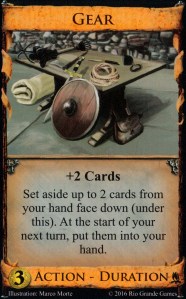
At first glance, Gear looks similar to Moat: +2 cards and some additional text. But it’s this additional text that enables Gear to provide so much control over your turns, and makes Gear one of the strongest cards in Dominion. Let’s look at all the valuable things you can do by setting aside cards with Gear:

  • Save excess money from turn to turn. This is especially important when you only have one buy. Early on, you can save a Copper to turn a $4 hand into a $3 hand in order to hit $5 on the next turn. Later in the game, you can save money exceeding $8 so you can buy Provinces more consistently.
  • Save an unplayable terminal action for the next turn. This is especially important in games without villages.
  • Improve your starting hand. You can set aside +card or +action cards that will make your next hand stronger. This is especially valuable when you have a few powerful draw cards such as Scrying Pool or Storyteller.
  • Force bad cards to miss the shuffle. If you’re about to trigger a shuffle, you can set aside green cards so that you don’t draw them in that shuffle.
  • Pair up synergistic cards. Gear can help you pair up your Estates with a good Estate trasher, or Province with Tournament, or Gold with Encampment, and more!
  • Let’s dive deeper into a couple contexts in which you might use Gear.
  • Gear in the Early Game

    Gear is a very strong card with a $3/$4 opening. If you draw Gear on turn 3, you’re guaranteed to be able to see and play your other opening card on turns 3 or 4. If your other opening card doesn’t draw, you will end turn 4 with an empty deck – having seen all twelve of your cards. You will be able to freely distribute your deck’s total money over these two turns. If you draw Gear on turn 4, you might have to set aside your other opening card to play on turn 5 (if it’s an action you can’t play), but you will also have an opportunity to cause 1-2 weak cards to miss your next shuffle.

    If there is a key $2-4 card on the board that you want to open with, consider a Gear opening carefully. If the key card is non-terminal such as Quarry or Transmogrify, Gear is usually a great accompaniment. However, if you open Gear with a terminal trasher such as Chapel or Steward, they might collide on turn 4. Gear will probably only be worth opening if you can get a cheap village while trashing.

    If there is a key $5 card on the board, Gear + Silver is an excellent opening. So long as Gear is drawn on turn 3 or 4, you are guaranteed to be able to buy a $5 card and (almost always) a $4 or $3 card (perhaps another Gear, if the key $5 card is non-terminal). You can also open Gear alongside a coin-generating action such as Poacher or Swindler, but you run the risk of not hitting $5 on turn 3 or 4 if you draw poorly. Gear + Potion is also one of the most reliable ways to hit $3P on turn 3 or 4.

    In the rare event that there are no kingdom cards costing $5 or less that you want early, double Gear is a good opening. With a double Gear opening, if you draw Gear on turn 3, you have a good chance to hit $6 on turn 4 for Gold (or something better). If you don’t see any Gears on turn 3, you can buy Silver and have a great chance to hit $6 on turn 5.

    Gear + Money

    Usually, you will want to play a card-drawing engine, and a few Gears will fit in well. But, sometimes there is no good engine to build, in which case you should play primarily with Gear and treasures. This is often the case when there are no villages and no non-terminal draw in the kingdom. Gear is a very strong card in moneyish strategies, because Gear’s money saving and terminal spacing functions give you tremendous control over your turns.

    Gear + money strategies benefit most from Estate trashing and treasure gaining, so consider incorporating them into your strategy. Gear + money’s strongest supports are cards and events that can trash Estates with very little lost tempo: Trade, Transmogrify, and Plan. With strong support, Gear + money can beat slower engines – especially if there are no handsize attacks or alternative VP available.

    Non-terminal support cards such as Sentry or Treasure Trove are easy to incorporate into a Gear + money strategy. Because Gear can help space terminal actions, using 3-4 terminal actions is a good rule of thumb for a Gear + money strategy. Sometimes, Gear is better in a support role with strong terminal actions such as Witch or Haggler. In this role you can use 1-2 copies of Gear along with 2 additional terminal actions. More often, you will want to combine 2-3 Gears with one copy of a supporting terminal action such as Salvager or Bandit.

    Sometimes, there aren’t any other beneficial kingdom cards. Unassisted, you should open double Gear hoping to get Gold on turn 4. You should get a third Gear as soon as you are confident you can get Gold. With 3 Gears, you should be able to play one Gear each turn pretty consistently and smooth your money to exactly buy Golds (3-4), and then Provinces. Without support, Gear + money does not get 7+ Provinces very fast, so beware strong alternative VP.

    Gear Tips

    Gear is almost always good; buy it, you won’t regret it. Here are a few final Gear tips:

    • When playing Gear, if you choose not to set aside any cards, Gear will not stay in play.
    • Usually, set aside all the cards you don’t need on a given turn, even if it’s just one card.
    • When using Gear as your primary source of draw (not recommended if there are alternatives), only save cards with your final Gear.
    • When trashing from your deck with cards such as Sentry or Lookout, stop using Gear to save cards you want to trash pretty early.
    • The cards saved by Gear are not in your hand during opponents’ turns, so you can’t use saved reactions such as Moat.
    Posted in Adventures, Articles, General Strategy, Individual Card Analysis, Uncategorized | Leave a comment

    Counting House + Night Watchman

    This post is an expansion of a post from the Dominion Strategy Forums by aku_chi, with editing help from the Dominion Strategy Blog staff.

    Counting House was once considered the weakest $5 card – and for good reason.  It requires some very specific support to be powerful. Counting House works best when you can consistently draw it with a discard pile full of Copper.  Fortunately, some of the most recent Dominion expansions have provided excellent support for Counting House. Travelling Fair from Adventures has a very strong combo with Counting House, as discussed in a recent article from this blog.

    Night Watchman from Nocturne presents another strong combo with Counting House, which works a little differently.  This combo works by having two pairs of Counting House and Night Watchman and alternately playing these pairs of cards while buying one Province each turn.  Once the combo gets started: your deck will be empty, you’ll play your Counting House and draw to 8 Copper, you’ll buy a Province, then you’ll play Night Watchman to set up a 5-card deck including your other copy of Counting House and Night Watchman – which you draw for your next turn.  Rinse and repeat.

    This combo can usually be set up starting on turn 7, after which you can reliably buy one Province per turn until the Province pile is empty (turn 14 if your opponent doesn’t help you).  This is usually faster than competing strategies.

    Playing the Comb0

    There are four conditions you need to meet to start the combo:

    • Have the following deck contents: Counting House x2, Night Watchman x2, Copper x8, Estates (or Shelters) x3, one other card.  The other card could be a ninth Copper, a Silver, an Heirloom, or (if you’re lucky) a Duchy.
    • Have the following hand: Counting House x1, Night Watchman x1, three other cards.
    • Have the following deck and discard pile: Counting House x1, Night Watchman x1, Coppers, and at least two non-Copper cards.
    • Be able to generate $8: This is usually accomplished by having all Coppers in your hand or discard pile.

    From this point on, you can buy Province, play Night Watchman, discard to a 5-card deck that includes your other Counting House and Night Watchman, and do the same thing over again.  If your opponent doesn’t affect your deck, this combo is 100% reliable through 8 Provinces. For the 8th Province, you can discard your Night Watchman to find your Counting House.

    Building to the Combo

    You need to gain six cards before you can start the combo: Counting House x2, Night Watchman x2, Copper, and one additional card.  In most circumstances, you should aim to start the combo on turn 7 after buying one of these cards each turn. Rarely, there will be a way to accelerate this process and start the combo on turn 6.  Conversely, sometimes you’ll get unlucky and your Counting Houses or Night Watchmen will stick together, or maybe you’ll have a difficult time affording your second Counting House, but these usually only set you back one turn.

    The order in which you buy these six cards ought to depend on your opening split:

    • 4/3: This the best case.  Buy Copper turn 1, then Night Watchman turn 2, to set up $5 on turn 3, which you should use to buy your first Counting House.
    • 3/4: Buy Silver on turn 1, then Night Watchman on turn 2 to set up $5 on turn 3, which you should use to buy your first Counting House.  You still need to buy a Copper at some point, but there’s no rush.
    • 5/2 or 2/5: Open with Counting House and Copper.  Often, you can buy a Night Watchman on turn 3 and guarantee your second Counting House purchase on turn 4.

    Once you have one Counting House and one Night Watchman, you should have opportunities to set up a $5 turn to buy your second Counting House.  You can also sometimes use your second Night Watchman purchase to set up a good Counting House turn to buy a second Counting House. Once you have two Counting Houses and two Night Watchman, you will want to try to get them into alternating pairs.

    If all goes well, you might have alternating pairs of Counting House and Night Watchman set up by turn 6.  However, you will not be ready to buy Province yet (unless you got extra gains, somehow). You need 8 Coppers for the combo to be reliable, so make sure you buy an eighth Copper before buying Provinces.  Even if you have the eight Copper by turn 6, you won’t have enough non-Copper cards to take a Province while setting up your next turn: grab fewer Coppers with Counting House and buy a Duchy instead.

    Opponent Disruption

    There are many cards your opponent can play that will affect this combo.  Haunted Woods completely kills your combo by making you unable to play your Night Watchman.  Minion discards your Counting House and Night Watchman. Pillage can discard either your Counting House or Night Watchman.  Against Enchantress, you can protect yourself by buying a couple dummy actions (ideally cantrips) to protect your Counting House plays.

    Because this combo relies on keeping a full discard pile, any card that causes you to draw or reveal additional cards from your deck can trigger a combo-killing shuffle (e.g. Council Room, Bandit).  If you know the opponent can only play one of these cards in a turn, it is possible to slow down the combo 1-2 turns and keep 1-2 extra cards in your deck. This will also hurt your reliability, because your Counting House or Night Watchman might be in these 1-2 extra cards.

    Most handsize attacks and junking attacks merely decrease your reliability by adding more non-Copper cards to your discard pile.  Once you have 9+ non-Copper cards in your discard pile, there is a chance that you cannot guarantee Counting House and Night Watchman in your next hand.  Still, you should be reliable through 5-7 Provinces and win unless there is extremely strong alternative VP. Early handsize attacks can make it more difficult to afford Counting Houses.  Against junking attacks, buying 1-2 extra Night Watchman can help with reliability.

    Practice Makes Perfect

    Counting House strategies are generally wacky, and this combo is no exception.  If this combo sounds interesting, I recommend practicing it a few times solo so you have a good feel for how to play it if you encounter it in the wild.  Happy counting!

    Posted in Articles, Combo of the Day, General Strategy, Uncategorized | 1 Comment

    Gold

    This article was written by Polk5440 with editing help from the Dominion Strategy blog team. The article is based on an article originally posted to the forums in September 2017.

    “Over you gold shall have no dominion.”

    – Lady Galadriel, The Fellowship of the Ring

    Gold increases your buying power, does not cost an action to play, and is available in every kingdom. What a great card! You can’t draw it dead with Smithy! It’s so shiny! A no-brainer buy, right? No. Do not succumb to dragon sickness.

    “Just because you can afford it, doesn’t mean you should buy it.” This aphorism — who knew Suze Orman gave such great Dominion advice? — is especially true with Gold. In fact, buying Gold whenever you can afford it or even just when you can first afford it is often an unmitigated disaster.

    Why does the allure of glittery Gold spell your eventual defeat?

    • Gold is a “stop card”, preventing drawing or cycling through your deck.

    Ask yourself at the beginning of the game: “What’s my ideal deck going to look like? What cards do I need lots of? What’s my plan?” With each passing expansion, a deck that buys mostly Treasure with only a couple of Action cards is increasingly a losing proposition to Action-heavy decks thinned of cards that stop you from drawing or cycling through your deck. Estates, Coppers, Shelters, sure, they’re junk, and too many terminal Actions can obviously stop up your deck, but even though Gold produces $3, it, too, is a “stop card” that slows you down.

    • Gold isn’t the strongest card you can afford.

    Costs in Dominion are a funny thing. Just because something is expensive does not mean it’s better than all of those other cheaper things. There is usually something better to buy to advance your plan and improve your deck than Gold, and it may not cost $5 or $6 either. Do you need a village for more actions? Or maybe desperately need an extra buy? Sure, it may feel pretty terrible to buy a $6 Herbalist at first, but if you need the card, get the card! And it makes sense, right? What’s the point of having lots and lots of cool Kingdom cards and lots and lots of expansions from which to pull those cool cards if buying Gold on $6 is always the right call? Boring! Dominion expansions would be such a rip off.

    • Gold is not the best payload in the kingdom.

    “Payload” is what you actually use to end the game with a win. Buying gold should be thought of as the payload of last resort, not the default one. There are lots of great cards in Dominion and lots of interesting decks you can build that do not rely on Gold as the payload to buy Provinces outright. For example, Gold isn’t always the best Treasure available for maximizing your coin available. Or maybe you are building a very Action heavy deck that gets more than enough coin and buy from Action cards, instead. Maybe you are able to gain lots of cards and empty piles early. If your answers to “What’s my ideal deck going to look like? What cards do I need lots of?” and “What’s my plan?” do not involve lots of Gold, then don’t buy it! Don’t be afraid to buy something more useful, instead.

    I’ll admit, there are some good uses for Gold.

    • Gold can be engine fuel and a trash for benefit target.

    Gold in a engine? Yes! A timely Gold or two can directly fuel a draw engine that relies on Encampment or Storyteller. It’s also the necessary companion card for Legionary’s attack, which is great for slowing down your opponent while you continue to build. Finally, Apprentice loves the high cost of Gold, drawing you as many as six cards.

    In fact, Gold is often a great target for many types of trash for benefit. It’s exactly $2 away from Province which is very convenient for cards like Remodel and Governor, and the $6 cost is great for VP from Bishop and Ritual, boost of coin from Salvager, or gaining expensive engine components or late Duchies from Stonemason.

    • Gold is sometimes the only payload option you’ve got.

    So even though I just knocked the idea, sometimes Gold is the best payload for implementing your plan (you haven’t forgotten your plan, right?), either through generating lots of coin, then buying Provinces or through trash for benefit. (Hey, sometimes it happens!)

    However, even if Gold is your designated payload, resist the urge to add Gold to your deck sooner than you need it. Build your deck first, then add Gold as payload as late as possible. You need to first ensure that you have enough draw in your deck to handle the additional stop cards (i.e. The Golds). When you add the Gold before you’re able to reliably draw it, it will simply get in the way.

    • Gold can be a good card in a money-ish deck.

    Sometimes you just can’t build a deck that draws a huge hand every turn or cycles efficiently through the junk. In fact, the fewer cards you play on your turn, the better Gold tends to be. For example, in a Legionary game with no way to increase handsize, gaining multiple Golds is almost certainly going to be essential to victory.  On the other hand, a deck with Embassy and Treasures can get by fine with 0-2 Golds.

    • Gold provides economy.

    Sometimes you just need the money to act as a reliable springboard to more expensive engine pieces. I get it. Just don’t get greedy. Ask yourself “Do I really need a/another Gold now?” If there is a critical Attack, trasher, engine component, or other card you need first to execute your plan, and you can afford it, get it. Do not be afraid to buy a cheaper card that you need, and look for other ways to integrate the necessary Gold gaining, instead.

    Also, even if you have to rely on Treasure to get the necessary economy for your deck, ask yourself whether you really need Gold, specifically. You already got to $6, didn’t you? Was it a perfect shuffle to get there? Or is your deck already capable of what you need? In many kingdoms, due to it’s convenient price point and the many possible gainers, Silver may be the only Treasure you need.

    • Free Gold is better, but not always good.

    When using Gold as engine fuel, payload, economy, or even in a money-ish deck, the last thing you want to do is waste a precious buy and $6 on such an expensive lump of coal. Luckily, Gold is often easier to gain than to buy. The gaining is built-in on cards like Governor, and interactions like Apprentice-Market Square and combos like Hermit/Madman-Market Square rely on Gold gaining to work. Lots of cards like Tunnel, Soothsayer, Bandit, Courtier, Bag of Gold, and events like Windfall, can give you the necessary golden fodder easily, as well.

    However, do not get bogged down with too much Gold. It’s tempting to overuse the “gain Gold” option. Every Gold you add to your deck is a stop card, even if it’s free. Too much Gold and you’re just Cursing yourself to the delight of your opponents.


    Posted in Articles, Dominion, General Strategy, Individual Card Analysis, Uncategorized | 2 Comments