Annotated Game #2

(Friday’s preview)

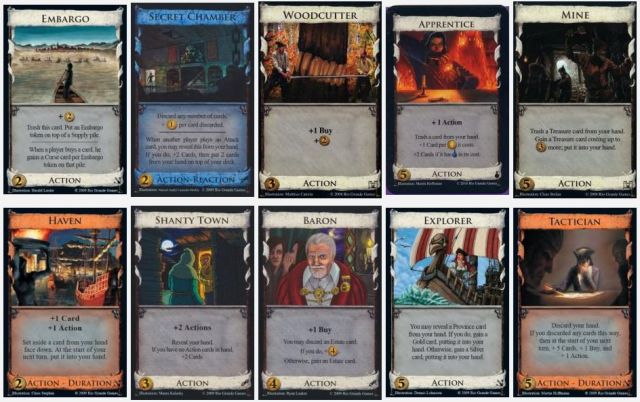
Embargo, Secret Chamber, Woodcutter, Apprentice, Mine,
Haven, Shanty Town, Baron, Explorer, Tactician,
Platinum, Colony

Annotated Game #2

(Click for enlarged version at dominiondeck.com)

This is a 2-player Isotropic game played between me and Mean Mr Mustard.  The log is available here.  Thanks for all the great comments on the preview, as well as all of you who tried the set out on Isotropic. Continue reading

Posted in Annotated Games | 35 Comments

Annotated Game #2 Preview

Below is a recent 2-player game I played on Isotropic, with Colonies and Platinums.  I will post the annotated game on Monday, February 14.  You’re welcome to comment on the set (how you think players should open, what cards to go for) and try it out for yourself.

Embargo, Secret Chamber, Woodcutter, Apprentice, Mine,
Haven, Shanty Town, Baron, Explorer, Tactician,
Platinum, Colony

Annotated Game #2

(Click for enlarged version at dominiondeck.com)

If you have interesting sample games that you’d like to submit for annotation, please submit them via the Contact Us link. Criteria for annotating games include:

  • Reasonably skilled play by both sides
  • An interesting set where the Kingdom cards are important (as opposed to Big Money Smithy games)
  • Diverging strategies taken by both players, especially in terms of openings
Posted in Annotated Games | 68 Comments

Dominion: Laboratory

Laboratory

Dominion

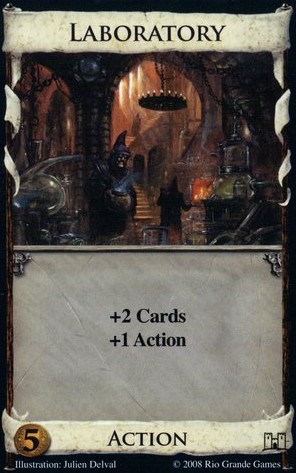
The benchmark against which every other $5 card is measured.  Laboratory was the first Dominion card released with such delicious self-synergy: unlike +Actions/+Cards engines, Laboratory chains can’t sputter because it drew its cards in the wrong order.  And there’s no fine-tuning selection of purchases needed, no need to balance between terminals and +Actions: just spam Lab over and over again. This makes Lab chains easier to run than a Village/Smithy chain, albeit a bit more expensive.

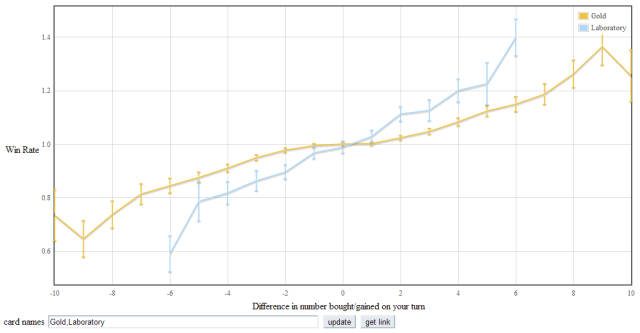
Along with City, Laboratory is one of the few non-attack $5 cards that might be worth buying with $6.  (Similarly, it’s also one of the cards that might make opening with Feast worth it.)  It’s not as important as City or Mountebank or Witch, but you can quickly fall behind if you allow your opponent to grab all the Labs, even if you establish a counterbalancing Gold advantage:

This isn't conclusive, but it indicates that you can't forsake Labs entirely to concentrate on Golds
Graph from CouncilRoom.com

Laboratory is an excellent addition to just about any deck, since almost every deck benefits from increased handsize, and no other non-terminal instantly increases your handsize (other than a Level 2 City, Alchemist, and Wishing Well (sometimes)). But Laboratory is especially powerful in trimmed decks, because its value is entirely tied to your deck’s average card value. At the same time, Lab doesn’t actually improve your deck in a macro sense.  It’s easy to get caught up in a Village Idiot situation, where despite being able to draw your deck, you have nothing worth drawing.  So it’s important to balance your Lab buildup with actual deck improvement if you foresee being able to draw your deck.

In a high-powered Lab deck, you also need some source of +Buy.  Ideally you’d pick up some kind of Market, to facilitate drawing more Labs and use your terminal on an attack instead, but if you see that you’ll be building a Lab chain, and there’s no non-terminal source of +Buy, you can get the need for +Buy out of the way with an early Woodcutter.

If there isn’t +Buy, it’s important not to build too fine-tuned a deck.  It’s no use spending time getting your Lab chain to consistently draw $20 if you can only buy one Province at a time: you’ll likely fall too far behind an opponent whose deck only gets to $10, but got there two turns sooner than you did.

Works with:

  • All cards that work with big hand sizes:
    • Cellar/Warehouse
    • Vault/Secret Chamber
    • Bank
    • Forge
    • Coppersmith
  • Conspirator
  • Market/Grand Market/some other source of +Buy
  • Early trashing, particularly Chapel if you can get it on a 5/2 opening
  • Throne Room / King’s Court

Conflicts with:

Posted in Dominion | Tagged | 42 Comments

The Five Best $4 Cards

Disclaimer: Dominion does a really great job of balancing its Kingdom cards. Pretty much every card has some situations where it shines, and some situations where it doesn’t. Nevertheless, some cards just end up being flat-out better than others, either because they are more useful more often, or just ridiculously good when they are useful. Don’t expect this list to be very scientific.

Choosing the best and worst $4 cards turned out to be quite a bit more difficult than the $3’s and $2’s.  There were quite a few great $4’s, and it took a lot of effort not to have a 10-card “Five Best” list.

Throne Room

Dominion

Honorable Mention: Throne Room

There were a bunch of candidates for this slot: Moneylender, Island, Remodel/Salvager, and even Treasure Map.   To be perfectly honest, you could substitute any of them here (or even in the top 5), and I couldn’t really argue with you.  But in the end, I went with Throne Room, for its Actionlicious combo potential.  The card was only bumped up to $4 at the last minute when Donald X. realized just how ridiculous $3 Throne Rooms could be in a heavy Action deck.   It lost some of its luster when King’s Court came out, especially since Throne Room sometimes leads to trouble when you do something like (Throne Room – Throne Room – Smithy) and then find yourself forced to Throne Room a Trading Post.  But Throne Room’s considerably more accessible price makes it much easier to pick up multiple copies and build lovely headache-inducing Throne Room recursion trees.  It makes certain cards really good (Conspirator, Shanty Town, Steward), and makes most of your attacks ridiculously painful (Sea Hag, Mountebank, Torturer).


Envoy

Dominion: Promo

5. Envoy

Really, this entry is for both Envoy and Smithy, which earn a joint #5 because of their impact on the game’s tempo. The presence of either of these cards gets the clock ticking: Big Money sets a 4-province baseline of ~17 turns, but Big Money + a single Smithy or Envoy cuts that down to ~14.5 turns and is more resilient to attacks to boot. Envoy and Smithy leave an indelible mark on Dominion strategy because their presence holds players to a higher standard: if you can’t get your deck together by that time, you’re going to get crushed.

On their own, of course, they’re also great, being the center of most +Actions/+Cards engines. Envoy gets the nod over Smithy, though, simply because the discard is usually not that big a deal compared to the benefit of drawing an extra card.


Caravan

Dominion: Seaside

4. Caravan

Pretty much the greatest cheap +1 Action / +1 Card in the game.   The appeal of this is absolutely obvious and incredibly easy to spam.  It makes cards like Ironworks and Talisman (almost) worthwhile: you can’t win by loading up on early Spies or Wishing Wells, but you can definitely win with a monster Caravan stack.   It’s especially nice with something to take advantage of your next ultra-turn (Bank, Forge, Vault), but there’s never anything wrong about increasing your handsize.


Militia

Dominion

3. Militia

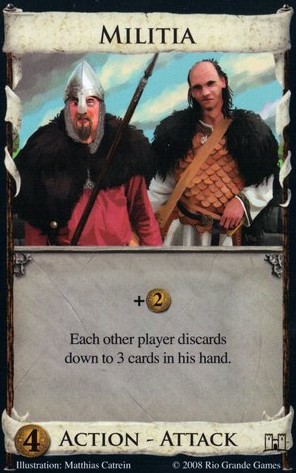
In the base game, Militia was second behind Moneylender as the best $4.  But with subsequent expansions and more trashing ability, Moneylender has slipped behind Militia in many sets.  In the absence of trashing, I might still take Moneylender over Militia, but as a concession to my multiplayer readers (apparently some people play Dominion with more than 2 players!  Who knew?), Militia is a devastating opener, especially for those ahead in the turn order.  It dramatically changes the pace of the game, turning the first few turns into painful slogfests as players struggle to get to $5 and $6.  And it’s especially gratifying at the end of a Council Room chain.


Bishop

Dominion: Prosperity

2. Bishop

Usually cards that give benefits to your opponents are really, really powerful.  Bishop is no exception, and has the added benefit that its opponent-friendly effect goes away quickly after early game, especially in the presence of strong trashing.  In exchange for providing your opponent some minimal trashing, the typical Bishop will net you at least a Province’s worth of free VP chips.  You can build ridiculous five card decks with it (Bishop/Gold/Gold/Gold/Province), you can use it to dramatically exploit Quarry and Peddler‘s cost changes, or you can use it to grind up the crap that the Goons bring into your deck.  It’s a potent scoring card, and one of the most underrated openers.


Sea Hag

Dominion: Seaside

1. Sea Hag

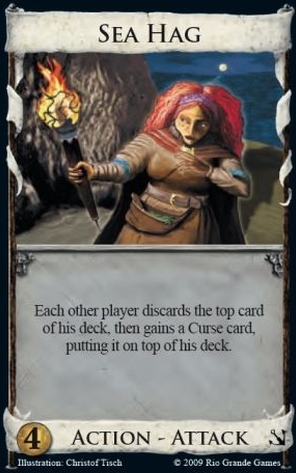
I think $4 is the cheapest a Cursing attack could conceivably be, since opening with two Cursers seems like a ready-made recipe for a degenerate games.  As it stands, Sea Hag is already a near must-buy (especially in multiplayer games); without an easy way to trash the top of your deck (Upgrade, Lookout), its Cursing attack is the most powerful in the game.  It’s a god-awful card once the Curses have been handed out, and the only “dead-end” $4 card (providing zero benefit to your own deck), but its attack is so strong that like Ambassador, you pass it up at your peril.

Posted in Rankings | Tagged , , , , , , | 47 Comments

Introducing CouncilRoom.com: Dominion Statistics

Statistical vindication of Beyond Silver

When we asked you, our readers, what you wanted to see, at least one of you wanted more numbers.

As a numbers kind of guy myself, I’ve been hard at work scraping and parsing the Isotropic Dominion logs. Without further ado, I present CouncilRoom.com: Dominion Statistics.

The site has four main features:

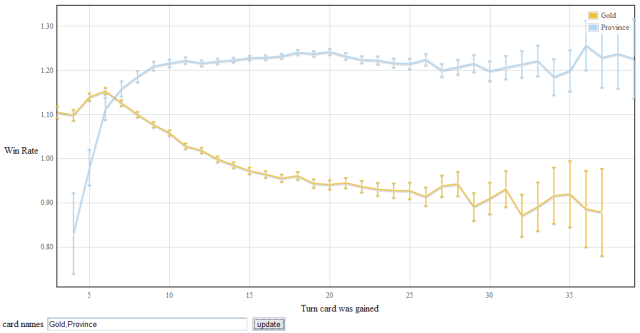
First, we have graphs of the turn a card is purchased versus its winrate. For instance, as demonstrated in the picture above, buying non-terminal +1 Action/+1 Cards is indeed superior to buying Silver, starting as early as Turn 5. Or you can see that buying Province starts to be better than buying Gold as early as Turn 7:

Province beats Gold

On the other hand, the Turn 4 Province turns out to be a losing move. Who knew?!

Second, graphs of card advantage against winrate. For instance, you can see that having a Minion advantage over your opponent(s) substantially increases the likelihood that you’ll win, much more so than having a Market advantage (or even a City advantage):

Minion beats City

Why the race for Minions matters

As you may have noticed, the query field supports some logical operation syntax. Currently, the supported operations are:

  • && and || (AND and OR operators, with parentheses support)
  • Comparison operators (>, <=, and ==)
  • Cost (e.g., “Cost==7” returns Bank, Expand, Forge, and King’s Court)
  • Actions (e.g., “Actions > 1” returns all +2 Actions cards)
  • Cards (e.g., “Cards <=1" returns all cards that draw at most +1 Card when played)
  • Action/Treasure/Victory (e.g., “Treasure && Victory” returns Harem)

Third, player pages, which contain the player’s game history sorted by opponent.  It even accounts for the mess that the BGGDL inflicted on players’ usernames.

Finally, a game search page, for finding games based on players and Kingdom cards.

I realize that this is just the tip of the iceberg of what is possible with this data.  So far, I’ve only generated the two graphs above, but I’d love to hear your suggestions and have you rank ideas on the CouncilRoom.com UserVoice page.

For programmers among us, the source code is open and available. Even if you aren’t interested in the code, I could provide a parsed representation of the log data for your own purposes.

There’s much to be learned from all this data. I’m very excited about introducing even more of these kinds of insights on the Dominion Strategy blog: I’ll be supplementing theory’s articles with interesting statistical analyses. Stay tuned!

Posted in Dominion Stats | 48 Comments

The Five Worst $4 Cards

Disclaimer: Dominion does a really great job of balancing its Kingdom cards. Pretty much every card has some situations where it shines, and some situations where it doesn’t. Nevertheless, some cards just end up being flat-out better than others, either because they are more useful more often, or just ridiculously good when they are useful. Don’t expect this list to be very scientific.

Choosing the best and worst $4 cards turned out to be quite a bit more difficult than the $3’s and $2’s.  As it turns out, none of the $4’s are actually all that bad: the vast majority are just specialized (Coppersmith, Scout, Navigator), and it’s hard to fault something like Coppersmith if you’re not pursuing a Coppersmith strategy.

Thief

Dominion

Honorable Mention: Thief

As a devoted 2-player gamer, I admit that I’m prejudiced against this card.  Depending on your point of view, Thief either scales very well with more players, or very poorly with fewer.  It’s nigh-useless in 2-player games, but absolutely devastating in 4-player Chapel games.  Still, even in a multiplayer game, no other attack that carries such a risk of no gain to yourself and significant gain to your opponent.


Treasure Map

Dominion: Seaside

5. Treasure Map

If you love games being decided by shuffling, then look no further than Treasure Map.  If it appears with an enabler (Steward, Loan, Chapel, Warehouse, Talisman/Watchtower, etc.), then both players are essentially locked into letting a random number generator decide their fate.  If there aren’t any enablers for the Treasure Map, passing on them is the right call, but sooner or later you will lose games you should have won due to unassisted Treasure Maps.  No other card in the game (with the possible exception of an early King’s Court) has such a dramatic dichotomy between luckiness and unluckiness.


Ironworks

Dominion: Intrigue

4. Ironworks

Both Workshop and Ironworks suffer from the same problem: you’re spending an Action and space in your hand to get more non-essential cards.  Ironworks is slightly better than Workshop, but not really by much; unless you’re grabbing Great Halls, even a non-terminal Ironworks takes up a valuable slot in your hand.


Talisman

Dominion: Prosperity

3. Talisman

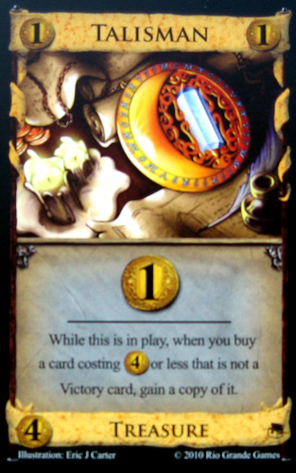
OK, so it gives you cheap cards and more cheap cards. But you rarely want that many cheap cards, even if they’re all non-terminal.  It works great with Gardens or Quarry (EDIT: and Bishop), but otherwise there’s no point to set up amazing Village/Smithy chains if you don’t have any money to go with it.  And if you draw it with $6, you’re forced to choose between either wasting a $6 buy on a Caravan, or reconciling yourself to the fact that you bought an expensive Copper.

That having been said, it is occasionally viable to build a deck concentrated on $2-$4 cards (typically including Fishing Villages, Caravans, and/or Bridges).  But remember that spending this much time on building Action combos is a risky proposition, since you might get brute-forced by Big Money before you have a chance to activate.


Cutpurse

Dominion: Seaside

2. Cutpurse

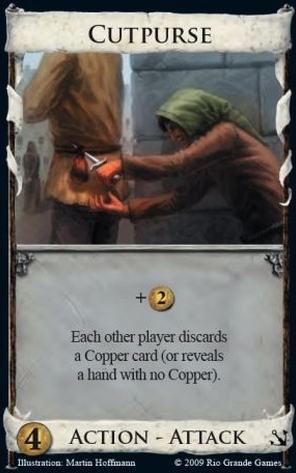
A solid opener, and that’s about it.  Theoretically it combos with Torturer and Masquerade, but Militia and Goons are almost certainly more effective for cutting handsize at the Action-combo point of the game.  It’s not a bad opening card—I’ve even seen players successfully double up on it on Turn 3, leading to a pretty miserable game all around.  But I’ve never seen anyone pick this up past Turn 4.  The fact that it dramatically exacerbates the first-player advantage is another point against it.


Bureaucrat

Dominion

1. Bureaucrat

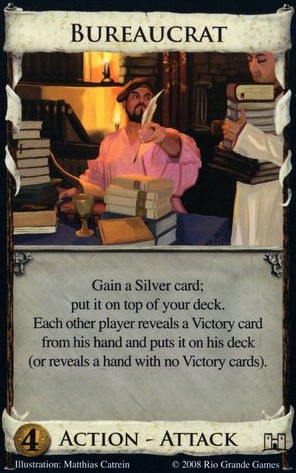
One of the most perplexing cards.  Its attack is much tamer than Ghost Ship, and its non-attack benefit is … well, there’s a limit to how many Silvers you really want.  About its best use is if you’re making a beeline for Duchy/Duke, but even then its terminal nature makes it a really hard sell.  And other than Dukes, I can’t really think of anything that Bureaucrat “combos” with.  Venture comes closest, but Venture also happens to be the perfect counter to Bureaucrat’s attack.  It might be valuable in a multiplayer game where you know you’ll be mired in Curses and Coppers for a long time, but even then you’d probably rather be Cursing instead of playing Bureaucrat’s piddly attack.

This is usually the point where I say that it’s only worth it if there are no other worthy terminals, but honestly, I wouldn’t recommend Bureaucrat even then.  Clogging up your deck with Silvers is really a losing proposition, and playing half a Ghost Ship on your opponents doesn’t nearly make up for it.

Posted in Rankings | Tagged , , , , , | 68 Comments

Annotated Game #1

(Yesterday’s preview)

Secret Chamber, Warehouse, Caravan, Mountebank, Harem,
Smugglers, Watchtower, City, Saboteur, Peddler

Caravan, City, Harem, Mountebank, Peddler, Saboteur, Secret Chamber, Smugglers, Warehouse, Watchtower

(Click for enlarged version at dominiondeck.com)

This is a BGGDL game played between me and yaron.  The log is available here (spoiler alert!).

Yaron is an excellent player; I’ve played him enough to identify unique characteristics of his playing style.  I won’t share these on such a public forum, but suffice it to say I can’t expect him to make obvious mistakes. Continue reading

Posted in Annotated Games | 35 Comments

Annotated Game #1 Preview

Thanks to everyone who commented on yesterday’s post!  We’re still open to more feedback, of course, but since one of the top requests was for individual game annotations (combined with some analysis of kingdom sets), let’s start with that.

Below is the Kingdom set for a recent 2-player BGGDL game I played on Isotropic.  (No Colonies or Platinum.)  As suggested by susie, I’ll be posting the set today and analyzing the actual game tomorrow.  You’re welcome to comment on the set (how you think players should open, what cards to go for) and try it out for yourself.

Secret Chamber, Warehouse, Caravan, Mountebank, Harem,
Smugglers, Watchtower, City, Saboteur, Peddler

Caravan, City, Harem, Mountebank, Peddler, Saboteur, Secret Chamber, Smugglers, Warehouse, Watchtower

(Click for enlarged version at dominiondeck.com)

If you have interesting sample games that you’d like to submit for annotation, please submit them via the Contact Us link.  Criteria for annotating games include:

  • Reasonably skilled play by both sides
  • An interesting set where the Kingdom cards are important (as opposed to Big Money Smithy games)
  • Diverging strategies taken by both players, especially in terms of openings
Posted in Annotated Games | 25 Comments

Looking ahead

We’ve decided to take a moment to ask the readership what you would like to see more of on the blog. General strategy posts, more card analyses, guest articles, annotations of sample games, or anything else — just let us know in the comments! We greatly appreciate the feedback all of you have already provided, and hope to make the blog even better in the future.

Posted in Uncategorized | 51 Comments

Guest Article: Chancellor

This article is written by Drew Hardin.
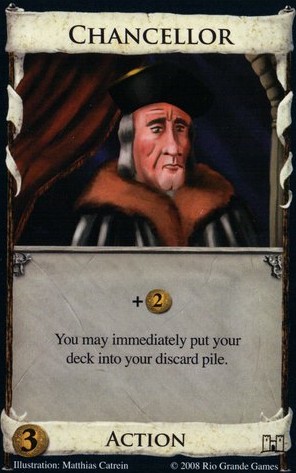
Chancellor

Dominion

This article will discuss the Chancellor. The Chancellor is commonly (but not completely) viewed as a weak card. The most common arguments are that the card is highly situational and the benefit of the card power is marginal. I will attempt to refute both claims and propose how the Chancellor can benefit your strategy.

Issue #1: Is the Chancellor situational?

Yes. Chancellor is one of the cards that you should use only in certain situations. In this sense the reputation is deserved. However, I would point out that most cards are situational and should only be used in specific situations. If anything, the sign of a truly powerful card is the ability to use it in almost every situation. Chancellor is simply not one of those cards. Very few $3 cards are useful in all situations.

Issue #2: Is the Chancellor benefit marginal?

This is where I disagree. Chancellor’s power allows a player to immediately cycle the draw deck into the discard pile regardless of the number of cards in the draw deck.  In practice this power can be very useful.

Issue #3: The Chancellor power requires lots of memorization.

Simulation data suggests that using the Chancellor power each time you play the Chancellor is only marginally weaker than making an optimal Chancellor play. Most of the benefit of the Chancellor comes from using the power.

Issue #4: The Chancellor is highly random

Yes. The card is random. If you draw it early it is much better than drawing it late. Then again, most cards have this problem to some degree. Drawing Silver Copper Estate Estate Estate is a bad draw on Turn 3. If you worry about drawing a card at the wrong time then Dominion is going to make you miserable. The Chancellor power is about using the card to the maximum when the situation is in your favor (such as drawing Chancellor Silver Copper Copper Estate on Turn 3) and avoiding the problems when the situation is not in your favor (such as drawing Chancellor OtherTerminalAction Estate Estate Estate on Turn 3).

Using the Chancellor Effectively

To understand how to use the Chancellor it is helpful to understand why the power is useful. There are three features of the Chancellor power that are important to incorporate into your play.

The first feature is fairly obvious. Early in the game when you buy almost anything your best cards are now in your discard pile. The Chancellor gives you the opportunity of putting those cards into your draw deck on your next draw.

The second feature is less obvious. When you buy a very good card (a good VP card late or a powerful $5 or $6 card early) you have often used up more of your good cards than bad cards. This is especially true very early in the game when you only have 1 or 2 cards granting Coin.  It would be best to get those cards back into play.

The third feature of the Chancellor is the optionality of the card. You don’t have to use the power unless you desire. If you feel that your draw pile is better than your discard pile you can skip the power. The card is a may, not a must. You gain the benefit but can avoid the negatives.

Buying a Chancellor is essentially taking a gamble. In essence you are replacing a safe Silver purchase for a risky Chancellor purchase. The Chancellor has the same +2 Coin value as Silver but requires an Action to gain the benefit while the Silver does not.

Simulation evidence suggests that buying a second Chancellor is of minimal value (an exception may be the Chancellor/Stash)  so more often than not you are faced with only one question you must decide:

Should I buy the Chancellor instead of my first Silver?

Phrased differently, the question is really:

Is the benefit of using the Chancellor greater than the risk of drawing the Chancellor and not being able to play the Terminal Action?

If the answer to this question is yes then buy the Chancellor instead of the Silver. The problem is determining if the answer is yes or no.

The benefit of the Chancellor buy is simple. Each time you play the Chancellor the next time you draw cards you get a reshuffle. Most of the time this means that if you use the Chancellor as the last action of the turn all the cards you just bought (and used that turn) are back in the draw pile and may be redrawn immediately.

In a perfect scenario you draw the Chancellor and your best cards on Turn 3. Then you draw the Chancellor and your best cards on Turn 4. In 41.7% of the openings the Chancellor will appear on Turn 3. If the power is then used to purchase a card it will appear again on Turn 4 38% of the time. In roughly 1 in 6 of your games you will have used the Chancellor power twice. If you draw the Chancellor on Turn 4 your new purchases will be one of the five cards you draw instead one of the three cards you draw after you draw the last two. Simply put, the Chancellor is an accelerator. It puts the cards you buy early into play faster.  The key to the acceleration is the possibility of getting the Chancellor early.

The weakness of the Chancellor is the possibility of drawing the card as the terminal Action with another terminal Action. This is a very real problem and not a desirable outcome. However, the Chancellor is unusual in being able to reduce the impact of this problem. When the happens if you use the Chancellor power the Action Card you skipped this turn will be available to draw immediately instead of waiting another cycle to play.

Another weakness commonly stated about the Chancellor is the Chancellor has few combo cards (though the Counting House and Stash both benefit from putting the draw pile into the discard).  This is true in the sense that the Chancellor rarely combines with any other $3 or $4 card (though Chancellor/Mining Village has an excellent chance of getting a good card early). For this reason the Chancellor often combines with an opening buy of Silver. This opening has been discussed elsewhere.

The Chancellor/Silver opening may not be sexy but it is a stronger opening than many others. The idea behind the Chancellor/Silver opening is to combine the Chancellor with the cards it works best with. The Chancellor combines just fine with any strategy that relies heavily on +1 Action chains or that uses  the powerful +2 Action $5 cost cards. In essence the Chancellor is about bypassing the early weak cards in favor of an accelerated $5 and $6 card buying spree.

So, the Chancellor is a card that produces a key early acceleration, sustains a middle game acceleration but risks costing you a key terminal Action at a bad time.  The problem can be entirely mitigated by simply not buying a second terminal action. Sometimes you need to buy a second terminal action. So, what are the options for mitigating the problem and maximizing the benefit?

First, in some situations the Chancellor should be avoided entirely. The power of the Chancellor is increased in games where trashing is difficult or impossible. The ability to cycle becomes important in these games. The power weakens in heavy trashing games where the power is not needed. In general the Chancellor combines poorly with pure trash cards like the Chapel but does fine when used as part of a ‘trash for value’ strategy like the Salvager, Forge or Upgrade.

The Chancellor performs poorly when combined with terminal actions that draw cards, such as the Smithy, Council Room or Torturer and you are weak on +2 Action cards. In these situations you would rather have drawn Silver.

The Chancellor performs well with any strategy that is heavy on Coin and makes heavy use of non-terminal Actions. Since most of these cards cost $5 or $6 it synergizes well with openings that early  emphasize Coin (such as the Chancellor/Silver).

The impact of attacks on the Chancellor is mixed. Like most Coin heavy strategies discard attacks are a problem. The Chancellor defends well against Treasure stealing attacks such as the Thief and Pirate Ship. The Chancellor cycling ability helps minimize the impact of Curse based attacks by making use of variance to allow you to buy Provinces (or Colonies) with lucky draws then immediately put your best cards back into play.

Summarizing, the Chancellor is a card that plays well in setups where early acceleration through high Coin mixes well with solid $5 and $6 cost cards. The card is basically a replacement for a Silver buy that attempts to speed up your development by taking advantage of early draws and decent card buys.

Posted in Dominion, Guest Articles | Tagged | 13 Comments