Interview with Donald X. Vaccarino, Part II: Dominion

This is Part II of a three-part interview with Donald X. Vaccarino, covering Dominion, Dominion hindsight, and alternative Dominion cards.  Questions and answers are collected from this forum topic.

The Game of Dominion

Tables asks: “Suppose a new player just got the base game for Christmas, but wants to get an expansion immediately because they love the game. Which expansions would you recommend?”

I specifically made Intrigue to be the first expansion, and saved Prosperity for 3rd (4th because Alchemy got pushed ahead) so that you had time to get used to not having Colony before getting it. And then the sets get more complex later. So you might think I would just say, go in order, shifting Alchemy to last. However! I feel like I got better at making sets as of Seaside; the main set and Intrigue both have a greater number of uh weak / narrow cards. So I would say, get Seaside.

theory asks: “What is your personal favorite Dominion card and why?”

In Magic psychograph terms I am a Johnny; I like to have unique experiences in games, to be creative. A lot of my favorite Dominion cards involve exotic experiences and combos. Overall my favorite is Rats, from Dark Ages. You give your kingdom a Rat problem and then somehow this works out for you. Dark Ages is my favorite expansion, and it’s because of all the various ways it gives you an exotic deck or crazy combo.

Ozle asks: “Was Rats always your favourite card?”

No, Rats does not even predate me showing the game to RGG.

It was a while before I felt like I had to consider what might be my favorite card, and your tastes change over time. In the early days I was especially fond of Pawn and Upgrade.

Schneau asks: “Have you looked at the Dominion memes thread? If so, do you have a favorite?”

I have read that thread. My favorite is easily the Baron one – “I don’t always discard an Estate, but when I do, I gain $4.” Man it looks just like that guy.

ConMan asks: “Out of all the Dominion cards so far released, what is your favourite interaction – combo or nombo – between two or more of them?”

I already failed to answer this question. I will list a random interaction for each large set.

Dominion: Thief / Gardens has a certain charm.

Intrigue: I will stick with, Swindler / Silver. You couldn’t possibly give me a Swindler, they’re so terrifying.

Seaside: I am going to cite Smugglers / Pirate Ship. You open with Smugglers. You draw it and on their turn they buy Pirate Ship. Man. I don’t want a Pirate Ship. Man. Urhrhrhr. Smuggle Pirate Ship, buy a Pirate Ship.

Prosperity: I am big on Worker’s Village / Peddler.

Hinterlands: I have opened Develop / Spice Merchant so many times.

Dark Ages: Fortress is a pretty fun defense against Knights.

SirPeebles asks: “What was your reaction when you first heard fans talk about “the Silver test”? Do you feel that Big Money strategies are too strong in base Dominion, and was that a consideration at all when you put together the flagship set?”

I’m not sure I would put it like that – more like, when I first heard a non-fan talking about it. I thought, lol. It’s pretty obviously stupid and while it’s good to realize “hey maybe buying a terminal action every turn won’t work out,” that obv. doesn’t mean the game is broken. Dominion clearly survived that nonsense and so much for that.

I think base Dominion could have better replayability/variety via swapping out some of the duds for more interesting cards. That would also make more-interesting decks better; a bunch of decks where you play just 1-2 terminals plus money is not as much variety as, you know, not that. But I would be changing it for the variety issue, not due to wanting to hurt heavy money strategies.

Heavy money strategies were not a consideration for picking the cards in the main set. Being simple enough was the main concern, followed by, variety. It did well on simplicity, probably it could have been slightly less simple. It wasn’t going to have as much variety as when you add an expansion, but it could have had more variety.

Silver isn’t awful, and the game has this “only play one action per turn” rule. Those both seem like good things, but together they lead to, sometimes you can do well without many actions. Not playing many actions is just one of the basic solutions to only being able to play one per turn. There are other solutions though, and the main set has them: I can play lots of +1 action cards like Lab, I can play Village and more terminals, I can play Remodels and Remodel Remodel, I can go for Gardens and just live with lots of terminals.

aaron0013 asks: “Is Seaside your second favorite set?”

Comparing just the large sets, I like Dark Ages best, then Hinterlands, Prosperity, Seaside, Intrigue, Dominion. They are just strictly in order from worst to best. The biggest gap is between Intrigue and Seaside though; from Seaside on they’re all so good that who cares which set is better. I’ve had plenty of fun with Intrigue and Dominion but for sure there’s room for improvement there.

It’s hard to fairly compare the small sets to the large ones (or Dark Ages to normal large sets). I like Cornucopia more than Alchemy. I like Alchemy though, I am no Alchemy hater. I probably like Guilds best, but it’s close.

Powerman asks: “How many games of Dominion would you guess you have played?”

Man. Well, in the thousands. IRL I must have played at least 3K games; it’s hard to estimate because any given game night may have involved other games. There are 3600+ posts in playtest forum threads for posting results from playing online; they aren’t all games and I’m not in all of them, although a lot are and I’m in a lot of them. That doesn’t cover all online games, just from Cornucopia on (I had a bad online version when working on the main set).

WanderingWinder asks: “What goes in to writing those flavour paragraphs?”

For the main set, they had an awful “impress the king” thing they put in as a placeholder. Man. Impress the king. You don’t need to acquire land to impress anyone – it’s its own reward. So I wrote up a replacement intro, which then got hacked up to be less conversational and therefore slightly less funny. It was still better than what they’d had so okay (the later ones mostly escaped editing).

For Intrigue I thought, oops, now I have to write another funny intro. I wrote it very quickly though, it was effortless.

For Seaside I sat down to work on a list of jokes to turn into a paragraph. You can see that in detail at http://forum.dominionstrategy.com/index.php?topic=124.0

For Alchemy I again worked on a list of jokes. It didn’t turn out as well as I’d hoped, but people seemed to like the main jokes, phew. For Prosperity, another list, this one turned out well. The baklava statue was originally a piece of pumice that looked like the pope, but not enough people got that joke. For Cornucopia I didn’t do as well and then Jay cut the jesters fighting to the death, which was one of the main jokes. The roast hay doesn’t carry the paragraph but well it turns out these things don’t loom large in my life afterwards, hooray.

For Hinterlands I wrote down, “The world is big and your kingdom small,” fitting the faraway lands theme, and then immediately thought of a joke from one of my screenplays, that started, “It’s a big city out there, and we’re little people. I mean little when compared to the city…” So I just copied that with the words changed, and the rest was easy except for what concept exactly for them not even to have a word for, which I picked a day or two later, although I think mamihlapinatapai was immediately in the running.

For Dark Ages I wrote one paragraph the usual way. It wasn’t as good as I wanted and I wrote a completely new one, then merged them.

WanderingWinder asks: “What gave you the idea for doing secret histories?”

There was a BoardGameNews preview of Dominion. I was asked a bunch of questions, but whereas most people would just post my answers, W. Eric Martin kind of hacked it up. There would be one sentence quoting me, and then two sentences describing what I said. This made it a little less accurate, but I corrected the thing I cared most about in a comment on it, and hey W. Eric has to have fun too. Anyway that article was about the game and he also asked about the outtakes (which I barely said anything about), but it didn’t cover the cards in the set. And there was stuff to say there. So I wrote up an article and posted it on BGG, which didn’t have an article.

These days BGN is no more, and BGG has “designer diaries.” I stuck with the Secret Histories though. I feel like they’re plenty visible to the people that want to see them, and I don’t want to be too in-your-face with them.

Hindsight is 20/20

HiveMindEmulator asks: “Besides specific card changes, is there anything you would have done differently in Dominion development if you had it all to do over again?”

I would probably change how reactions work, actually to make them how they originally worked, which is, you play them at special times (so, they end up in play). This would have been simpler, and better for like everything but Moat, but Moat was the main set one and so I warped them to make Moat better.

werothegreat asks: “If you could go back and edit any Dominion cards, knowing what you do now, which would you and why?”

Fortunately there is an essay about this already, which you can see in the dominionstrategy.com forums. http://forum.dominionstrategy.com/index.php?topic=3179.msg56362#msg56362

Piemaster asks: “Other than Chapel are there any cards that, with hindsight, you either regret making completely, or at least regret publishing in their current form?”

I do not regret Chapel. There is an essay where you can see what I’d change: http://forum.dominionstrategy.com/index.php?topic=3179.msg56362#msg56362

Overall the card I most regret printing as-is is Scrying Pool; I’d rather it didn’t Spy. The card that I could change for the greatest positive effect through would just be any dud card in the main set, being replaced by anything good that isn’t too complex.

Tables asks: “If you could go back in time and redesign which cards were in which sets, and the order the sets came out (but not changing/adding/removing any cards), what would you move and why?”

Obviously the move is to put all of the worst cards in the last set and then not release it. The sets aren’t full of duds so it would be a small set. A few worthwhile cards would be left out but what can you do. This is still the move if it has to be published, I mean I am not here to make people buy awful stuff, and putting it all together is the best I can do to let you dodge it in this scenario. Then of course the main set, well it doesn’t want all the best cards, but it wants the best simple cards. It matters more than any of the other sets and for sure could be better via swapping cards. I would replace Chancellor, Woodcutter, Feast, and Spy with more interesting cards, giving the main set more replayability. Lots of cards would be good enough.

For set order I like going Intrigue, Seaside, Prosperity – set trying to be a good first set, generally good set, set that adds Colonies. I would put Alchemy last, where it was; it was there because I knew some people wouldn’t like potions, because somebody hadn’t. You could swap Hinterlands with Seaside but I wouldn’t. After Prosperity then there are Hinterlands and Dark Ages to order and well you have the question from before of whether or not Hinterlands is a standalone. I like having another standalone, and if it is one then I would put it ahead of Dark Ages. Possibly I would anyway. A question is, do you recombine Cornucopia and Alchemy. If people don’t like Alchemy then it’s nice that they get a tight package of just it, rather than buying it to get Cornucopia or passing on Cornucopia because of it. So possibly it’s worth keeping them separate. Large sets are better though, so either expand Cornucopia and Guilds or combine them. That’s another decision to make before knowing what order to put them in, but Guilds wants to be near the end due to complexity. If they’re not one set then large Cornucopia could go between Prosperity and Hinterlands still, uh depending on how it turned out.

Alternative Dominion Cards

eHalcyon asks: “Similar to the above — do you ever look at fan cards? If so, do you have a favourite?”

I don’t usually look at them, because

  1. I don’t want people feeling like I’m taking their ideas, which probably I had years ago, not because I am amazing but because the obvious ideas are obvious and I had a big head start; and
  2. the cards that aren’t in sets already are usually awful, nonstop things I wouldn’t do that are boring and redundant or else obviously bad for the game in some way, and if it’s not obvious then I already tried them and found out the hard way. At best they are things I’m already doing; none of it is good reading.

Let’s do an experiment, I will look at the first four cards of “Books of Magic“, the first listed fan expansion at BGG. I am looking at the first four images sorted the default way (“hot”), skipping the big image of a card sheet.

Ghost Town: My first version of this was called Fool’s Gold and was “+$2. Put this card into your hand.” That turned into a card that gave you +$2 and an extra +$2 for each unused action you had when you played it, then +$1, then I made it into Diadem.

Book of the Dead: Getting something from the trash and saving a card for next turn were the two most suggested card premises ever (prior to those cards being published), followed maybe by a reaction to punish attackers. This card manages to put the card on your deck like Graverobber does, but of course is missing the crucial “provide a way to get stuff into the trash that you’ll want” part.

Fairy Gold: The first version of Feast was this only with +1 Action, for $4. It was too strong and turned into the Feast you know. I eventually did a one-shot Gold that you can’t buy, with Spoils.

Gravedigger: I haven’t actually done giving yourself a Curse in a published card, although Death Cart gets close. I tried multiple cards that gave yourself a Curse; everyone hated them. Death Cart dodges the problem by giving you a use for the Ruins.

So, four-for-four, nothing new or interesting here. Sorry Books of Magic guy, it was just an example.

Sir Bailey made Courtyard, but he managed that because he showed me his homemade cards when I didn’t have that many homemade cards of my own yet. Even so I had already done “+2 cards +1 action, put 2 cards from your hand on your deck,” but abandoned it because it played so slowly. Dame Josephine similarly managed to get Counting House in relatively early on.

I will cite two favorite fan cards though.

As I said most are awful. The stand-out awful card, the epitome of awful fan cards, was one called Locusts that read “each other player discards a Gardens.” First the guy of course must have meant “trashes a Gardens card from his hand” but blew it and ended up with the most useless thing ever. If he had gotten it right then it would still be crazy awful. He started with the flavor of “locusts destroy plants” and did not think of “wait you have to want to play the card though.” The old Magic expansions Legends has stuff like this, where they made flavor-based stuff and just did not consider, why would anyone play this.

There has been to date exactly one card I saw where I thought, hey, cool idea. It was something like, “when you gain this put it in the discard pile of the player to your left; at end of game worth 2 VP for the player to your right.” I have done hot-potato cards that did not work out and probably this would fail for the same reasons, but still, neat idea.

michaeljb asks: “Adding on to other fan cards questions…Agricola Gamers Deck was designed by fans. Is there any chance of something similar happening with Dominion, perhaps using the Mini-Set Design Contest hosted by rinkworks as a starting point?”

Unlikely. If there was something good enough then maybe a single promo.

The main issue is, aside from me wanting to be the guy and getting to, that I also want to ensure a certain uh level of quality. If there were a fan-made set I would have to playtest it endlessly. Man. I’m busy. And as I’ve noted I don’t expect there will be awesome fan-made stuff to do; if there is any cool stuff it will be complex. If I had to do a complex set I would just make one myself.

You could instead hope for some other famous game designer to make a set sometime. Tom Lehmann had an idea for one although I never heard what it was. Again I would need to playtest any such set and am not keen to, but it’s at least more likely than a fan set.

Schneau asks: “How many Dominion cards do you think you have come up with, including different variations on the same card that were at least considered and maybe tested? Do you have a spreadsheet to keep track of them all, so you can record things like “reaction that hurts attacker | bad idea” and ideas for possible future promo cards, etc.?

There is an old ideas file, which has lists of ideas sorted by card type. I guess there’s an even older file that I turned into this file. Ideas are sometimes marked with a rating, + for good, . for okay, – for bad; this doesn’t reflect testing, just, how much do I like this idea. Some things have a comment in brackets after them, sometimes reflecting testing. Let’s peek at the first five things on the discard-attacks list.

. att: each other player discards silver
. att: name treasure. each other player discards it [strong at 5]
. reveal top. if not silver, each other player ebbs. gain top silver. [multiplayer cumulativeness]
. if another pl. has < 5 cards, do x. otherwise, they discard.
each pl. looks at left's hand if they have 5+ cards, chooses a discard

As you can see I tested one of those, although I don’t think I printed out anything for it. “Ebb” means “put from hand onto deck” – after the Magic card Time Ebb. “Do X” is of course a placeholder to just show off the actual idea; similarly most cards would also make +$2 or something; that isn’t the idea part.

There are just 21 things on that particular list, plus a list of general approaches at the top. The file is 58K and also includes lists of general mechanics. These lists have been combed over; there are probably a few things that would be okay in there, but you know, the discard-attacks list, those are the 21 variants I passed over in favor of better ideas.

Then each set has a file, with ideas specifically for that set, and a list of the set as it stands at the top, with some notes on what cards fill what roles. For example for Dark Ages, the original list of ruins ideas is:

junk possibilities
 - +1 action / +1 buy / +1 card / +$1 (ruined village / market / library / abandoned mine)
 - look at top 2, may discard them (survivors)
 - pass this left
 - gain a copper / gain a card costing up to $2 / gain a card costing up to $1
 - blank / trash this
 - draw up to 4
 - +1 card, -1 card
 - action cards cost $1 less this turn
 - worth 1 vp per 5 ruins in your deck

In that list the minuses are just for indenting, not passing judgment. Later I considered a few other things, including “play up to two ruins cards” for Ruined Village, but they aren’t on this list. The initial five worked out so there wasn’t a lot more work there.

The Dark Ages cards file is 59K (distinct from the file with the secret history and such). It is just an endless sprawl of card ideas, with some to-do list items like “fit in a 3rd spoils card.”

Finally there are the image files. Dark Ages has 30 pages of card images to test (9 cards per page), plus full versions of the sets that sometimes include cards not on the other pages, especially the older ones when I wasn’t saving everything yet. It is hard to meaningfully count those pages; it’s 36 pages, not counting the original 3 page version or the brief 2 page version, but most of that stuff is redundant. And of course most of the images are things in the Dark Ages text file.

I am looking at the 4th page of Cornucopia images, which was the first page without a version of a card from Guilds. It has:

  • Three versions of Horn of Plenty, two of them actions.
  • Two version of Wandering Minstrel that may appear unrelated to it (it started out +$2, name a type, dig for one and leave it on top).
  • Two random cards that didn’t make it – “gain 5 silvers minus a silver per card in hand” and a thing that made other players ebb a card if they had any duplicates in hand.
  • A precursor of Harvest that drew the non-duplicates in your top 5.
  • Horse Traders but called Foreign Traders.

I flirted with posting the image, but man let’s save that stuff for after Guilds is out, not have any slip-ups.

Not every version of every card makes it anywhere though. I say, “this game, this card will be different,” and explain what I want to test and we test it. Maybe it works out and gets an image and more testing; maybe I’m immediately done with it. Maybe it seems promising and I change the cost and we try that, but the original cost is never in a file. You know.

I do not know how many cards ideas I’ve had, but there’s some of the data I’d be looking at to guess that number. For a normal game I make maybe twice as many cards as end up in the game (distinct cards, rather than slight variations or wordings fixes or what have you). Like, for Nefarious, there were about twice as many twists tested as were used. I pared it down a couple times. There would also be a list of twist ideas I didn’t try, however many, I’m not checking. For Dominion the numbers are higher; some cards just have one version, but some have 10 versions, and for any idea there are probably lots of ways you could do it that would be fine, and you can list them and consider them, but once you commit to one then the others aren’t so interesting anymore.

Posted in Uncategorized | 3 Comments

Interview with Donald X. Vaccarino

Donald X. Vaccarino

Over the holidays, instead of card articles, we’ll be posting an interview with Donald X. Vaccarino himself.  Donald has been graciously answering many questions from the forum community, and we’ve selected the best of them to publish here.

We’ll post the interview in multiple segments:

Part I: Designing Dominion; Designing Boardgames in General

Part II: The Game of Dominion; Hindsight is 20/20; Alternative Dominion Cards

Part III: The Future of Dominion; Other Boardgames; Donald X. himself

If you have questions you’d like to ask the great designer, feel free to ask away!

Posted in Uncategorized | 3 Comments

Interview with Donald X. Vaccarino, Part I: Boardgame Design

This is Part I of a three-part interview with Donald X. Vaccarino, covering the design of Dominion and boardgame design in general.  Questions and answers are collected from this forum topic.

The Design of Dominion

theory asks: “At what point during the process of making Dominion did you realize that it was not just any other board game, but one that was going to be a really special game?”

It was clear immediately that it worked, that it would be a good game. For a week or two it was just that, it could go in the pile with my other good games. When I made Dominion I had a game night and a Magic night. Dominion took over the game night immediately and the Magic night within a few weeks. Then we got in more nights of Dominion because how was that enough. I made some new games a month or so later and no-one wanted to try them, they just wanted more Dominion. And more people got to play it and they would just play for however long we had. So, gradually over a couple months, it became clear that here was the game, and why wasn’t I trying to get anything published. The first game of Dominion was on Oct 30 2006; I email’d RGG Jan 22 2007.

GendoIkari asks: “How did you decide on the theme for Dominion?”

Right around then, I had been meaning to make a game with a medieval kingdom-building theme. I did not know that this theme had like, been done; I was not too up on such things. It was flavor I liked and I hadn’t done it yet, or at least not in a game that worked out. My most common theme is 20’s gangsters; Infiltration started out as thugs robbing a bubble gum factory (they are stealing money and valuables though, I don’t know why people who hear that think they are stealing bubble gum), and I have contracts for two games that started out gangster-themed, although I rethemed one of them. I’ve done a bunch of time travel, D&D-ish stuff, and movie stuff. I have more exotic themes too but in general don’t want to spoil them; maybe I will do those one day.

Anyway, I had been meaning to do medieval kingdom-building, it looked like a good fit here, I used that flavor, it did not have problems. I had been thinking kingdoms, but the initial batch of cards all involved a castle, so I called it Castle Builder. I moved outside the castle for the second expansion, which I therefore referred to as Abroad. That expansion in the long run got split into Seaside and Hinterlands; Seaside got its flavor from a few cards that were on the shore already, and Hinterlands took over the getting-away-from-the-castle flavor.

I might as well do the other expansions. Intrigue probably comes from, initially I thought I might do like an event deck for an expansion. In the end that seemed pointless; you get plenty of variety from changing what cards are available, and your opponents attacking is like an event already. It ended up with an event theme anyway though, via one-shots, and then when it lost that functional theme it kept the flavor. Which was intrigue, because like, what kinds of events happen in castles?

Alchemy got its theme from the idea of adding a resource, and what would it be. Prosperity gots its theme from its mechanical theme of spendy cards and treasures that do things. That makes it really on-theme, I mean you really feel like the theme matches the functionality. Cornucopia just came from a list of potential themes I made when I needed more themes. It was originally Harvest Festival; they are proper medieval things. Dark Ages was originally War; it was an obvious direction to shift to when war turned out not to be a suitable theme for Hans im Gluck. And War had come from, you know, the Crusades and stuff. Finally Guilds got its theme from a few card names. Those of you speculating as if I started with “guilds” and then tried to make a neat mechanic, no guys, as usual I started with cards and then needed a theme for them.

HiveMindEmulator asks: “How have isotropic and the online forum community affected the development of Dominion expansions?”

The big isotropic thing is just, we used it for testing, and it was pretty convenient and easy to use, so we got tons of extra testing in that way. So the later expansions are all better due to having that good way to playtest them.

Intrigue was finalized when Dominion came out, so Seaside is the first time any feedback from fans could have meant anything. I am sure some things have changed due to that feedback. One thing was, it turned out people didn’t like the idea of an attack that doesn’t produce resources. So I stopped doing those after Sea Hag (well not counting Sir Michael). That was not something I would have known otherwise. Alchemy made it clear that I had to make sure cards weren’t too slow to resolve; Wandering Minstrel is an example of a card that got tweaked specifically because of that. Alchemy also made me steer clear of things like a new resource in the future, although probably Guilds is the only place I might have done something like that. Some people don’t like cards that make them not draw their good cards (such as Loan), so I pulled back on those, although that kind of thing isn’t verboten, I just work more to make sure those cards are worth having.

^_^_^_^ asks: “Of the many people you’ve met (both irl and online) through the making of this wondrous game we call Dominion, who do you think has had the biggest effect on how the game has evolved over time?”

The people who have affected the game the most are all in the credits, no surprise there.

In the early days, which mattered the most, Dame Josephine, then Dame Molly, then Sir Destry. I mean they were the ones playing every week (or twice or more a week for the dames). And Dame Josephine had to listen to me talking about the game when we weren’t playing. I didn’t meet them through making the game though.

During development, we can add Valerie and for all I know Dale, since they did work on the game and the game was changed due to her/their suggestions; plus my original online playtesters (using my own program which did not have internet support – we played over aim), including Sir Michael (especially for later, he didn’t play much at first), plus Sir Vander, who did not play so much but chatted about the game. Post-release, some other playtesters have been notable, especially John Vogel and Bill Barksdale (sorry I couldn’t knight you guys). The early playtester credits include a bunch of “people who got to play the game before it was released,” which is to say, sorry guys, I really did not get much out of you and I am not sufficiently polite not to say it, although at least I’m not naming names. Later credits just have the people who really contributed and well they all did, you had to contribute extra to make the credits. Anyway again, I didn’t really meet most of the playtesters through Dominion, I already knew them. Or met them but not through Dominion, just because they were playing games in the same place that I was playtesting.

So, if we stick to “that you met through Dominion,” then Valerie, for all I know Dale (I put it like that because stuff came from Valerie), and hey, Jay. Alchemy got pushed forward and smallified because of some mix of Jay, HiG, and Schmidt-Spiele. Intrigue didn’t have colored treasure coins because of some mix of partners. And the promos exist because of the people who wanted them, Spielbox etc. I haven’t even met those people. Dark Ages isn’t War because of HiG.

The game itself had that pile of expansions in various states before being released; there was a lot of balancing for playtesters to work on, but “how the game has evolved over time?” There was no evolution except better testing, so there was no-one to affect that evolution.

Powerman asks: “Of all the cards you come up with an idea for, what percentage eventually get tweaked into a printed card?”

You will have to try to work out something more precise from that other answer. It’s changed over time too. A typical idea is just something stupid on a list, like “Each other player discards a silver.” That’s obvious from Cutpurse and not interesting but who knows it could work out well, why not list it. The best things on the list get tried and some get an image and some of those work out and are published in some form.

I feel like this is all springing from “no I don’t look at fan cards.” Man, ideas are easy, that’s not the hard part.

Davio asks: “What I’ve always liked about Dominion and disliked about Magic is that in Dominion all players have the same choices. Every card in the kingdom was available to every player. You weren’t limited to the amount of money you wanted to spend on random booster packs and such. You could just buy a set, know every card you were going to get and have equal access to all of those cards.  Cornucopia changed this with the Tournament prizes and it seems that a lot of games are decided on who gets Followers or Trusty Steed first. Dark Ages introduced Ruins and Knights and even made the initial shuffles more different with Shelters.

Now I understand that it’s sometimes fun when games are this asymmetrical, but it seems like you’re straying further from the original “equal access” concept – if that even ever existed. Even cards that “do something with the trash” attribute to this as the timing of when you play your trasher/trash-grabber matters a lot.

Did you have an “equal access” concept in mind when you started designing Dominion? Is there a reason you’ve been exploring asymmetry more and more?”

When I thought of the premise, my original thought was that there would be some cards to buy, and when you bought one we’d deal out a replacement. When I actually made the game, months later, that sounded bad. Wouldn’t a lot come down to having a good card turned over when you got first shot at it? It might seem just like if we draw cards from a deck and I draw a better one, but it’s much more in-your-face. Anyway I didn’t manage to come up with a good solution, so for the first game, I just put (all) ten cards out at once. I figured, it would make it easy to find the broken cards, and if the game seemed promising I could come up with something better later. Then of course we liked getting to pick from ten cards. So this significant feature of Dominion was something I just lucked into.

From my perspective there has been no trajectory like you describe. The Knights and Black Market are from 2007. I have asymmetry in this area because it was something to do. There sure isn’t much of it. It’s like $7’s; some people felt like $7’s would break the game, not realizing that, even if I made say four of them, you still wouldn’t have one in most games.

GigaKnight asks: So what was the concern, exactly? That the existing $7s were just too powerful? Or that any card at $7 would inherently be too powerful? The latter seems mistaken; any achievable cost can be “balanced” (even though most of them won’t be worth doing).”

I had no concerns – I tried a $7 early on. People on BGG would talk about how not having a card costing $7 was good for the game, and reason that thus there would never be a card costing $7. This was poor reasoning because even if not having a $7 is the bee’s knees, you still get that experience most of the time if there are a few $7’s, while also getting to have whatever experience the $7’s give you.

I did not specifically avoid $7 for any value that hole provides – I avoided $7 because it was hard to make those cards sexy enough in non-Colony games. I solved the problem by doing them in Prosperity, then made $7’s more special by not doing them in other sets (though I might not have anyway).

The basic cards have a hole at $4, and that caused me to make more $4’s than was sensible early on ($5 is the important cost), and to put Potion at $4 (which was fine).

Drab Emordnilap asks: “Dolan, why 10 kingdom cards? Did you ever try 12 cards available at a time, or eight? (Different cards, not cards per pile)”

As you add more cards you get more options but the game is harder to play, especially when you’re new. Of course at a certain point you aren’t increasing options much anymore because cards displace other cards for you.

Originally I had ten cards and decided to just put them all out. We could cope with ten so it stayed ten.

At one point I played with eight for a while. It worked fine but was not as good. I never really considered twelve because ten is already too many to remember them all (and I didn’t consider odd numbers). There’s the neat trick of, it’s my first game ever, man I’m not reading all these, I have $4, what costs $4, I’ll read those. But ten cards is still a lot.

Another thing is that the number has an effect on the variety you get. With 25 cards and 10 at a time, it takes you, you know, 2.5 games to see them all. If it were 8 cards at a time it would take 3 games. That was the big reason to test 8 for me, and it pushes away from putting more cards out at once.

ednever asks: “Why 8/12 victory cards? And how did you get to that number? My guess is that you started playing 3/4 player and wanted a number that was evenly divisible by that group- 12 is the obvious number. And then you shrank it to 8 to make 2p games similar. Related question: why not 12 of each kingdom card then too? Making them evenly divisible seems fair using the same logic.”

Originally there were 12 of every kingdom card and victory card (and I gradually printed more Copper / Silver / Gold / Curses, not knowing how much would be enough). Most of my games initially try to work with 3-5 players, and then I support 2 or 6+ if that works out. In a 5-player game where everyone wants a particular card, you may just end up with one of them. They get $5 on turns 3-4 and you don’t, you know. I wanted enough copies of a card that I could expect to get a couple copies if I wanted them. So that was what mattered for a lower limit. And then the upper limit was, I can only print so many cards. I didn’t know at the time that the number of cards would be an issue for publication, but man, I didn’t want giant stacks of things we weren’t buying. So 12 seemed reasonable and I went with 12. Yes, being divisible by 3 and 4 was nice too.

The original game ending condition was any empty pile. Normally it would be a victory pile though. When I learned that the number of cards was an issue – will people buy a box of just 500 cards, no incredibly valuable board or anything – I looked at ways to cut down. One was, lower the action card piles to 10 cards, but change the end condition to any victory pile. You had to leave a buffer you see – if I bought the Remodels down to one left, whoever’s winning could buy that to lock in the win. So I have to leave two Remodels. With Remodel not ending the game, having only 10 Remodels was like having 12 had been before. We were getting use out of that last Remodel that never did anything but end the game, plus the Remodel you had to leave as a buffer. But the victory piles were still the end condition so they stayed 12. Then when I changed the end condition to “no provinces or 3 empty piles,” I kept the non-Province VP piles at 12, because I felt like, having 12 of a kingdom victory card made it easier to go for that strategy. I wanted those cards to be competitive and having more cards was part of that. Now, Estate for sure did not need 12 and could have just not been a pile. If I had needed to cut cards, it was on the list. Since I didn’t, it was 12 because the other VP piles were.

For 2 players you could just have a longer game, but it seemed good to pare it down, so it’s 8. For more players you need more Provinces and so I add 3 per extra player to keep it a multiple of the number of players. Possibly 4 per player (so 16 for 4 players) would have been better; my thinking at the time was, more players means a longer game, so maybe it’s not so bad to only have 3 per player for 4+. Speed it back up a little.

Curses ended up as 10 per opponent to make it possible to balance Witch over different numbers of players. It’s probably 10 because it’s a round number; it seemed like enough pain. And then Copper/Silver/Gold just tried to be enough to reasonably handle expansion cards that I already knew were coming.

philosophyguy asks: “How often does the community come up with something that you never thought of?”

I think the only real surprise has been King’s Court / Masquerade / Goons. You can easily play a set of 10 that I haven’t, and maybe see something I haven’t, but you know, that’s the nature of the game. Probably there are tons of random low-profile combos I haven’t played that people have talked about, but you know, not like King’s Court / Masquerade.

Davio asks: “How did you arrive at the “1 Action, 1 Buy” principle?”

Playing one action per turn is extremely simple and opens the door for making cards like Village and Spy (and less obviously, Remodel and Vault and Bank and Gardens). I value both of those things. I made a TCG that had you just play one action per turn, as part of an attempt to make an extremely mainstream TCG, and it worked great. So I already knew it was a fine direction to go in. I wanted something simple and went for it. It immediately worked well so that was that.

In my initial notes it was going to be that some cards let you buy cards, but that seemed bad once I thought about it. It had to be that you could just buy stuff. I didn’t have Gardens etc. at that point and could have just let you buy multiple cards, but again I knew that limiting you to one card was simple and would let me make Market. Village and Market were maybe the 2nd and 3rd action cards I made; they were inherent in the game premise.

Schneau/DStu asks: “What were the first Dominion cards made?”

In the early days I did not keep everything – I put new cards in the image files where dead cards had been. The oldest sheet of cards goes “Dungeon,” Village, Market, Smithy. I know Dungeon and Smithy weren’t in game one, and that Village and Market (in worse forms) were. Mine is next and was in game one, so it was probably the 5th card. You can read more about these pages at http://forum.dominionstrategy.com/index.php?topic=5905.0.

Designing Boardgames in General

HiveMindEmulator asks: “What goals do you have for yourself as a game designer (if you haven’t reached them all already)?”

The big one is to have a current project I can really get stuff done on; something that we enjoy playing that’s far enough along that it’s easy to work on. Whenever I don’t have such a project, that is the big thing, I need a new one.

Mostly I just want to make games we like to play; if they turn out to be publishable then that’s great. Sometimes I specifically work on games for particular companies, and sometimes I am trying to make new German family games. I will work on something skill-heavy and then want to do something light.

I guess also, I want to get as many of my existing good games published as possible, and especially, before other people think of them and get them published. My big regret as a game designer is not getting a Magic-style drafting game published ahead of 7 Wonders. I have several good ones; the first one is from 1998.

aaron0013 asks: “When did you first become interested in making board games?  Do you have any advice for ambitious game designers?”

I made games in my youth, from time to time, but mostly it was my fixed version of someone else’s thing. Magic: The Gathering is what got me seriously interested in pursuing game design, in trying to figure out how games worked and make good ones. I started playing Magic in 1994. I was seriously designing games in 1995, and ramped up over the rest of the 90s.

I don’t think I have any advice that will change someone from a failed game designer to a successful one, except possibly, you have to go to cons to show your games to publishers. That’s what I needed to hear (and didn’t). If you want to specifically focus on “ambition” – that is, making something especially successful, rather than having to keep your day job – then it seems clear that there are two big audiences for games: German families and American families. They overlap some, with Dixit being a good example. I am a little ambitious these days, I would like the respect and admiration of my peers, but ultimately I have to make games my friends and I want to play, whether or not that’s what will sell.

PSGarak asks: “If there were such thing as a perfectly designed game, which player skills do you think it would emphasize, and which skills would be secondary concerns?”

Meh, people get different things from games. There’s no perfect game except from a particular narrow perspective we choose in order to get an answer, and since it’s so narrow, who cares?

theory asks: “Do you consider yourself as having a ‘game design philosophy’?”

Well in general I aim for short games, with low downtime, minimized politics, variety, and interacting rules on cards.

An example of an overall philosophy would be, it has to be fun to lose.

theory asks: “Do you think of your games as related by some unifying theme?  Or are they just random areas of design that you wanted to explore?”

There were two big areas I explored when I first started seriously designing games.

First there were, games where the rules change. This comes from Magic; I loved how the game could work so differently from game to game. I seriously mapped out this space. The rules can change once per game, once per turn, or somewhere in-between; they can be rules the players make up, or that the players build inside the game, or they can come pre-built. In the end it turns out the best approach is, they change once per game and are all pre-built. I made a lot of games coming to this conclusion though, and then more games just doing it.

The other area was game theory. I read about game theory in the William Poundstone book Prisoner’s Dilemma, and thought, but wait, games don’t do this stuff (yes some do). So I made games with simultaneous decisions that would often be dilemmas. You don’t just automatically get a dilemma; you can aim for more or fewer dilemmas. Simultaneous decisions are great eight ways from Sunday and that was the biggest thing that came out of this. A typical game of mine has simultaneous decisions.

These days I am doing more turn-based games, and trying to do stuff with boards, but I haven’t forgotten my roots.

A third area I’ve focused on is building stuff; especially, assembling combos.

theory asks: “How would you describe the process for you, from initial seed of an idea to final game?”

I either randomly have an idea, or find it by working through possibilities looking for the good ones.

Then months or years go by, while I try to convince myself that the idea is actually worth making the game for. Maybe a particular flaw will be obvious and I won’t want to make a prototype until I’ve fixed it. This stage is the biggest hurdle.

When I finally make a prototype, I play it with whoever will have me and then decide whether to work on it more based on how it goes. If it doesn’t go well, probably I drop it immediately, and maybe come back to it months or years later.

If it goes well then it becomes a regular game that I play. I’ll put a bunch of work into it and then it will coast along and I’ll gradually tweak it.

Then I have to consider whether or not to submit it to a publisher, and who to send it to. This is another significant hurdle, unless a particular publisher wanted the game already, or wants games in general.

If I don’t get anywhere with publishers then probably at some point I focus on the game a little more, improve it slightly. This could happen multiple times.

If I find a publisher then we interact over the contract, and then there’s a delay in which they are committed to the game but nothing is happening. Maybe I work on it some more, although this work isn’t as good because it’s not automatically in – anything I change before a publisher sees it, that’s all just up to me, but once the publisher has it, maybe they will disagree with my change. I might have to convince them of it or something. Or not, but you know. Get your changes in before the publisher has it, that’s my advice.

The publisher may or may not work on the game, I mean probably they do but not always. If they do it probably involves me – they say, we don’t like this, we want this change, and I fix it or replace it or argue about it or what have you. I will repeatedly try to make sure I will see the rulebook in time to proofread it. They might show me sketches or finished art or might not.

I write up an article to post when the game is in stores, and work on other things. If the game has expansions, or expansions are wanted, I work on those things as a new general project, but maybe there aren’t any. When the game comes out, I read about it on the internet.

Posted in Uncategorized | 5 Comments

Dark Ages: Bandit Camp

This article was written by ftl for the DominionStrategy Wiki.

Dominion: Dark AgesDominion: Dark Ages

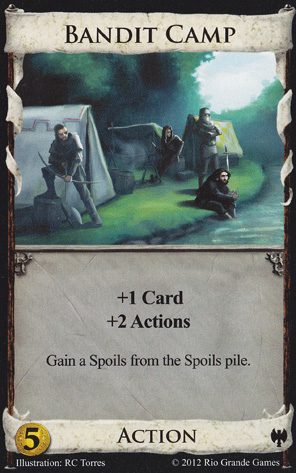
Bandit Camp has two separate effects. The first is the same as a vanilla Village – +1 card, +2 actions. Simple, but far overpriced at $5. Now, a Village is a good thing to have, but you need to match it up with some terminal actions, and you’re gaining Spoils which will get in the way of that; you’d think that in an action-focused engine, you don’t want every Village you play to gain you a treasure!  (But you’ll see later why this isn’t necessarily the case.)

The second effect is gaining a Spoils – gives you a one-shot Gold to use later. Gaining Spoils is pretty nice, especially in Big Money strategies.

1) Bandit Camp and Big Money

In those strategies, Bandit Camp should be thought of as a delayed Gold; it might as well have said “+1 card, +1 action, Gain a Spoils” or even “+1 card, +1 action, trash this and gain a Gold” and had usually the same effect. On the first shuffle after you buy the Bandit Camp, it does nothing for you, but replaces itself; on the second shuffle after you buy it, you have a Spoils (one-shot Gold) and a Bandit Camp that replaces itself in your hand and refreshes your Spoils. Basically like having a Gold – except with a little more flexibility, since there are ways to be clever with Spoils and save them up at the right times. (That may be outside the scope of this article, and is better served discussed on the Spoils article specifically; always playing Spoils when they get you to a higher price tier is probably not optimal, and sometimes saving your Spoils and buying a Silver may be better than spending your Spoils and buying a Gold.)

Used this way, Bandit Camp will typically be better than a Silver. If you open Bandit Camp/Nothing, that’s like guaranteeing a Turn-3 Gold – pretty good. However, you have to be wary of a few things:

a) In the late game, the extra shuffle to wait to get the benefit from the Spoils might be too long. If you only use one Spoils from the Bandit Camp, having a Silver twice might have been better! Use your judgement.

b) If you’re playing Terminal Draw Big Money specifically, such as with Smithy, Envoy, Embassy, etc… then the analogy of Bandit Camp to a delayed Gold no longer holds, since it can be drawn dead. (Bandit Camp+Wharf plays far more like an engine, it’s still great, but Envoy/Bandit Camp doesn’t work, since the whole point of the Envoy is to just draw a lot of playable Treasure, not to draw your Actions dead.)

c) It antisynergizes with discard attacks –  With a hand of {estate, bandit camp, silver, gold, spoils} you would probably discard the Bandit Camp and buy a Province but then you don’t get the Spoils for the next shuffle.

Of course, in a Money-heavy game without terminal draw, such as with Merchant Ship or Monument, or filled with cantrips, feel free to get Bandit Camps at $5 to your heart’s content.

2) What about an Engine? Don’t the Spoils and Village effects anti-synergize?

Not really.  The point is that instead of having to buy Gold and having to buy a Village, you can just buy your Village and let it generate Golds for you as you play it.  The fact that the Golds are one-shot is not a big deal if you draw your deck and play your Bandit Camps every turn — if anything it’s actually a good thing, because it ensures you can keep playing your engine.

To see when the effects don’t anti-synergize, imagine a simple thought experiment – you have a 5-card hand with a Bandit Camp and some cheap cantrip, perhaps a Pearl Diver. You play a Bandit Camp, get +1 card to bring you back up to 5 cards in hand, gain a Spoils. Then you play the Pearl Diver and lets say you draw that Spoils. You’re still at 5 cards in hand, one of which is a Spoils, and you have 2 Actions.

So if you draw the Spoils on the same turn you gain it, it’s almost as if the Bandit Camp read “+0 Cards, +2 Actions, gain a spoils in hand!” And hey, that not-really-Bandit-Camp card would be pretty good. It immediately suggests a comparison to Festival, which gives +0 Cards, +2 Actions, +$2 and +1 buy; a Spoils in hand is +$3 (but doesn’t combo with Watchtower/Library/Menagerie), so you’re up a coin and down a buy compared to a Festival.

But the real Bandit Camp is even better than the thought-experiment one. You get +1 card NOW, and the Spoils gets left in your discard, to be picked up later in the turn. So if you’re running a sleek engine, Bandit Camp makes your deck turn out perfectly – Villages and Smithies on the top of the deck, with the Spoils on the bottom, to be picked up by your last Smithies.

3) Bandit Camp in a deck-drawing engine

So in an any engine where you expect to draw your whole deck, Bandit Camp is a better source of coin than Gold is. While your engine is running, the Bandit Camp is a Village and keeps things running smoothly; and then when you’ve picked up all of your engine components, you’ll find that you now have a discard pile made up of only Treasures, a number of Spoils equal to however many Bandit Camps you had in your deck, lined up perfectly for your Smithies to draw. Why would you get Golds which you might draw early and which would gum up your Village/Smithy chain before you’ve drawn everything you want to draw?

4) But the good times can end

However, Bandit Camp only seems so great when you maintain the ability to draw the Spoils on the same turn you gain it. If your engine collapses, it becomes harder to get it running again. If you’ve played a bunch of Bandit Camps, but have let your engine choke on green, and you don’t get a chance to draw those Spoils you’ve gained… then you’re in trouble. You don’t have enough to spend this turn because you didn’t draw your Spoils, and next turn, you’re going to have an even harder time getting your engine running and you’ll have to make do with a mixed hand of green, Spoils, and probably an engine component or two that don’t go together. Oops!

5) How to use Bandit Camp – ideal case

So, that leads to an obvious strategy for using Bandit Camp:

  • Build an engine, and make sure you can draw your deck.
  • Build up your buying power by adding more Bandit Camps, not Treasures – your engine will stay reliable because you’ll always draw your Bandit Camps first and your Spoils last.
  • Your engine keeps going even after you start greening because you are replacing the Spoils with green cards (hopefully!)
  • Make sure you keep drawing your whole deck while greening, because once you stop, it’ll be hard to start back up again.

6) Less perfect use cases

OK, but you can’t always expect a card to fit into its niche, sometimes the rest of the board just isn’t there. So how do you use Bandit Camp then?

In the less-than-perfect case, if you don’t draw your deck all the time, you can still use Bandit Camp to good effect. If you aren’t drawing your whole deck, but as long as you are using up the Spoils at the same rate you’re gaining them, then you have still saved yourself several Gold purchases, allowing you to snag the additional engine component. Even if the Spoils show up at the wrong time – it that any more likely to have happened than if you bought a Gold, or any more damaging? It isn’t as awesome as the best case, but it is a good way to have both Villages and Coin to spend.

Bandit Camp is also excellent as an opener with Chapel, if you happen to draw 5/2. In that case, you don’t mind having the Spoils come a little late, to find your Chapel and trash faster.  And it solves the problem of how to trash down while simultaneously building up.

7) Comparisons to similar cards:

Bandit Camp should be compared to Bazaar and Festival, the other 5-cost villages that give coin. They often play somewhat similarly – they both face the same problems that other expensive villages have, namely that it takes a long time to accumulate both the expensive villages and the expensive terminals that you want to play with them.

Bandit Camp provides more coin than Festival (a Spoils is 3 instead of 2). It gives a separation between the “+1 Card” up front and the “-1 Card, +$3” later in the deck. This can be an advantage if you have good control over when you draw the spoils, but a disadvantage if you don’t. Bandit Camp also does not provide a +Buy, which it desperately needs. (It also does not combo with draw-up-to-X engines or Menagerie, obviously).

Compared to Bazaar, Bandit Camp offers a major advantage – $3 for spoils instead of +$1 – but also a major disadvantage, since to get the +$3 you have +0 cards total, whereas Bazaar gives +$1 AND +1 card. This makes Bazaar better when your card draw or trashing is weak, but worse if you’re not worried about draw power and want more buying power.

9) Unusual cases playing with Bandit Camp:

As with many Dominion cards, there are non-obvious niche cases that crop up with Bandit Camp

A) Running out of Spoils

What happens if you’re running a Bandit Camp deck and you run out of Spoils? You’re dead in the water, that’s what.

This won’t happen often in a standard 2-player game; 15 spoils for 2 people means you’d have to have about 7 spoils in each player’s deck before they affect anything – that’s a lot of Golds that are sitting there unused, almost three Provinces worth per player.

But as you add more players, it becomes easier to run out the 15-card spoils pile. At 3-player, that’s 5 spoils per player, still a lot. In 4-player, that’s less than 4 spoils per player – if the players save up spoils between turns even a little, you’ll soon find that you can barely buy a single Province with the Spoils you can get. It only takes a few King’s Courted Bandit Camps to run down the pile. And if other players start deliberately trashing the spoils, then watch out – your economy will be dead in the water in no time.  Forager and Spice Merchant seem like they’d be the most likely culprits for such gimmicks, since they give you +Coin and +Buy for trashing the Spoils.

Other Spoils-gainers can also interfere. If there are four players and a few of them are Pillage-happy, then it only takes one King’s Courted Pillage from two of them to leave you without any economy.

Black Market can provide cute tricks to save you from Spoils depletion, letting you play the Spoils mid-turn, then gain them back.

B) Bandit Camp as a cantrip that gains you cards

Hey, sometimes you just need fodder for your Altar, Forager, Spice Merchant, Junk Dealer… or even your Expand or Remodel. Bandit Camp is a cantrip which gains you a card, and that’s actually very rare. Sometimes that’s what you need.

10) So, to conclude:

Works with: heavy trashing. Since it’s best when you draw your whole deck, heavy trashing is a good way to do that. Engines of all sorts – as long as you’re aiming to hold your whole deck by the end of a turn.

Also, works best with +Buy – since the spoils go away on use, you want to make the most of every single one, and that means having +Buy to spend all the cash you can. Otherwise, you’ll either have to waste spoils, or let them accumulate and clog up your deck.

Also works with fickle engine components like Throne Room, King’s Court, and Procession, ones which are much more easily disrupted by having a handful of treasures when you’re just starting out, since the Spoils can go away and not get in the way.

Works with Counterfeit, since Spoils/Counterfeit work well together in general. Adding a counterfeit to an overdrawn Spoils deck adds $4 and a buy, more than adding a Bandit Camp.

Even if Spoils are near-depleted, Black Market  can let you do cute tricks with playing Spoils and re-gaining them.

Poor House can also fit well into the sleek decks that Bandit Camp likes, and Bandit Camp decks can guarantee that you draw your just-gained Spoils AFTER your full-strength Poor Houses.

Bandit Camp works well enough in Big Money without terminal draw, such as Monument – if you happen to draw $5s at the right time.

Conflicts with: middling engines. You know the type – where you ‘re not quite aiming to draw everything and are content with maybe connecting a Village with two terminals. Where you’ve had a reason to buy a bunch of terminals, and then some Villages to smooth them out, but you always have a bunch of stuff in your discard, so those Spoils will always seem to get drawn at the wrong place at the wrong time. Maybe then you’d rather have a Gold up-front than a delayed one, and a Walled Village instead of a Bandit Camp.

Sifters, a little. Warehouse and Cellar are great, but don’t work with the Bandit Camp mentality – at the end, you’ll wind up having drawn all your engine parts, and with your spoils AND your sifted-out cards in the discard. You have to draw them all, or else you have no treasure now and an unreliable hand later… that’s not to say Warehouse won’t help your engine, but be mindful that green you discard might come back to bite you the same turn again.

Some engines prefer coin on actions rather than via spoils-gaining; in those cases, Bandit Camp is inferior to Festival and Bazaar. These include Minion engines, draw-up-to-X engines, Golem engines.

Discard attacks can make Spoils less effective – the aforemented hand with both Spoils and Bandit Camp which gets hit by a Militia.

If there are other spoils-gainers, good reasons to trash spoils instead of playing them, or multiple opponents, you have to beware of Spoils pile depletion.

Rush strategies of course have no particularly good time to pick up a Bandit Camp. Terminal draw Big Money don’t like Bandit Camp either (they don’t like much of anything, really). Wharf is a special case, with the huge hands and super-fast cycling to find your Spoils naturally facilitating a transition to a more engine-like game.

Posted in Dark Ages | Tagged | 4 Comments

Intrigue: Upgrade

This article is written by jsh357, originally posted on the forum.

Upgrade

Dominion: Intrigue

The Basics

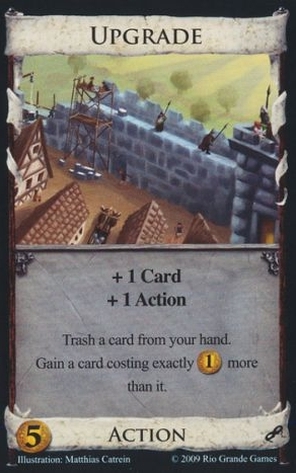
Upgrade is a higher skill card than it might initially seem.  What it does is pretty basic: replace a card with a more expensive one, or trash it entirely if no card exists that costs $1 more (in particular $0 cards like Copper, Curse, Ruins).  However, doing this effectively can be quite challenging, and many good players will look like they’re performing some kind of wizard voodoo with Upgrade.  Don’t get scared.  The thing to remember is that Upgrade is not a simple trasher like Chapel or Steward.  Trashing $0 cards is icing on the cake, but not the moist, wonderful center.  In its best form, Upgrade can be used to accelerate engines by rolling out unneeded cards for strong ones.  This is especially the case for engines that need expensive parts in bulk, such as $5/$6 actions.

One great example is Upgrade’s direct interaction with Grand Market.   Under normal circumstances, a Grand Market engine can be very difficult to get going, but Upgrade only requires a hand containing another copy of itself (or any $5 card) to snag you one.  Ideally, the second Upgrade is not needed in your deck any longer, so you have no problem trashing one for a Grand Market.  Furthermore, Upgrade trashes your Copper, thinning your deck to make the double Upgrade hand more likely.

In general, Upgrade can keep your deck rolling along.  Bought an early Steward for trashing?  You can make it a Caravan later.  Already won Followers from the Tournament?  Go ahead and make that Tournament that keeps getting blocked a Duchy near endgame.  There are countless possible Upgrade interactions, but the key is to get the cards you need in your deck later on–if you stay focused on the now, you can end up with dead cards in your hand.

To illustrate, imagine a game where I open with Smithy/Silver on a board with no Villages in an attempt to get some $5 and $6 cards early, then transition in to an engine using Grand Market.  Normally, this wouldn’t be feasible, but Upgrade makes such a thing possible.  The only catch is, at least in a Kingdom with no Village cards, the Smithy will eventually be drawing actions dead, which doesn’t help me.  Thus, the Smithy I bought early on makes a prime candidate for Upgrade.  I can Upgrade the Smithy into another Upgrade, which will in turn increase my chance of getting more Grand Markets.  It’s a little scary to trash your action cards, but it’s also important to envision your deck’s goal.  Sometimes a card is only helpful to you during certain phases of the game.  However, as with all cards in Dominion, you must use your discretion.  It can be better to hang on to that Ambassador for a while before making it a Conspirator.  You should probably reconsider Upgrading a cheap card if it is still fulfilling its purpose.

In short, Upgrade is a card that’s all about transitioning.  Changing from one card to another, one strategy to another.  It’s a powerful card that gives you something new and gets rid of something old, and it is also non-terminal,  meaning you can keep playing Upgrades or any other card you need to afterwards.  Even if you aren’t gaining anything particularly good on the Action end, trashing an Upgrade for a Gold will often benefit an engine.  Few cards are as potent at engine building as this one.

Removing $0 cards, Estates, and Silver

Unless Poor House is in the Kingdom, Upgrade is a good Copper trasher.  If you have nothing significant to gain from Upgrading another card this turn, removing a Copper will at the very least reduce your deck’s size by 1.  Upgrade can also trash Curses, which is always nice.  Upgrade performs better with fewer cards in the deck, so even though I stressed that the card is at its best upgrading expensive cards, that doesn’t mean this ability should be ignored.  Sometimes Upgrade’s the only method of Copper trashing available, and it makes a pretty good one since it can be used later on too.

Upgrade loves to have good $3 parts in play (though it doesn’t care about those too much if you’re playing with Shelters).  The ability to make starting Estates in to long-term useful cards like Fishing Village and Menagerie must not be ignored, and contributes to making Upgrade a good opening card on 5/2 and a good pickup in the first reshuffle.

Trashing Silver for important $4 cost Action cards can also be an important strategy.  Conspirator, Vineyard, and Scrying Pool decks come to mind; these decks benefit more from having extra actions than having a Silver.

Piling Out

Upgrade is fantastic for ending the game on three piles, and some of the most skillful uses of the card involve doing so.  Again, the Upgrade / Grand Market interaction makes a nice example.  In that scenario, you’ll have few problems purchasing all the Upgrades (probably with the help of your opponent), which will then make it simple to empty Grand Markets.  (Furthermore, Grand Markets make it easy to run out the Estates or other $2 piles)  As with any pile out strategy, do be wary of your opponent’s actions.  You only want to end a game early on a win, so if he’s running a fast strategy like Embassy/Big Money, be mindful of the score before getting any wise ideas.  Note that you can also leave a pile at 2 or 3 cards your opponent cannot easily run out, then pounce on them at a later time.

The Upgrade trap

Many novices (totally not me when I first saw it, nope) will see Upgrade’s effect and think they can easily just keep Upgrading the same cards, eventually getting up to a Province.  While theoretically this seems nice, the simple fact of the matter is it’s one of the slowest ways to play Upgrade (Upgrade is a deck accelerator, not a slog card, remember) and this strategy rarely ever works.  You don’t want to focus on doing such a thing, and a better option is actually to BUY expensive cards and THEN Upgrade them.  To spell it out more plainly, why spend up to six turns (which you can’t even guarantee lining up) Upgrading Estate -> Silver -> Militia -> Upgrade -> Grand Market -> Forge -> Province when you could just buy one of the last three and get your Province faster?  Remember, six turns is a lot of time in a game of Dominion, and while you may be able to pull this off once, you usually need more than one Province to win.  I think that it’s better to consider Upgrade a setup card than a finisher.

$7 -> Province (and similar)

That said, it’s viable to upgrade $7 cards to Provinces, or even Provinces to Platinum if you’re bold and sure it won’t backfire (Even in a Colony game, losing six points could matter).  However, if you cannot accomplish this quickly, there are probably better ways to get the cards you need.  Schemes can be used to set up such a scenario (top-deck Upgrade and a $7 action card), but Scheme is one of only a few cards that can.

In the late game, odds are you don’t mind losing a Forge, which you probably would have used to gain a Province anyway.  Many $4 cost cards are also better to change to Duchies when things are coming to a close.  The only bummer is that you can’t gain a Colony in this way without lots of cost reduction cards (and if you had enough of those, you were probably winning the game anyway).

When not to Upgrade

Upgrade is a strong card for setting up engines, but there are some cases where you should probably avoid it.  The first is in any sort of Big Money deck.  These decks rely on just a few actions and many treasure cards.  The problem for Upgrade is that treasure costs go up in increments of $3, so you won’t be able to get the cards that a Big Money deck needs the most.  Besides, those decks often don’t mind hanging on to Copper and Silver in the late game.

If you already possess cheaper cards serving the same purpose (Remake being a great example), the opportunity cost on Upgrade may be too great.  Upgrade can still be useful in tandem with other upgrading cards, but if you only need one, you can often pass.

The other reason to avoid Upgrade is if there are no good upgrades to be made.  For instance, if there are lots of good $4 actions in the Kingdom but no $5 actions you want, all you’re getting out of Upgrade are Duchies and Gold (if you get multiple Upgrades) unless there is a $3 -> $4 transition you want.  However, that price point tends to be more trivial than the jump from $4 -> $5.  Use your discretion, though.

A third reason to avoid Upgrade is against handsize reduction attacks.  With only 3 cards in hand after a Militia, playing an Upgrade can sometimes leave you with uncomfortable choices as to what to trash.

Specific Interactions

Upgrade is highly interactive with other cards, but I’ll mention a few cases to keep in mind.

Possession
While you have to trash cards when you Upgrade them, have a party when playing Possession on your opponents.  You can turn those Duchies in to Golds at no point penalty, get useful engine parts for trashing something you didn’t want to lose from your own deck, and so on.  You can also trash Provinces or Colonies if you need all of the other cards in hand.

Scrying Pool
Scrying Pool decks love Upgrade!  Ditch Coppers, turn Estates in to useful action cards, get rid of Silvers you no longer need, eventually ditch the Potion… the possibilities are endless, and it’s one of the deck archetypes that benefits the most from Upgrade.  Remember, decks that want lots of actions want their actions to stay relevant.

Festival/Library or other Disappearing Hand engines
These types of engines sometimes suffer from being unable to afford their parts quickly enough. Upgrade helps out by eliminating some of the needed $5 buys and replacing them with $4 buys.  You could pick up some intermediary card on a $4 hand such as Caravan, then Upgrade it to a Festival.  Removing Coppers and Estates also greatly benefits these engines, and Upgrade even reduces the hand size on play.  It’s a win-win.

Moneylender and other trashers with diminishing returns
Many trashers run out of steam after you have eliminated the cards they want to trash.  Upgrade, naturally, combos very nicely with them.  Moneylender is a particularly good case because it can also become an Upgrade or even a Duchy (which might be helpful by the time it runs out of Copper).  Upgrade also helps to remove Copper, accelerating you to the point where Moneylender is no longer useful.

Cursers/Looters
Are all the Curses or Ruins out?  Why don’t you turn that lovely Sea Hag in to something more useful now?  Incidentally, Upgrade also helps trash any Curses you received along the way.


Cards that want variety
Menagerie probably gets the biggest boost from Upgrade out of the variety-based cards.  Why?  Well, you can trash cards from the hand to set up a Menagerie’s secondary effect, and you can remove cards you have several duplicates of at the same time.  Otherwise, Upgrade is a fairly obvious way to get multiple types of cards without having to expend many buys.  In Fairgrounds Kingdoms, it’s often difficult to get 15 or more types of cards and also keep up an economy, but Upgrade helps to pull that off. Estates can become $3 cards, extra Silvers can become $4 cards, and so on.  Upgrade can also Upgrade a copy of itself in to a Fairgrounds, which has the added benefit of not removing a card type from your deck.

Fortress
Gain a $5 card and get the Fortress right back to be Upgraded again?  Yes, please!  This trick can be used to pile out fast or just to gain lots of powerful cards (Wharf/Upgrade/Fortress is pure dynamite).  Not much else needs to be said about this combo.


On-Trash Effect cards
Upgrade makes a great enabler for many Dark Ages trash effect cards as it trashes through a trimmed deck.  In other words, the likelihood of triggering one of these effects is pretty high.  Rats and Market Square are particularly good, the first for drawing cards while gaining $5 cards (one of the few Rats combos that seems immediately powerful) and the second for trashing junk and replacing it with Gold.

Poor House
Poor House has the sometimes unfortunate effect of making the $1 Upgrade on Copper less effective, as it no longer thins the deck.  However, should you have the Villages and draw power to make a Poor House engine acceptable, Upgrade is an excellent enabler.  It removes Copper from the hand and deck, and then (unlike Remake) allows another action, giving you the benefit from a Poor House in hand immediately.

Procession
Sometimes you just want to play Upgrade a few times, then get rid of it.  Procession allows this with no hassle, and can even be good if there are no $6 actions available, assuming you just wanted to be rid of the Upgrade to begin with.

On-Gain Effect cards
Upgrading in to an on-gain effect has the benefit of the cards being available on the same turn, should you be able to draw them afterwards.  An example case: Upgrade an Upgrade in to a Border Village and Witch, play a Smithy, reshuffle and draw the Border Village and Witch.  That’s a case of perfect shuffle luck, but scenarios like it can be set up in some cases.

Cost-Reduction

This is more of a fun combo than a helpful one, though it can certainly be powerful if the Kingdom can actually set it up.  Playing multiple Highways or Bridges will allow you to Upgrade cheap cards in to very expensive ones.  After four Highways, any card cheaper than a Duchy can become one.  After seven, you can gain Provinces out of just about anything.  If you’re pursuing this strategy, watch how many Highways you play–playing eight means you won’t be able to green, and you will lose the ability to trash $0 cost cards after a single Highway.  Note that in order to pull such a thing off, you will likely need heavy card draw (Tactician, Alchemist, Wharf, King’s Court, Menagerie, etc…) and a faster trasher than Upgrade in play.  Nonetheless, it’s a fun interaction to consider.

Watchtower

Watchtower combos with everything and Upgrade is no exception.  In fact, Watchtower likes Upgrade a whole lot, especially with Village support.  Why?  Well, you can trash a card (let’s say Estate), gain a useful upgraded card such as Fishing Village, top-deck the card with Watchtower, then even play Watchtower and draw the new card.  Drawing with the Watchtower is especially beneficial since Upgrade reduced the hand size.  This is useful early in the game when you need to keep cycling and still good later on when you need lots of money–trashing a $5 card for Gold you can immediately use is nothing to sneeze at.

Countering Junking Attacks (Saboteur, Ambassador, Swindler)

Upgrade, while not a hard counter to these types of attacks, helps mitigate their effectiveness.  When an opponent forces you to take a card you do not want, Upgrade can make it something better (or even remove it altogether).  Sadly, you still lose the card that got junked in the case of Saboteur or Swindler.  In the case of Swindler, do be aware that Upgrade can be Swindled in to a Duchy, which is downright painful early on in a game.

Posted in Intrigue | Tagged | 7 Comments

2012 DominionStrategy.com Championships have begun

Good luck to all competitors!

Here is the final entry list, the brackets, and the tournament forum.

Fun facts about this year’s competition:

  • 256 competitors, including 13 of the top 15 players on the Isotropic leaderboard
  • Average level of 25.281, median level of 26.018
  • Highest level in the tournament belongs to -Stef-, clocking in at 51.696
  • The 256 players combined have played over 500,000 games on Isotropic
    • The top 10 seeds account for nearly 50,000 of those games; the top 32 account for almost 150,000.  WanderingWinder himself accounts for 10,000 games alone.
Posted in DominionStrategy Championships | 2 Comments

Registration closed!

Registration for the 2012 DominionStrategy.com Championships is now closed!

However, if you are level 35 or higher on Isotropic, you can still qualify in one of the wildcard slots.  Please enter here; the current entry list is here.

Otherwise, good luck in the tournament, and if you didn’t register in time, well, there’s always the Kingdom Design Challenge!

Posted in DominionStrategy Championships | 1 Comment

Introducing the DominionStrategy Wiki!

We are very excited to announce a much-requested and long-awaited new feature:

wiki.DominionStrategy.com

The wiki has already been started with all of the old blog articles and additional forum content.  We intend it to be the ultimate Dominion reference — an easy, one-stop source for Dominion strategy, news, rules questions, and events.

This doesn’t mean that the blog won’t still publish articles — it will.  But if you’re looking for a Dominion reference, especially for older cards, the wiki is a great source to consult because people continue to update it as new expansions are released.

And hey, if you have an insight to add, feel free to make an edit or bring it up in the Wiki forum.  Don’t feel like you have to be an expert to contribute: we review edits and will correct any obvious mistakes, but we want as many people to contribute knowledge as possible.

Thanks especially to all of the initial editors and administrators who helped get this off the ground:

AJD
DStu
ftl
greatexpectations‏‎
jonts‏‎
Schneau
Thirtyseven‏‎
TwiNight‏‎

And in particular, thanks to Qvist who took the lead in implementing and hosting the wiki on the server.

If you have any feedback, please let us know in the Wiki feedback forum.

We’re very excited about this new feature, and we hope you are too.

Posted in Uncategorized | 2 Comments

The 2012 DominionStrategy.com Championships

November 12 2010 – ?

We recently celebrated the two-year anniversary of DominionStrategy.com. You all are the reason why we have blossomed from a small, niche blog into a full-fledged site featuring a flourishing forum and the best and brightest boardgamer community around. With over 3 million blog visits, and over 10 million forum page views, we are humbled and awestruck to have been a part of this.

So in honor of our two-year anniversary, and the wonderful readership that has brought us this far, we are very proud to announce:

Continue reading

Posted in DominionStrategy Championships | 21 Comments

Dark Ages: Beggar

This article is written by Schneau, originally posted on the forum.

Beggar

Dominion: Dark Ages

Beggar is the new Copper hipster. When we were all introduced to Dominion, we thought Coppers were cool. Who would want to trash them? Hipster Chapel, I guess. But, as time went by, we all realized that trashing Coppers was fun, and the hipsters started saying they liked Chapel before it was cool. Now the hipsters are back into Copper, and Beggar is their new retro king.

Before considering how to use it, let’s take a look at what Beggar does. The action part is pretty simple, right? Gain 3 Coppers into your hand. But, it’s more subtle than that. Beggar can be seen as a terminal Gold that comes with the drawback of three more Coppers in your deck. The reaction part of Beggar gains you two Silvers, one on top of your deck. This is also more subtle than it looks, and depends on what Attack card it is reacting to, as we will discuss in a bit.

As an Action
So, when would you want to use Beggar? Didn’t we all learn long ago that Coppers are bad? Well, yes, they are bad in many engines. But, as most things in Dominion, it isn’t as simple as that and it depends on the kingdom. Even in a thin engine, there may be a time and place for Beggar.

The thing to realize about Beggar is that $3 on a terminal Action is really good, especially on a $2 card. With a terminal Gold, it is easy to hit $5, $6, and even $7 on early hands, making it easier to get those important high-cost cards. The only downside is that you now have Copper clogging your deck. So, if you can play it in situations when you don’t mind the extra Copper, it can be fantastic.

Another general use for Beggar is as a late-game buy to keep your money going strong as you start to green. If you can pick up a Beggar with an extra buy when you expect to see it only once or twice more until the end of the game, it can be used as a terminal Gold without worrying about the Coppers hurting your deck too much. In non-trimmed decks, this can make all the difference in hitting $8 more often than your opponent, and in thinned engine decks, it can boost you to $16 for the all-important double Province or $13 for Province + Duchy.

Early Beggars aren’t good in straight Big Money or BM+draw decks – they conflict with drawing terminals, and aren’t good enough on their own since the Coppers slow things down a bit too much. They also aren’t good early in engines, where they put too many Coppers between important engine parts. As mentioned above, Beggar can be worthwhile later in both of these types of decks as a boost to large payoffs. In Curse or Ruins slogs where you aren’t as worried about a few extra Coppers, Beggar can be more effective early, since it can help buy important Attack cards and Provinces and Duchies later. Additionally, Beggar’s reaction provides a benefit when hit by the Attack cards that are slowing down the game.

One situation when extra Coppers don’t hurt much is if you aiming for alternative Victory cards. Gardens are a natural fit, since playing Beggar allows you to gain 4 cards on a turn and all but guarantees enough money for a Gardens (see below for more detailed analysis). Beggar works decently well with other alt-VPs, namely Silk Road and Duke, and possibly Feodum if your opponents are going heavy on the Attacks. These strategies require a heavy density of Beggars, which is probably easiest to achieve if there is a source of cheap +Buy, especially if it is non-terminal such as Hamlet, Worker’s Village, Forager, or Market Square. In these games you will want to load up on 4 or 5 Beggars, and then start hitting the Victory cards. Note that in games without cheap +Buy, these strategies will more likely end up being slogs than rushes.

Specific Card Combos
Some Action cards don’t mind having a pile of Coppers around. Apothecary might be the strongest combo here, where Beggar can be the terminal after an Apothecary chain. The Apothecaries will just sweep up those extra Coppers to easily get to Province or Colony range. Non-terminal +Buy would definitely help here, both for Apothecary+ buys as well as Province+ buys.

Similarly, Counting House can be a good partner in an otherwise mediocre kingdom – you can easily get more than enough Coppers in your deck to get Colonies. Also, since Beggar is a terminal Gold, it is easy to hit early $5 to get the Counting Houses. This should come with the usual caveat that Counting House is not a good card, and should only be attempted if no strong strategies are present.

Bank can also be one of Beggar’s best friends (which is sort of ironic when you think about it). Bank has several properties that make it work well with Beggar. It is a Treasure, so you can play Beggar and Bank on the same turn without a village (unlike Counting House and Coppersmith). Beggars can help hit the high $7 cost early in the game. Plus, each time you play a Beggar and a Bank in the same hand, you are already guaranteed $7, which means you just need a Copper more to hit Province.

Gardens may be Beggars most powerful combo. Unlike just about any other board, it may be optimal to buy a straight Victory card on turn 1 or 2 with the opening Gardens/Beggar. This allows you to get a jump on the Gardens pile to almost guarantee an even split of the Gardens, if not a split in your favor. According to simulations performed by DStu, just buying Gardens / (Estate when Gardens are low) / Beggar / Copper wins against a basic Workshop / Gardens bot 80% of the time. When your opponent is not rushing the Gardens, you should buy Duchies once the Gardens are gone to help 3-pile and get more VP. This wins against a DoubleJack bot 75% of the time.

Even though Coppersmith + Beggar intuitively seems like it would work well, I think most of the time it will end up being more of a nombo than a combo. Coppersmith likes Coppers, but more of the time it prefers you just draw your starting Coppers on the same turn you play Coppersmith, not that you actually gain extra Coppers. Playing village then Beggar then Coppersmith is doable, though unlikely. And once you have played Beggar a few times, the extra Coppers make it difficult to line up your village + draw + Coppersmith for the big hands. If you are playing Beggar a lot, you may be able to expect at least 3 Coppers in hand with your Coppersmith, though you will be unlikely to hit the necessary 4 for a Province.

A few other cards may combo decently depending on the board. Stables will enjoy guaranteed Coppers to discard, though the Copper flood will limit the ability to build an engine. Philosopher’s Stone, like Gardens, likes a thick deck and may be a decent option, especially with other Potion-cost cards present. If you have a Trader in hand, you can Beggar for 3 Silvers, albiet ones that go to your discard pile instead of your hand. Counterfeit, Moneylender, and Spice Trader can all trash Coppers for benefit, though in most cases it won’t be worthwhile to go Beggar if you want to trash down your Coppers.

As mentioned earlier, Beggar can boost you into the expensive card zone early on, with Bank being the star of the show. Additionally, expensive cards like Goons, Hunting Grounds, Forge, and Alter may be willing to sacrifice having 3 extra Coppers to buy them early. On the other hand, cards like Grand Market, King’s Court, Border Village, and Expand conflict with having lots of Coppers around, making an early Beggar not worthwhile to get to them. If you need to hit $5 on your first reshuffle for some important card (Witch and Mountebank come to mind), Beggar all but guarantees their purchase while giving some defense if your opponent is also grabbing attacks.

As a Reaction
You rarely want to buy Beggar solely for its reaction. But, if you were thinking about it anyway for its Action, you may be swayed further by its reactionary ability. Beggar is often happy to be hit by an Attack card. Gaining 2 Silvers is very good, unless you’re going for a Treasureless deck, in which case why would you buy Beggar in the first place? Unlike Moat, and somewhat like Horse Traders, Beggar’s reaction acts differently depending on what attack triggers it, making it a better defense against some Attacks than others.

Junkers: Beggar’s reaction is probably weakest against Cursers and Looters. You still get the Silvers, but no other advantage. On the other hand, Beggar’s action can be good in Curse slogs, so Beggar may still be worthwhile in these games. Beggar pairs well with Ambassador as described above, both for its action and reaction abilities.

Discard Attacks: Beggar is very good against many discard attacks. Against a vanilla discard attack like Militia, Beggar allows you to discard it to gain 2 Silvers, while reducing your hand size so that you have to discard one fewer card. This works great against Militia, Goons, Ghost Ship, and Urchin/Mercenary, and decently against Margrave. Beggar is an excellent counter to Pillage, since it removes itself from your hand, giving you 4 cards which makes you immune to Pillage. Similarly, Beggar allows you to dodge Minions if you wish, or you can choose not to reveal it if you don’t like your hand. Beggar is bad against the targetted discards of Cutpurse and Bureaucrat, which don’t care about handsize.

Deck Inspection Attacks: Though cards like Spy and Scrying Pool will usually discard the topdecked Silver, they are often played frequently and therefore you can expect them to be played when you have Beggar in hand. Beggar is not as good against Rabble, Fortune Teller, or Oracle, which will discard the topdecked Silver. It is pretty decent against Jester, which prefers to hit your really good cards or your really bad cards; Silver is in the middle ground which gives your opponent the least advantage.

Trashing attacks: Beggar somewhat protects against Thief and Noble Brigand, since you’ll likely gain a Silver while giving your opponent a Silver. It is excellent against Saboteur, Rogue, and Knights, since the topdecked Silver protects your better cards. It is also great against Swindler, where you will gain a Silver and another $3 card. The one card you’ll almost never want to reveal Beggar to is Pirate Ship – you will guarantee they’ll hit Treasure.

Works with:

  •  Alt-VP, especially Gardens
  • Apothecary
  • Bank
  • Counting House
  • Hitting high price points early (Bank, Goons, Hunting Grounds, Forge, Alter)
  • Buying late with an extra buy
  • Discarding attacks and some trashing attacks

Conflicts with:

  • Colonies
  • Strong trashing
  • Buying early in engines or BM
  • Grand Market, King’s Court, Border Village, Expand
  • Pirate Ship
  • Cutpurse
  • Venture and Adventurer
  • Poor House
Posted in Dark Ages | Tagged | 11 Comments