Alchemy: Transmute

This is a revised version of a guest article by chwhite, originally posted in the forum.

Transmute

Dominion: Alchemy

Is there any card more unloved than Mr. Transmute, with his sad eyes and mountain man beard, futilely trying to turn lead (Estates) into gold?  For most people, Transmute is a card whose main ability is showing up dead last in any ranking it’s a part of:

  • It was the worst potion card in theory’s front-page ranking.
  • It won a plurality of votes in this forum topic asking for the “worst card in Dominion”, garnering almost twice as many nods as the next most-hated cards, Duchess and Thief.
  • In Qvist’s card rankings, Transmute was not only dead last, but by a nearly unanimous vote. Only one person dared to dissent.
  • And of course, Council Room stats bear out this general theme.  Only two cards- Thief and Counting House- have a worse “Win Rate With”, and Transmute is near the bottom of most other metrics as well.

So, what gives?  Why is Transmute thought of so poorly?  Does it deserve all the scorn it gets?  And when can it be useful?  The fact of the matter is that Transmute is indeed a weak card, since it is so awkward and slow to buy and use.  Most of the time, it’s best avoided.  However, there are in fact a number of situations where it can be useful: it may not be good, but it’s better than you think.

Why do you usually not want Transmute?

Described by Donald X. as an “exotic Remodel” in the Alchemy Secret History, Transmute is a trash-for-benefit card that (like most TFB cards) works on only one card at a time.  The main thematic conceit of Transmute is that it changes the nature of the card from one type to another: Victory cards become Treasure (always Gold, which is thematically fitting and also the best Treasure always in the game); Treasure becomes Actions (always Transmute, since it’s the only Action always in the game with Transmute), and Actions becomes Victory (Duchy, which again is always out).  It’s a cycle!

Like its closest relatives Remodel, Expand, and Develop, the benefit is “more/better cards”.  It does not give cash and/or +Buy (Trade Route, Salvager, Moneylender, Spice Merchant), nor +Card (Apprentice, Spice Merchant), nor is it VP chips and cash (Bishop).  All other things being equal, this is the weakest category of trasher there is.  If you are trashing early, to thin your deck for an engine, then you really want a card which can get rid of multiple Coppers and Estates at a time, like Chapel/Remake/Steward.  Failing that, you’d prefer for the card to give you cash to make good purchases now, as Moneylender/Salvager does, or at least be non-terminal like Upgrade and Apprentice.

So, cards in the Remodel family are generally not for early-game use, but are better in the mid-to-late game, where they can turn mediocre cards into great ones (say Developing a Sea Hag into Cartographer/Silver after the Curses are gone), or Gold into Province, or burn through the Colony stack to prematurely the end the game with a lead. But, if you take a closer look at Transmute, you’ll see that it doesn’t have the same flexibility as Remodel and Expand, and seems to want to be used more in the early game.  You can’t just get anything, you have to take what the ‘Mute gives you, and if you don’t want those things, then you don’t want the ‘Mute.

The most immediately appealing use, of course, it to turn your starting Estates into Gold, making the most useless card in most decks into the most useful; it’s also an improvement of $4 worth of value, better than any other trash-for-benefit Action.  This needs to be done early, though, because otherwise you could just buy Gold.  If you could pick up Transmute on Turn 1, then you’d have a good chance of turning Estate into Gold on Turns 3/4.  That hypothetical card would be a strong but swingy opening in the vein of Baron, which also relies on Estate collision to work.

But you can’t pick it up on Turn 1, because Transmute has that most awkward cost: Potion.  You need to open Potion, and then you need to throw away all the rest of the money that came with your Potion on Turns 3/4 to get the Transmute.  And by then, your deck has diluted to the point that you’re very likely to draw Transmute with four coppers and wish you had just bought Silver and Gold instead, like your opponent who is pulling down $5s and $6s.  Pursuing Transmute early as a source of deck-thinning and Gold gain is, like opening Treasure Maps without strong support, almost guaranteed to fail.  The simulators have shown, in fact, that there is no way to add Transmute to an optimized BM strategy and gain advantage.

The other options are even less appealing.  Turning Treasure into more Transmutes is obviously horrible on most boards: your terminal density will skyrocket, you’d have better luck just buying stuff with Copper!  Turning Actions into Duchies is a better proposition, and actually slots well into late-game use, but even that has its problems.  Duchy is fine and all, but it’s no Province, and if you have the Actions to burn, chances are you’d prefer to build up to Province or Colony anyway- in general it’s money decks that want the Duchies more.  In addition, you’re still left with the problem that Transmute’s potion cost is really awkward unless you have other desirable Potion cards and/or +Buy: even if you do have an Action chain that needs to grab a bunch of Duchies late, when are you going to go out of your way to get the Transmute?  And using Transmute to power a Duke strategy is not usually going to be the best plan: an opponent who has a deck full of Silvers will steal the Duchies underneath you, and have the money left to buy Duke afterwards.

So, to review:  You don’t really ever want Transmute when there’s faster trashing (which is most everything that’s not Remodel, Expand, Trade Route, and Develop). You don’t want it when there’s a fast Big Money strategy that doesn’t need trashing.  You don’t want it if there’s a slow Big Money strategy- you’d rather buy no Kingdom card than Transmutes.  You don’t even want it with Dukes most of the time.  When would you ever want one?

When do you want Transmute?

Well… the first line of Transmute is “Trash a card from your hand.”  Not every card is an Action, a Victory, or a Treasure.  The above analysis has so far failed to mention the fourth type of card: Curse.  Curses are bad.  Real bad.  They slow you down, kill your buying power, and your score.  You want them out of your deck come hell or high water (well, maybe you can handle them if you have something like Vault, or a zillion Golds, but generally this is true.)  They are worse than Estate- and they are so bad that the vast majority of trash-for-benefit cards give you no benefit for them, since getting rid of that Curse is benefit enough.  Apprentice gives you zero cards.  Salvager gives you zero dollars.  Bishop may as well be trashing the empty air.  Remodel… very often will force you take an Estate or Copper.

In this company, Transmute does just as well as the rest of ’em.

If you have lots of Curses being flown about, than Transmute will have more targets: not only will it turn Estate to Gold, but if it’s the only way to turn Curse into nothing, that’s worth it too.  And with Curses around, the game will slow down: you’re more likely to have $P or $1P hands where you can’t buy anything else, and you’ll also have enough turns such that the slow Estate-to-Gold action is actually worth it.  Now if only there was another Potion card that gave out Curses, such that by opening Potion you are gaining access to not only a way to give out Curses, but a way to fix up your own deck too.

Yep.  Familiar.  Familiar is by far Transmute’s best friend.  What’s even better is that, since Familiar is non-terminal, you don’t need to worry about collisions.  And once the Curses run out, Familiar -> Duchy ain’t so bad either.  I would go so far as to say that whenever you want to buy Familiar, you also want to buy Transmute, since the main contraindication for Transmute that is still relevant in Curse games – strong, multi-card trashing – is also a contraindication for Familiar, which is often too slow against the likes of Chapel anyway.

Of course, what makes Familiar such a good partner to Transmute is that it provides the two strongest triggers for a useful Transmute – Curses and other Potion cards which you also want – in one package.  There are a handful of such triggers, which either minimize the ‘Mute’s weaknesses, or make its less-useful features more useful.  On sufficiently weak boards it might be worth it to go Transmute with only one of those triggers, but normally Transmute needs two or more to really shine.  Here they are, with some sample games to show how the Transmute can add value to a surprisingly wide variety of decks:

Trigger 1: Other Potion Cards (Trigger 1a: Familiar)

The big thing about having other Potion-cost cards in the setup is that it drastically reduces the opportunity cost for Transmute, since you want that Potion anyway.  If you’re building an engine with +Buy, so much the better, since than you can pick up Transmute with your other cash as well, and +Actions are also useful, to ensure that the ‘Mute can actually be played.

Here is a good example of Transmute fitting into an Alchemy-heavy deck: not just Familiars, but Golem, Apothecary, Alchemist, and Vineyard are all on tap here- and Herbalist for +Buy!  Add in Tournament and Fairgrounds, and you have a long, messy, high-scoring game where Transmute is used to good effect on all four types of cards (Action, Treasure, Victory, Curse).

Trigger 1b: Vineyard

After Familiar, Vineyard is the second-best Potion card to pair with Transmute.  The reason for this is that Vineyard decks actually want you to go Copper -> Transmute, because then you’re increasing your Action count and pumping your Vineyards; therefore, Transmute will basically always have a useful target.  Get one early, and they will be fruitful and multiply.

This match against JimmerFan features both Alchemist and Vineyard, and Pawn for +Buy.  The Transmutes are happy to hit Estate early and Copper late, and thus facilitate both Provinces and Vineyards.  With Alchemist and Vineyard, the second potion becomes a good idea, further lowering the opportunity cost of buying the ‘Mute.

In this one, ehunt shows how Vineyard-Transmute can even best a strong double-Tac Conspirator deck- his six Vineyards are worth 7 VP each at the end.

Trigger 2: Curse-givers

Familiar isn’t the only Curse-giver which slows the game down enough to make Transmute worth it.  Sometimes it can be worth it to get the Potion, to get the Transmute, primarily to clear Curses (but Gold and Duchy is also welcome), on slowish boards.  If there are top-notch BM sifters and +Card effects like Embassy, you don’t necessarily want to bother.

Here’s one against WanderingWinder with IGG and Hag, where frankly I erred in not buying the Transmute earlier.  This one also had Golem as another reason to buy Potion, and it clears me of all my Estates and Curses.  Playing Transmute on Coppers also marginally increases the chance of Menagerie hitting, making it less obviously bad than usual.

Other cards which dramatically slow down the game can sometimes substitute for Curse as a trigger: in situations such as this 3p Ambassador game, everything is slow and junky enough that Transmuting Estates into Gold, believe it or not, was the fastest way to actually get spending power.

Trigger 3: Copper-specific trashing

Once in a rare while, Transmute can actually be half of a dedicated early-game deck-tuning strategy, turning Estates into Gold while another card takes care of the Coppers.  This strategy is probably too slow against a strong BM + X that can handle the Estates and Coppers, and is smoked by real top-level trashers.  But if, for instance, Colonies are out, the slow start can actually be worth it.  Then, in the late-game, the ‘Mute can sneak out a Duchy or two, which is more than you can say for Chapel in most endgames.

This one required opportunistic shuffling, but when you can take the first-turn Mint AND still buy Potion on Turn 3, you are going to have a deck stuffed to the brim with Gold very quickly.  A better example is this Potion/Loan opening, which might have been slow for Provinces but was absolutely worth it in the presence of Colony.

Trigger 4: Alternate VPs, especially Duke

In addition to Vineyard and Colony, a couple other alternate VP cards can be a reason to consider Transmute.  One possibility which is generally more interesting in theory than practice is dual-type cards: Action-Victory cards give you a Gold and a Duchy, while Treasure-Victory cards give you Gold and Transmute.  That “bargain” is basically never worth it for Harem and hardly any better for Nobles, so we can set them aside; but Gold and Duchy for a Great Hall is a better deal, and might be something to be aware of, if you have other reasons to pick up those cards in the first place.

Duke, on the other hand, can sometimes be facilitated by Transmuting Actions into Duchy if the conditions are right.  In this game the presence of Curse and an Inn-fueled engine is a boost to this approach, while in this game, Stef builds a massive Action-happy Scrying Pool-Transmute engine which gets the money necessary to buy multiple Dukes on the last couple of turns from… Transmuted Gold.

Generally, if at least (preferably more than) one of these triggers are out, and none of the strong contraindications for Transmute are out (basically, superior trashing or a faster-than-usual BM strategy), it’s a card worth considering.  Transmute is tricky to play, it’s among the most slow and situational cards in the Dominion universe.  But good situations do exist, so cheer up mountain man!

Works with:

  • Familiar, Familiar, Familiar
  • Other game-slowing curse-givers
  • Alchemy-heavy setups, especially those with +Action and +Buy
  • Copper-specific trashing
  • Vineyard
  • Great Hall, Duke, Colony (sometimes)

Doesn’t work with:

  • Most normal Province games
  • Uncomplicated BM strategies
  • Alternate VP cards that aren’t Vineyard or Duke
  • Superior trashing
  • Fast games in general
Posted in Alchemy | Tagged | 26 Comments

Intrigue: Courtyard

Courtyard

Dominion: Intrigue

Appearances can be deceiving.  Courtyard looks (and is priced as) a gimped Smithy, effectively only drawing 2 cards instead of 3.  In reality, the top-decking effect makes Courtyard a far stronger card than Smithy, at least when you aren’t actually looking to draw your deck.  It means any Actions that you draw dead can be placed back on top of your deck, and any incomplete combos (like Fool’s Gold) can be placed back to be drawn another day.  In a single-Action game, where you’ll only have a single terminal Action and several nonterminal Actions, Courtyard is far preferable to Smithy.

In many ways, Courtyard is like Haven.  It smooths your turns and assists your combos so that you can draw $8 and $8 instead of $7 and $9.  Multiple Courtyards are much less useful than multiple Havens, but Courtyard makes up for its terminal-ness by drawing you to a 7 card hand first.  In other words, Courtyard tends to lend itself to Big Money, while Haven lends itself to engines.  This is borne out by simulator results, where Courtyard is one of the premier Big Money enablers (along with Wharf and Jack of All Trades).

Where Courtyard really excels is when you run a predominantly Big Money deck that has a few combo pieces in it.  Tournament, Baron, Fool’s Gold, etc. are all very strong additions to a Big Money-Courtyard deck.

Paradoxically, where Courtyard is least effective is when you actually try to use it at a Smithy.  Here, you’ll just find yourself re-drawing that top-decked card over and over again, and you’re really just drawing 2 cards at a time.  The point of Courtyard is not actually to draw +3 Cards; it’s the deck rearrangement and handsize increase that makes it such a strong card.

Works with:

  • Big Money
  • Combo pieces, like Tournament, Baron, Fool’s Gold
  • Single-Action games

Conflicts with:

  • Engines
  • Situations where you’re actually looking for +3 Cards
Posted in Intrigue | Tagged | 14 Comments

A review of Dominion, 4000 plays later

This was an entry for the Voice of Experience review contest, which aims to compile reviews written by those that are experienced with the games they review.

Dominion (Base)

Like reading a novel, playing a board game in depth involves trust. You have to trust that the time and effort you invest into the game will be rewarded. You have to trust that the designer has thought through the implications of the rules, that the game will persistently entertain and challenge you, and that the game’s strategy cannot be reduced down to a rote algorithm. Although you may eventually tire of a game through no fault of its own, it is the designer’s job to ensure that so long as you wish to continue playing, there will always be more to explore.

If you have never played Dominion before, many other reviews will tell you that you should. It’s accessible, a great way to introduce people to the hobby, and it lays the foundation for a whole slew of deck-building games to come. It’s not everyone’s favorite game, but most would probably recommend it.

This review aims higher: it is geared towards those that have played Dominion, but are undecided on its long-term potential. It was fun, but is it really worth playing over and over again? Is there really anything more to explore? Will I still find it interesting, or challenging, or entertaining even after I play it dozens, or hundreds, or thousands of times?

The answer is yes. In other words, Dominion is worthy of your trust. It is a game that is enjoyable the first time, but even more enjoyable your 1000th time.

I write this from the perspective of someone who has played Dominion over 4000 times in three and a half years, who manages the Dominion Strategy website and its community, and who still has yet to exhaust the depths of this game. I do not regret for one second the amount of time I have invested into this game, for it has consistently rewarded my exploration and presented new and exciting discoveries every game.

This review is not intended to discuss the components or the rules. If anything, it assumes a passing familiarity with the rules of Dominion. Nor is it intended to be a review solely of the base game. The base game is enjoyable on its own, but it is only with expansions that Dominion becomes a transcendent game.

So why do I enjoy playing Dominion, 4000 games later?

Variety / Depth

When you shuffle together a Kingdom of 10 cards, you are, in all likelihood, playing a Kingdom that has never been played before and never will be played again. These are not subtle changes that merely tweak how the game plays out. In most games, the variable setup is something that you must adapt into your standard strategy, and the game tests how you are able to shoehorn the initial starting conditions into your pre-ordained route to victory. (For instance, the overall strategy in Pandemic is fairly well-defined, and the variability presents a predominantly tactical challenge.)

Dominion is different. Not only does it offer staggering variety (there are an estimated 2 quadrillion or so Kingdoms, enough that if you played a Kingdom every second of your life it would take 63 million years to play them all), but your entire game strategy (not just your tactics) must change to adapt to each set. Introducing a new Kingdom is not about tweaking your preferred strategy to fit the Kingdom, but about freshly analyzing each Kingdom, as if it were a brand new game.

As an example, consider the following two kingdom sets:

This Kingdom has Fishing Village, which allows you to play many Actions per turn. With so many Actions, you can stack powerful Actions on top of each other, and Treasures like Silver and Gold will only get in your way. Actions like Bridge increase in power multiplicatively, and so the best approach is likely going to involve playing a lot of Bridges (to buy out a lot of Victory cards at once). How do you get those Bridges in hand? Council Room will help you draw all of them into your hand, but it increases your opponents’ handsize as well. Militia is a solution to this problem, because it will cut your opponent’s hand down to 3 cards regardless of how many cards he draws from your Council Room. So you might want to build a deck focused on Bridges, Council Rooms, Fishing Villages, and a Militia.

The second Kingdom is the same, except with Sea Hag replacing Fishing Village. But what a difference that makes — now, with Sea Hag, every player will find their deck flooded with Curses. And without a source of additional Actions, you can’t play more than one Bridge or Council Room a turn. Nor is Militia as strong of a card any more: if much of your deck consists of Curses, then it’s not as big a deal to discard down to three cards in hand. Suddenly, you’ll want to adopt a completely different strategy, probably one relying on Treasures like Silver and Gold to increase your buying power. Trading Post becomes a valuable Action because it can crunch those Curses into Silvers. Gardens offers an alternative to Provinces: maybe you don’t thin your deck, and instead use those extra Curses in your deck to fatten it up for VPs from Gardens. If the Sea Hags run out the Curses, and you buy out the Gardens, then you only need to empty one more pile for the game to end, and you can probably accomplish this before your opponent(s) can rebuild their deck up to buy Provinces.

What this illustrates is that how changing even a single card in a Kingdom set radically alters the gameplay. Every card responds to the substitution: if you go into Dominion with the mindset that “Silver and Gold is the key to victory”, or “Militia is a strong attack”, or even “You should buy Provinces to win the game”, you will lose terribly when those maxims no longer hold true. In other words, mastering Dominion is not about memorizing a bunch of axioms; it is instead about developing the ability to evaluate a board holistically and spot the “big picture”.

Of course, there are not unique strategies for each of the 2 quadrillion possible Kingdoms. But the point is that Dominion’s variety is not just window dressing: there might not be 2 quadrillion different strategies, but there is certainly far more to Dominion than you can explore in any single game. It took tens of thousands of games for the community to discover the awesome power of the King’s Court – Goons – Masquerade pin. Not until earlier this year, with the aid of computer simulations, did most of the strategic community begin to appreciate the power of a Duke/Duchy engine. You could not hope to capture all of Dominion’s strategy in a single article: even an entire site, a year and a half later, could not encapsulate all there is to know about this game.

(If you are interested in further insights into how a high-level player approaches Dominion sets, I would highly recommend reading one of the Annotated Games (for example, #11, or #9) or watching a YouTube video.)

KC-Goons-Masq

It took the Dominion community years to realize the game-warping power of this cross-expansion combination.

This is what I think is the critical factor behind Dominion’s depth. Unlike most board games, it is quite literally impossible to see all of Dominion’s strategy space in a single game, or two games, or even a hundred games. Every game offers a new combo, an unexpected interaction, or a surprising counter. It is not uncommon for the next game you play to feature none of the strategic concepts you developed in the previous game. In most games, when you lose, you can go back and point to a mistake you made, and think, “Oh, I should have known that.” In Dominion, when you lose, you can look back and say, “Well, I learned something new this time.”

Many of Dominion’s critics point out that on any given board, it is simply a matter of divining the “optimum” strategy. This ignores Dominion’s occasional rock-paper-scissors strategy potential, as well as the tactical considerations in managing your shuffle luck, but more importantly, it fundamentally misses the point of Dominion. Dominion is a game that demands to be replayed. Playing Dominion once is as far from the true Dominion experience as playing a single hand of Bridge (or Spades, or Tichu). Each game presents its own challenges, but it is only with experience that you can develop the ability to handle a random board with confidence.

A natural consequence of this is that Dominion has unparalleled depth. This is not a game where a beginner would do well against an expert. You might be able to play one particular kingdom set well, but until you have had the experience of a thousand games or so, you cannot hope to defeat a well-rounded player on a random board. There are simply too many potential combinations, ranging from the obvious (Alchemist-Herbalist are in the same expansion for a reason) to the arcane (Horse Traders/Duke, Watchtower/Talisman/Treasure Map, King’s Court/Goons/Masquerade, all of which span multiple expansions), to the game-specific.

Some consider this a flaw. I consider it a virtue. There should be no reason to ever study a game where a beginner stands a reasonable chance of winning. I want a game that rewards experience, that permits further study, that has meaning to its replayability. If I can master (or even start mastering) a game after my first play, then it becomes a game consigned to the played-once-and-never-again bin.

So the main reason I love Dominion is that it is a game that never bores me. Playing it over and over again may sound repetitive, but it is anything but. The fact that every Kingdom presents new possibilities keeps me coming back for more: it is like playing a new board game every time. Although there are high-level concepts that carry over between games, each Kingdom poses a unique challenge, and there are enough potential Kingdoms to keep me engaged for decades to come.

Accessibility

At the other end of the pendulum, it is possible for a game to be so deep that it is no longer enjoyable to learn. Dominion’s true triumph of design is that it combines its depth with an extraordinarily simple rule set and quick playing time. I have not met a single person that was put off by Dominion’s rules, which are clear, consistent, and almost never subject to rules arguments. Moreover, not only is it simple to learn, it is also simple to enjoy. You can play the game 4000 times and enjoy the depth, but you can also enjoy it the very first time you play it. By contrast, you might introduce someone to Chess, Go, or Bridge, and be able to convince them of the depth of each game, but they will not enjoy the game very much until they reach a certain level of skill. There is no game like Dominion that offers both its level of depth and its level of accessibility.

In particular, Dominion is both rules-accessible and strategy-accessible. In other words, it is both easy to learn to play (play an ACTION, BUY a card, CLEAN up), and also easy for a beginner to have a vague idea of where to begin. By contrast, a game like Go offers rules-accessibility but not strategy-accessibility: you might know the rules, but not how to play. Of course, Dominion’s strategy-accessibility doesn’t mean that a beginner can immediately master its strategy, but the point is that there is meaning and enjoyability to this game at every level. You can study it, but you don’t have to. To me, that’s the mark of an outstanding game.

Criticisms of Dominion

I make no pretense that Dominion is a perfect game. Two of the most common criticisms of Dominion is that it lacks interaction, and that it lacks theme. Both are criticisms that contain some truth, but have not prevented me from enjoying this game.

Interaction

The primary criticism of Dominion is that it does not have “strong” interaction, in the sense that the game does not depend on opponents like The Settlers of Catan does. It is a game that can theoretically be played solo (though there is little point in doing so). Nevertheless, it has indirect interaction in several key respects:

  • Attacks affect other players, and responding to/incorporating/adjusting to attacks is one of the strategic linchpins of the game.
  • More importantly, your opponents help dictate your tempo. The goal isn’t to score as many VPs as you can; it’s to have the most VPs by the end of the game. How your opponents play affects how the game ends, and which of the game-end conditions you should pursue.

In other words, a Dominion board is not simply a puzzle where you attempt to identify the best strategy. It is a competitive puzzle, where your ‘solution’ is a combination of both what the board suggests and what best counters your opponent.

Nevertheless, Dominion will never have the same level of interaction as Cosmic Encounter. I tend to think that this an accusation in search of a flaw. I don’t play Dominion if I want a political, backstabbing game. Nor would I play Cosmic Encounter if I want a serious, low-chaos experience. Dominion focuses on what it does, and does it exceptionally well. You can pick on Dominion for low interaction, or Cosmic Encounter for high chaos, but such a criticism implicitly assumes that the perfect game is supposed to incorporate everything. In my mind, the games that stick with you, that cement their status as classics of the genre, tend to be the games that excel at what they do, instead of being middling at a whole bunch of things.

If anything, Dominion wears the “multiplayer solitaire” badge with pride, for it is an outstanding example of how you can make a superb game with zero politics involved. If you don’t like arguing about how you should put the robber on Rob because he’s already ahead, or how you should stop blocking me, because you blocked me already, and I’m so far behind, and why don’t you block Jill instead, then Dominion is the game for you.

Theme

The other common criticism of Dominion is that it does not have a good theme. I do not disagree with this assessment: Dominion is not intended to be a thematic game. If you like your games to tell a stirring narrative, you will not enjoy the prospect of trying to explain how one “remodels” a Moat into a Village.

For some, this is a dealbreaker. For others, it will not be a big deal. I tend to believe Dominion does not need a theme: as implied above, I would rather play a minimally-themed game than compromise Dominion’s elegant and precise mechanics. Of course, you may disagree, and prefer to sacrifice some elegance of mechanics in exchange for a stronger theme, in which case there are many Dominion spinoffs that you should consider instead.

X-Factors

I prefer to play this game online instead of in person. First, games are significantly faster (10 minutes instead of 30, plus no setup/teardown), but more importantly, it eliminates the need to constantly shuffle your cards. If you play this game in person, you have to deal with these annoying factors, which I admit may detract from the experience. Then again, this is a flaw common to most Eurogames, so take from that what you will.

Conclusion

I consider Dominion to be one of the finest board games this hobby has ever produced. It has no equivalent: there is no other game that combines rules-accessibility, strategy-accessibility, and depth the way that Dominion does. In particular, Dominion’s variable setup is an oft-imitated but never-reproduced mechanic: the reason it succeeds is that each new game of Dominion is not just a new set of tactical considerations, but an altogether new strategic landscape. In a hobby where people are always itching to try something new, or discard the familiar for the novel, or own hundreds of games yet never know what to play, Dominion reminds us that sometimes, all you need is one great game.

Posted in Uncategorized | 21 Comments

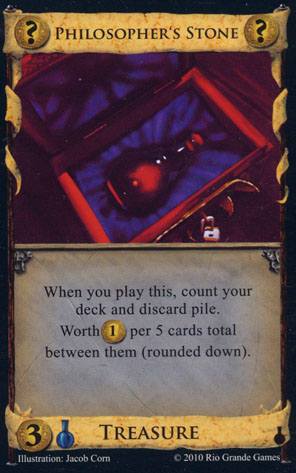
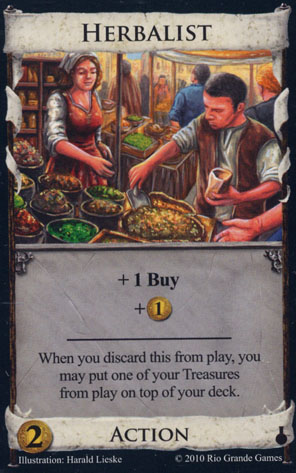
Combo of the Day #29: Philosopher’s Stone/Herbalist


The following is a guest post by Geronimoo, one of the top-ranked players on the Isotropic leaderboard, and author of the first Dominion simulator.

What happens when you combine one of the worst Potion cards with one of the worst $2 cards? Most of the time not so much, but if you find yourself in a slow and ugly game with lots of junk flying your deck’s way, this little combo could be a life saver.

Slow games happen when there are no engines to be built and there’s an attack card in the Kingdom like Mountebank or Militia. The Curses will clog up your hand, reducing your ability to buy Golds and later Provinces and the discard attack will have a similar effect.

Philosopher’s Stone alone will not help much in this case because there’s the opportunity cost of buying a Potion (which could have been a Silver or another Militia) and you might not draw the Potion/Philosopher’s Stone often enough to make up for it because of the bloated deck size. On top of that, the Potion will hurt your buying power just as much in the greening stage as a Curse would. This is where Herbalist comes in. In the early game it will put the Potion back on your deck so you can buy multiple Phil Stones in a single deck cycle and it will put the Stones back on your deck in the greening stage when they will be massive (+$5 or more).

In other words, Philosopher’s Stone is usually only for really big decks, and in those decks, Philosopher’s Stones are hard to buy (because of the Potion), hard to find, and hard to play often. Herbalist addresses all three of those issues, and then some, by adding a +Buy to both fatten your deck and also get value out of multiple Philosopher’s Stones in one hand.

So we’ve established where you might want to try this combo. It’s somewhat easy to spot because the two cards are paired together in Alchemy for a reason. The real point of the article is how to play this strategy, because optimal use of this combo is quite counter-intuitive. Let’s break it down:

Use Herbalist to put back Potion early, and Stones later

When you play the Herbalist in the early game, you can put the Potion back on top to buy another Philosopher’s Stone next turn. If you tracked your deck and know the Potion won’t allow you to buy a Stone next turn, don’t put the Potion back. In the late game the Herbalist will put the Stone back on top.

Buy only one Potion and buy it on the first turn

If you want to give this combo a go, you’ll need to buy those Phil Stones early and often. They won’t be worth much in the early game, but getting them later means you’ll get less of them. And yes, you only need 1 Potion! Most people will get a second if they hit an early $4, but this is a big mistake. The extra Potion will hurt you a lot in the greening stage and a Herbalist putting the Potion back on top will work just as well.

Buy all the Herbalists you can get

Another trap players fall into is buying a few Silvers or Golds or other stuff because Herbalist is awful and “I’ll get them when I hit $2”. WRONG!!! The turns you’re not buying Philosopher’s Stones should be spent buying Herbalists, more Herbalists and then some. It’s invaluable in the greening stage to put back the Stone each turn and the +buy  will bloat your deck to make those Stones truly massive.

Buy Coppers with extra buys

The Herbalist will always give you an extra buy so if you can’t buy an extra Herbalist, buy a Copper! Yes, they will bloat your deck, yes that’s exactly what you want.

Start greening very early

Another quirk of this strategy is that greening early doesn’t really hurt it. Most decks will grind to a halt when they start buying Duchies too early and never reach $8 again. This deck doesn’t mind a few Duchies or Estates clogging up a hand, as long as it contains a Herbalist and a Philosopher’s Stone which will provide all the buying power you need. I’d suggest buying Duchies as soon as one of the Provinces is gone and Estates when half are gone (and you have most of the Herbalists already)

So how good is this strategy really? According to simulations it should beat most attacking strategies in a 2-player game by a small margin (Ill-Gotten Gains rush, Sea Hag, Militia, Mountebank, but not Witch). But it’s the multi-player games where this strategy really shines. Anytime your opponents are choosing an attacking strategy slowing everybody down you’re going to crush them because you have the added advantage over 2-player games that the attacker is being attacked himself.

Here‘s a textbook example where I use this combo to its full effect to beat a Sea Hag player.

And here’s a video of WanderingWinder who despite some early game terrible luck pulls it out in the end.

Just don’t try this in a Fishing Village/Wharf game…

Posted in Combo of the Day | Tagged , | 35 Comments

Annotated Game #11

(Friday’s preview)

Scrying Pool, Scheme, Warehouse, Apprentice, Harvest,
Ambassador, Tunnel, Conspirator, Counting House, Bank

Annotated Game #11

Click for enlarged link at dominiondeck.com

This is a 2-player game played between me and Captain_Frisk.  The log is available here (spoiler alert!).  (If Council Room is down, the original Isotropic link is here.)
Continue reading

Posted in Annotated Games | 40 Comments

Annotated Game #11 Preview

Below is a 2-player game on Isotropic, with Colonies and Platinums.  I will post the annotated game on Monday, April 23.  You’re welcome to comment on the set (how you think players should open, what cards to go for) and try it out for yourself.  Please consider how you would open with either 5/2 or 4/3.

Scrying Pool, Scheme, Warehouse, Apprentice, Harvest,
Ambassador, Tunnel, Conspirator, Counting House, Bank

Annotated Game #11

Click for enlarged link at dominiondeck.com

If you have interesting sample games that you’d like to submit for annotation, we’d love to hear about them. Criteria for annotating games include:

  • Reasonably skilled play by both sides
  • An interesting set where the Kingdom cards are important
  • Diverging strategies taken by both players, especially in terms of openings
Posted in Annotated Games | 36 Comments

Seaside: Tactician

Tactician

Dominion: Seaside

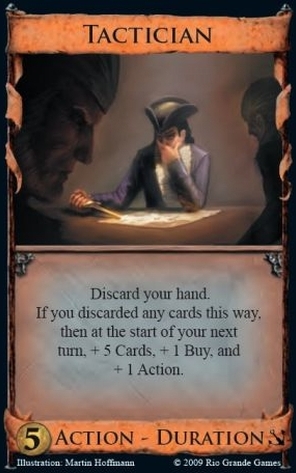
Tactician highlights the general Dominion principle that one good thing is usually better than two mediocre things.  There are two very different ways to play Tactician: Single Tactician, which is how you’d normally think of the card, and Double Tactician, a more advanced technique that sacrifices the ability to play Treasure in exchange for a ten-card hand every turn.

Single Tactician

Tactician is an easy solution to two big Dominion problems:

  1. Putting two pieces of a combo together.  Your Tournament doesn’t always find Province, and your King’s Court doesn’t always meet a good Action to play it with.  Tactician doesn’t technically “solve” this problem, but it sure makes it a lot easier to link up combo pieces.  Use Tactician to backdoor into a Treasure Map activation, or play multiple Barons a turn, or connect your Fool’s Golds: all things that are much easier to do when you have 10 cards to work with instead of just 5.
  2. Exploiting cards whose power increases proportionally with handsize.  Coppersmith isn’t going to get many Coppers to work with in a 5-card hand, but fares much better in a 10-card hand.  Forge gets to trash a ton of cards at once, instead of one or two at a time.  Crossroads can draw a lot more cards even if your deck doesn’t have that many green cards in it.  Bank grows tremendously in power (and gets the +Buy it so desperately needs). Vault/Secret Chamber have more to discard.  Cellar and Warehouse get a lot better when you have more choice.

These two considerations usually mean that the turn skipped by Tactician is worth it.  As a bonus, Tactician is a nice counter to most attacks.  Ghost Ship and Militia are mostly nullified; Witch is still a must-buy, but her Curses are a lot easier to deal with when you’re working with 10 cards instead of 5.

Generally speaking, you won’t want more than one Tactician in your deck (perhaps a second one if your deck is very large).  You don’t usually want to play a Tactician on your Tactician turn, because then you’re really going for Double Tactician (see below).  Occasionally, you see some “mega-turn” decks that repeatedly play Tactician until they can finally draw what they need: building for Throne Room x4 / Bridge x4 is a good example.

Tactician is worst when you have very strong trashing and/or deck draw.  If you can draw your whole deck, or almost all of it, every turn already, then there’s no point to skipping a turn to have a not-that-much-better second turn.  Likewise, any card that depends on having something in your discard or deck does not fare well when your whole deck is in your hand: Philosopher’s Stone loses $1 automatically, and Loan, Venture, Golem, and Adventurer aren’t benefited by a large hand (and in fact are usually hurt).  (A side note on Golem: although it’s possible to use it to get multiple Tacticians in play, for up to +50 Cards/+10 Actions/+10 Buys the next turn, in practice Golem simply does not work with Tactician.)

Double Tactician

Playing a Tactician on your Tactician turn will ensure that you draw another ten cards next turn, but it means that you’re discarding all of your Treasure cards during the Action phase, before you can play them for money.*

* Black Market/Tactician, of course, being the giant, gaping loophole exception to this statement.  It technically counts as a Double Tactician engine, but is sufficiently different from most Double Tactician engines that I’ll just mention it here and move on.

In your average deck, not being able to play Treasures is kind of a big deal.  But double-Tac, almost by definition, gets around this by earning money from Actions rather than Treasure. The goal is to play a bunch of Actions for a lot of money, Tactician away the rest of your hand, buy a Province/Colony, and hope to be able to repeat this every turn for the rest of the game.

Naturally, what kinds of Actions you can play is limited by the number of Actions you can play.  Tactician gives you an extra Action, but you still need an Action in the end to play the second Tactician.  So you have three options:

  1. Get tons of cantrip money, via Peddler, Market, Bazaar, etc.  Conspirator needs a little help along the way but can be a cheap pseudo-Grand Market.
  2. Get tons of terminal money but have enough Actions to play them all.  This is most easily done with Fishing Village, but can also be replicated with other Villages or King’s Court.  (Note that Bazaar qualifies for both this and cantrip money.)  Merchant Ship is one of the best sources of terminal money since it persists to next turn.  Baron is quite nice, since it gives you +$4 per Action.
  3. Get all the money you need from a single Action, via Vault or Secret Chamber (or Black Market/Tactician, as mentioned above).  Secret Chamber needs a little help: in a 10-card hand, the Secret Chamber has 9 cards to discard, but has to save at least two of them (the Tactician, and at least one card for the Tactician to discard), meaning it can only generate $7 at most.  Vault doesn’t need any help in a Province game, since it’ll draw up to 11 cards and be able to discard 9 of them for money.  Both will require some assistance in a Colony game.

Some things to keep in mind as you build this engine:

  • It is absolutely critical for this engine to keep drawing that second Tactician.  Without the consistent Tactician every turn, you can’t find all your Actions or that other Tactician, and it’ll cost you multiple turns for you to start the chain again.  And as you start to green, the chance that you miss that second Tactician grows.
    • So a sifter like Warehouse or Cellar is a fantastic addition to the engine, and Scheme just eliminates the problem altogether.  Otherwise, you need to be mindful that you’re building in such a way that can handle adding green cards to the deck (Crossroads is a great example, as is using Haggler to buy Province + engine part).
  • Like all engines, this takes a while to set up, and if you aren’t efficient, you might get outraced (especially since your opponent has access to Tactician).  This game is a good example of how building the double-Tac engine too slowly means I get outraced to the Provinces.
  • It’s a waste to spend extra turns building up your money to a level you don’t need.  Ideally you will hit $8 or $11 exactly each turn; of course, more money is nice, but not if it costs you a turn in setting it up!
  • Adding an attack or cards that give VP is almost a given, because you’ll able to play them every single turn.  Goons, of course, will do both and give you +$2.
  • Some trashing often benefits this engine: it helps you set the engine up faster, and the key advantage of this deck is long-term consistency, one of the big weaknesses of a Chapel-thinned deck.
  • Outpost gives you even more opportunities: depending on the set, you might be able to have your Tactician trigger on your Outpost turn instead of your Tactician turn (thus allowing you to double-Tac without having to sacrifice your Treasures), or even go for the rare triple-Tac (where you get a Tactician benefit on your Outpost turns too).
  • No matter what, don’t forget: always leave at least one card for the Tactician to discard!  It is always quite embarrassing to play Tactician with an empty hand and realize too late that there is no benefit to doing so…

As with most engines, double-Tac can be beaten in very fast sets (e.g., Governor, which can seriously slow you down by force-feeding you Silvers) and sets with Cursers, which will clog up your deck too much to reliably trigger the double-Tac.

Some sample Double Tactician games:

Works with:

  • All cards that benefit from big hands: Warehouse, Bank, Crossroads, Forge, Coppersmith, Vault, etc.
  • All cards that depend on hitting some other card: King’s Court, Fool’s Gold, Baron, Tournament, Treasure Map, etc.
  • Mega-turn decks
  • Black Market
  • Double-Tactician requires Actions that produce +Coin and benefits from +VP cards
  • Opponents’ handsize attacks

Conflicts with:

  • Decks where you can easily draw the whole deck without Tactician’s help
  • Menagerie
  • Diggers, or cards that depend on your deck/discard: Venture, Golem, Adventurer, Philosopher’s Stone
  • Possession (requires you to keep track of where your opponent’s Possession(s) are, and when it is “safe” to Tactician)
  • Double-Tactician conflicts with Cursers


Posted in Seaside | Tagged | 26 Comments

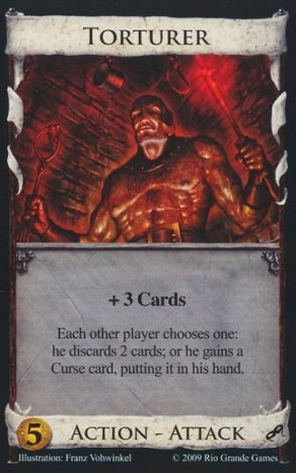
Intrigue: Torturer

Torturer

Dominion: Intrigue

I had a game in which one of my friends stood up, enraged, and went into the other room to calm down. This card was the reason. Don’t let it happen to you! The secret to happiness is, do not simply refuse to take a Curse no matter what. Sometimes, you have to take that Curse. Discarding five cards and passing is not the path to greatness. You’ve been warned!

–Donald X. Vaccarino, The Secret History of the Intrigue Cards

Probably the best-named card in all of Dominion.  Like a true sadist, the choice that Torturer offers somehow manages to make the card even crueler, as you futilely discard  hand after hand, hoping to avoid those Curses.

Torturer is only effective if you can play multiple Torturers on a single turn. Unsurprisingly, Torturer is therefore a card that depends heavily on “villages” (any card that gives +2 Actions).  Without them, Torturer is a lousy card and not worth the $5 in a 2p game.  Even with villages, as CouncilRoom.com demonstrates, the price point of the villages greatly impacts the efficacy of a Torturer chain:

$2 / $3 / $4 villages: There’s almost certainly not a better strategy out there than a Torturer chain.  Depending on how quickly you can get Curses into play, though, you might be able to beat a Torturer chain by handing out many of the Curses first with Sea Hag / Witch / Mountebank / IGG.  Otherwise, pretty much your whole game is going to be buying Torturers/Villages and being the first to trigger the Torturer chain.  The usual principle of Shanty Town being crap and Fishing Village being absurdly good in such decks remains.

$5 villages: This is a tough sell, first because your villages are now quite expensive, and second because it directly clashes with Torturer.  In other words, with Fishing Village, you can get Torturer when you draw $5 and Fishing Village when you draw less than $5.  With Bazaar, you don’t have that option.  On the other hand, your $5 villages are now way stronger.  City is the best example, because when Torturer runs out of ammo the Cities get upgraded.  Likewise, Bazaar and Festival give you money, which is critically important in a deck where you want as little Treasure as possible.  I wouldn’t go for this combo with another Curser on the board, however, or in very fast-paced games.

$6 villages: Ordinarily, this wouldn’t be at all sensible, because $6 is just too much for a village.  Nobles/Torturer, for instance, probably isn’t a winner.  But Border Village is a very special case, since it essentially lets you grab both pieces of the combo at once.  With Border Village, I like to open with a Torturer, get a Gold, and then start buying Border Village and picking up Torturer.

Within the Torturer chain, the power of Torturer is really the +3 Cards.  Without it, a Torturer chain is just a fancy set of Witches.  But because it can draw so well, a Torturer chain will draw the whole deck repeatedly so you can Torture on every turn.  You can’t do that with Witch without massive trashing.

When setting it up, your main focus is therefore to get your engine running as soon as you can.  Torturer chains tend to have a runaway leader problem.  Whoever is first to play the second or third Torturer in a row will deal a crippling blow to their opponent, thus impairing their own chances of setting off the Torturer chain.  It is therefore very important that you buy as little Treasure as possible while building your Torturer chain; you only need enough Treasure to buy your engine parts; you can focus on getting the money for Provinces after you start playing multiple Torturers.

The best way to build your engine is to roughly balance the ratio of villages to Torturers, with slightly more emphasis on the villages than the Torturers (since a hand of 5 Villages is better than a hand of 5 Torturers).   If you look at the “progressive” chart in the Fishing Village / Torturer card ratios graph, you see the that the ideal village-to-Torturer ratios during the game are around one more Fishing Village than Torturer.

The handsize reduction attacks work well with Torturer, because you can force someone to discard down to three before making the discard-two-or-gain-Curse choice.  Likewise, Masquerade is a good play when your opponent discards, though of course not such a good idea when they chose to gain the Curse!

Lighthouse, as with most attacks, is the best counter to Torturer.  Watchtower does too, but might get in the way of your own Torturer chain (and Trader definitely will).  Tunnel makes Torturer a real liability even after the Curses run out.  The fact that Torturer gains to your hand is a somewhat subtle weakness: it makes it a bit worse than Witch because someone with Trading Post or other trash-from-hand cards can just trash all the Curses immediately without it ever entering the deck.

More generally, as alluded to above, attacks that give out Curses are a lot faster and more reliable than Torturer.  Just like how Witch beats Mountebank, Cursing attacks tend to hurt Torturers more than Villages help it.

Barring those specific counters, I tend to take Curses whenever it doesn’t change what I was going to do on my turn.  I don’t discard engine parts, but I will discard Treasure if there’s a decent chance I’ll draw enough on my Torturers to buy what I want.  If I know that I’ll be hit again with the Torturer, then I’ll take the Curse.  As the opening quote suggests, if you’re discarding your hand every turn, then either you didn’t have much hope to begin with, or you shouldn’t have any any more.

Note that in multiplayer, Torturers become ridiculously, stupidly more powerful.  Even without +Actions, you might get multiple Torturers played on you in a single turn.  Without Lighthouse or other hard counters, I will almost always race for a Torturer chain while having little choice but to take Curses.

A final rules clarification: yes, if Torturer runs out of Curses to give out, then the attack is meaningless.  You can discard if you want to, but you can also just choose to take a Curse (unsuccessfully).  But don’t feel too bad for the Torturer: after all, he’s got a +Actions/+Cards engine set up in the meantime…

Works with:

  • Villages (especially Border Village)
  • Other handsize reduction attacks
  • Masquerade (maybe)

Conflicts with:

  • Lighthouse, Watchtower
  • Mass trashing from hand (e.g., Trading Post, Forge, Chapel)
  • Curse-givers
  • Masquerade
  • Tunnel
Posted in Intrigue | Tagged | 49 Comments

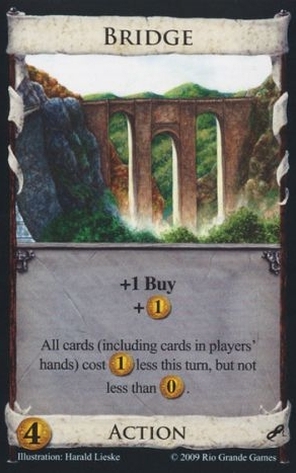
Intrigue: Bridge

Bridge

Dominion: Intrigue

A single Bridge is a terminal Silver.  Like most of the terminal Silvers (Swindler, Woodcutter, Chancellor) it gives you a little plus: you could think of it as a Silver with +Buy that gives you $1 more per buy.  So it’s a little more flexible than a Silver if you want to pick up cheap junk, but otherwise not all that interesting.

The real power of Bridge, of course, is stacking them on top of each other.  King’s Court and Throne Room are easy examples: KC – KC – Bridge – Bridge – Bridge is the original megaturn combo, which gives you -9 to all costs, $9, and 9 buys.  It is guaranteed to be able to buy out 9 10 Provinces in a single turn (enough to empty the stack in 2p), and with a little help can even empty 9 10 Colonies.  The key tipping point is when you have enough Bridges such that your target purchase costs $0: now your purchasing power is suddenly no longer limited by your money, but by your +Buy.

As most people realize, it’s difficult to play a mega-stack of Bridges without +Actions.  Chaining KC’s and TR’s will only get you so far.  But the true hidden crux of the Bridge megaturn is +Cards.  You can’t get enough Bridges in play unless you have some way of drawing them all.  This is why a simple Village / Bridge doesn’t get you very far: with just five cards in hand, you can’t rely on drawing enough Bridges to do what you want.  (Native Village/Bridge being a somewhat odd exception.)

In that sense Bridge is the archetypal “engine” card.  If you’re playing mostly just money, then there is surely a superior terminal for your deck than Bridge.  But with +Actions and +Cards, Bridge’s power accelerates with each Bridge added.  Bridge shines with cards like Tactician, City, and Wharf: the typical mega-turn cards.  In other words, Bridge is only worthwhile if you can play 2, 3, 4, etc. of them on a single turn, looking to empty all the piles at once.  On boards where you have no real way of doing this, you may as well look elsewhere.

It is technically possible to use Bridges to have some fun with Swindler, Upgrade, Saboteur, etc.  In practice, this will not work.  Don’t bother.  Highway is the card with which to do that; if anything, you’re more likely to shoot yourself in the foot with Bridge and trash-for-benefit cards like Bishop (which suddenly gets a whole lot worse once you’ve played a lot of Bridges).  You may as well just be playing an extra Bridge instead of going for these shenanigans.

In many ways Bridge is a lot like Goons, and indeed the two work very well together.  Buy phase synergy is a multiplicative product of three factors: +Buy, cost reduction, and buy duplication (with VP per buy being a special added factor for Goons).  A single factor doesn’t do much: it doesn’t matter how cheap Peddler is if you only have one Buy.  The power of Goons and Bridge derives from the fact that they are both “buy multipliers”: they each provide explosive buy phase synergy because they add multiple factors to the equation.  (This is incidentally why Highway will never be as good as Bridge: although it’s easier to stack, it is only giving you one of those four factors, and you need another one to make it worthwhile.)

Works with:

  • Other Bridges
  • Engine games built around a mega-turn:
    • +Actions, +Cards (Tactician, City, etc.)
    • King’s Court / Throne Room
    • More +Buy
  • Native Village/Bridge
  • Cards that contribute to a three-pile ending (and therefore advantage a mega-turn build): cheap alternative VPs, attractive Kingdom cards that will empty out
  • Other buy phase synergy cards (Talisman, Goons)

Conflicts with:

  • Money games
  • Attack-driven games
  • Your own trash-for-benefit
Posted in Intrigue | Tagged | 19 Comments

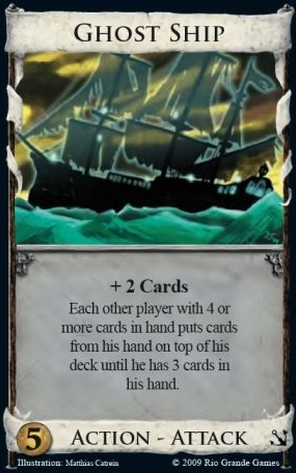
Seaside: Ghost Ship

The following is an expanded and revised version of a guest article by HiveMindEmulator, originally posted in the forum.

Ghost Ship

Dominion: Seaside

A ship by the side of the sea
reduces hand sizes to three.
And when played every turn
will quite often earn
a rage-quit without a “gg”.

The strongest aspect of the Ghost Ship attack may be its psychological component.  It’s difficult to appreciate just how nasty a Ghost Ship game can be until you’ve experienced what it’s like to live under a never-ending barrage of Ghost Ships.  Like Torturer, Ghost Ship is well-suited to ragequits; but while Torturer eventually runs out of Curses to threaten you with, Ghost Ship is a merciless and unrelenting foe.  There are plenty of stronger attacks, but not even Cursers slow a game down like a fleet of Ghost Ships.

Understanding the Attack

When you first look at the Ghost Ship attack, you probably think it looks a lot like the attack of Militia. But then when you think about it or play with it a little more, you see some difference:

  1. It seems weaker because your opponent can use the attack to organize their cards to give them one really good turn.
  2. It seems stronger because you can’t just discard weak cards and forget about it, since getting rid of them means you have to see them next turn. It also slows progress through the deck so it takes longer to shuffle in your new better cards.

So which is it? Is it weaker or stronger?

Well, if you have only one Ghost Ship, it’s probably a bit of a wash. Situationally, one of these effects may appear more prominent. But the real strength of Ghost Ship comes from getting consecutive plays of the attack.

As a thought experiment, consider what happens when you get attacked. With Miltia, your average 5-card turn is reduced into a “good” 3-card turn (a turn consisting of the 3 best of 5 cards). With Ghost Ship, you have to think about next turn as well, so you either reduce 2 average 5-card turns into a good 3 and a bad 5 or a bad 3 and a good 5. Well, usually you’ll want the latter, as a bad 3 and a good 5 can actually at times be even better than 2 average 5s due to general convexity of card values (a Gold is better than two Silvers).

But now imagine you opted to take a bad 3 and a good 5, and now, right before your good 5, you get attacked again. Now you’re looking at turning a good 5/average 5 into an average 3/good 5 or good 3/bad 5, both of which are now a major downgrade, even without considering the decreased cycle speed. This is where the real power of the attack shows.

This is the key to Ghost Ship, and the reason why its impact is much greater than it seems.  A single Ghost Ship is not a huge deal; the point of the attack only becomes apparent if you are able to play many in a row.  You choke your opponent’s deck, making it impossible for them to progress through it and reach their newly-bought cards.

Of course, in reality, you’re not just playing against BM, and so there are some counters to the attack (which we’ll get to later), but the point is the same: Ghost Ship is an attack that has a hidden self-synergy, because its one weakness (allowing the construction of one above-average turn) does not surface until you stop attacking with it.

How to use Ghost Ship

Now that you we understand that the strength of the attack comes from consecutive plays, the strategy question becomes how to set up a deck that can play multiple consecutive Ghost Ships — preferably one every turn. There are a few ways this can be accomplished:

  1. Get a lot of Ghost Ships
  2. Build an action-chain that allows you to play one of your 1-2 Ghost Ships every turn.
  3. (In multiplayer) Build off the Ghost Ships of other players.

The simplest answer is (1). If you just buy as many Ghost Ships as possible and as few other actions as possible, you have a pretty good Ghost Ship Big Money deck. The general plan with Ghost Ship BM is to try to get a bunch of Ghost Ships ASAP. You want to take an early Gold to help buy them, but a second Ghost Ship should probably take priority over a second Gold since the second Ghost Ship is where the real magic starts to happen. You may also want to get a third Ghost Ship before second or third Gold, but it’s hard to say. (The simulator can’t really answer this because it does not play against Ghost Ship properly.) Once you have have your Ghost Ships up, just buy Provinces, Gold, Ghost Ships, Silver, and eventually Duchies. You don’t really need to worry about over-buying Ghost Ships, because usually it’s better to have too many rather than too few. This is because a collision is just a waste of one card, but having a turn where you can’t play Ghost Ship gives your opponent an extra “good” turn, or at least 2 extra cards.

For openings, you can go with early-game Estate-trashers that you only want to play 1-2 times like Chapel, Remake, Steward, or Island, but not cards that get their value from being played in the mid-game like Monument or Militia, as ideally you want to quickly get to the point where you just play Ghost Ship every turn. Fishing Village can be a help, since it alleviates collisions while still providing money, but Walled Village or any of the other villages are probably not worth the loss in economy vs Silver since you’re not really trying to chain actions. Ghost Ship’s +2 Cards isn’t enough to fuel a real +Cards/+Actions chain.

That leads us to (2). If you want to play Ghost Ship in an action chain, you need a better source of draw, like Smithy, Council Room, or a Lab-type. Council Room has a nice interaction because the extra card given to your opponent by Council Room gets put back by Ghost Ship. If you’re going to compete with Ghost Ship BM, you probably also need some source of +Buy, since you’re bound to start buying Provinces later than the BM player. Generally, you want to play the action chain as you otherwise would, using the Ghost Ships, which are preferably acquired early, as extra terminals. While the draw isn’t enough to fuel the chain, it can be enough to offset the fact that you have to buy more villages instead of draw cards.

Another consideration is Scheme. If you have a Scheme, you don’t have to draw a huge portion of your deck to keep your Ghost Ships coming every turn. Similar tricks can also be pulled with other cards that can save away an extra Ghost Ship like Haven, Courtyard, or Mandarin.

Option (3) is not really something you can control. The only thing to really take from it is that Ghost Ship gets strong more quickly as the number of players increases. If multiple other players are already committed to Ghost Ships, keeping everyone at 3 cards, then there is no need to also go Ghost Ship.  You can instead focus on …

Playing against Ghost Ship

The easy case: if your opponent is not playing Ghost Ship next turn, and you have no ability to draw back the top of your deck, then you should probably save your good cards for next turn unless you have some good purchase possible this turn.

If you’re under perpetual Ghost Ships, the decision is a bit tougher and depends on what you’re going to be able to buy. Ideally, however, by this point in the game, you will typically have some way of drawing back the cards you put back. If you are actually forced to play primarily 3-card hands with no drawing, you basically have no hope. So even if you have no real hard counter to Ghost Ship, you at least need some source of +Cards (Ghost Ships of your own if nothing else). If you’re under perpetual Ghost Ships, you will also find that you play smaller hands than usual, and move through the deck slower, so you can afford to have a slightly higher density of terminal actions than you might have had otherwise. But don’t overdo it, because you do want to be able to reach the point where you regularly draw back the cards you returned from the attack.

There are some “hard” counters to the attack, including reactions which defend hand-size attacks (Moat, Horse Traders), cards that “draw up to X” (Jack of All Trades, Watchtower, Library, Minion), and the generic defense of Lighthouse. But there are also other “soft” counters that don’t directly ignore the effect of the attack, but take advantage of the fact that you return cards to the top of your deck. With Menagerie or Shanty Town, it’s easy to set up your hand so that you can draw the two cards back. They’re not “hard” counters because you just draw the cards back and miss out on further benefit from the cards. If you would have drawn 3 from Menagerie or 2 from Shanty Town anyway, the attack still hurts.

Cards that deal with the top of your deck (Secret Chamber, Spy, Scrying Pool, Jack, Oracle, Apothecary, Cartographer, Wishing Well, Venture, Loan, Farming Village, Golem, Native Village, etc.) can also take advantage of being able to know/arrange the cards on top of your deck. (Note that Jack is both on this list and the list of “draw up to X” cards. It counters Ghost Ship pretty hard.)  Minion is another case: you can put your good stuff onto the deck, and then save a Minion to discard your hand and draw the good stuff.

Another option is to go for “combo” cards like Tournament and Treasure Map.  Tournament missed the Province?  Just put it back and save it for later.  And even even any card that just draws a lot of cards like Wharf or Tactician can help simply because the effect of returning 2 cards is less meaningful when you draw an extra 4-5.

Cards that benefit from long games are also better than usual in Ghost Ship games.  The best example is Monument.  In a multiplayer game, where the other players are busy keeping everyone under Ghost Ship, you will do much better going for Monuments and just slowly racking up VP chips over the course of the game.  You can even afford more Monuments than usual, because if they collide you’ll probably put one back on your deck anyway.

Wharf Big Money should beat Ghost Ship Big Money, since the extra draw completely offsets the Ghost Ship attack, allowing both players to essentially play off of 6 cards every turn. However, Wharf has the added benefit of the +Buy and higher variance in hand-size (3-8 instead of 5-6). Oracle Big Money may also counter Ghost Ship Big Money. Even though the Oracle player will be playing with 4-card hands vs 6-card hands of the Ghost Ship player, the 4-card hands will be filtered into strong 4 card hands, while the 6-card hands will be filtered into weak ones.

As mentioned before, Jack of All Trades is the sickest counter, and Ghost Ship BM with a Jack opening loses to plain old Jack+Money. Venture is a nice card to add in to your Ghost Ship play once you have 3-4 Ghost Ships, since it semi-counters the attack and is a treasure. You should open Loan pretty often on Ghost Ship boards, since it helps counter the attack by skipping Estates while at the same time trimming away Coppers. This leads well into engines, and is still useful in the Ghost Ship BM scenario.  Many of the other counters can be quite nice, but need to appropriately be incorporated into an engine. It’s generally not worth adding in something like a Moat purely for the reaction.

Works with:

  • Money
  • Single-use Estate-trashers
  • Fishing Village
  • Council Room
  • Scheme

Conflicts with:

  • Jack of All Trades
  • Oracle
  • Menagerie / Shanty Town
  • Horse Traders
  • Library-types
  • deck-top inspection
Posted in Seaside | Tagged | 10 Comments