Dark Ages Preview #5

This is the fifth and final preview by Donald X. Vaccarino, introducing the next Dominion expansion: Dark Ages. The community is discussing these new cards in the Dark Ages Preview subforum.

Dark Ages Preview #5

Here they are at last, the Shelters. In an all Dark Ages game, your starting deck is 7 Coppers, Necropolis, Overgrown Estate, Hovel. When mixing sets up, the rule for using Shelters is similar to the Platinum / Colony rule.

Shelters may not be worth the 1 VP of an Estate, but they are way better to have in your deck. Necropolis lets you go a little heavier on terminals from the get-go. Overgrown Estate gives you an extra little treat if you ever manage to trash it. And Hovel has a built-in way to get rid of it – you move out of that Hovel, and into a nice Duchy or something.

You can’t buy Shelters, but they cost $1. That’s just to shake up how various cards interact with them. A Remodel doesn’t take you as far as it used to. And with only one being a Victory card, that Crossroads doesn’t go to as many places. Baron doesn’t know what to do with these. And an Ambassador can’t even give them away, since they have no piles to return to. On the other hand, they are fine places to get animals for your Menagerie. And how much exactly can you build Fairgrounds up to now, in games without Black Market? Man. A lot.

Even though I previewed 15 cards, only 9 of them were kingdom cards. There are 26 kingdom cards left that you haven’t seen. That’s as many as a whole set! It’s like there weren’t any previews at all. And yet they’re over. Someone will no doubt post the card list after the set comes out at GenCon next week, and I will post a Secret History shortly afterwards.

Posted in Uncategorized | 19 Comments

Dark Ages Preview #4

This is the fourth preview by Donald X. Vaccarino, introducing the next Dominion expansion: Dark Ages. The community is discussing these new cards in the Dark Ages Preview subforum.

Dark Ages Preview #4

Rats is my favorite Dominion card. Now you know that about me. You give your kingdom a rat problem. Sure, you get rid of some garbage, but now you’ve got Rats, and they don’t get rid of themselves. Isn’t the solution worse than the problem? Plus, let’s not forget, there are twenty Rats, rather than the usual ten. That’s right: today, you didn’t get the whole story just looking at the pictures. Twenty Rats, even in two-player games. Just chewing your deck to pieces. Well secretly there’s probably something you can do with them. Looking over the cards spoiled so far, they seem to be a combo with most of them, what’s up with that.

Pillage is a more conventional attack, in that it attacks your opponents. It’s a one-shot. There haven’t been very many but this is one. You make everyone else discard their best card, which is bound to hurt them, and you get two Spoils, which sounds good at least. It’s a pretty rude attack, but at least it only happens once per copy bought, barring Graverobbers or something. The thing being Pillaged in the art is of course a Village. I remember when that was a peaceful place, with a guy on a horse.

Spoils is a one-shot Gold. That makes Pillage a one-shot that gets you two one-shots. You can’t buy Spoils; there are three different ways to get it, and the other two get you them repeatedly. A one-shot Gold is pretty good if you were only drawing it once anyway, or if you didn’t really want Gold in the long run, and if those things aren’t true well hey it’s still something.

There are 15 Spoils. I have seen them run out (temporarily of course) but it’s rare. A little math reveals that there must therefore be only one victory card pile. Dark Ages has 35 kingdom cards, adding up to 352 cards, and 35 randomizers; 50 Ruins; 10 extra Rats; 10 Madmen and 10 of some other card you upgrade into; 15 Spoils; and 18 Shelters.

Posted in Uncategorized | 12 Comments

Dark Ages Preview #3

This is the third preview by Donald X. Vaccarino, introducing the next Dominion expansion: Dark Ages. The community is discussing these new cards in the Dark Ages Preview subforum.

Dark Ages Preview #3

Squire is the complement to Steward that you always knew I’d make. Okay maybe you didn’t figure that one out. You get a choice of three things that Steward doesn’t get you, plus $1 in the bargain. It’s a pretty nifty $2, just for that. And if he gets trashed, then you get an attack, any attack on the table. You can Remodel a Squire into a Remodel and a Familiar.

A major theme of Dark Ages is upgrading, whatever that means. Actually I think I can explain it: it’s, turning cards into other cards. Some cards turn other cards into other other cards, like Graverobber does, but some cards turn themselves into other cards, and Squire is one of those.

Hermit is another. He’s normally content to just trash certain cards and gain some Silvers or something. But if you don’t make enough trips into town, he loses it. He goes mad. And then he blows up one day in a fit of card-drawing. Which is my way of saying, well it’s all there on the card. That stuff.

Hermit turns into Madman, a card that isn’t in the supply. You can’t buy a Madman; if you want one, you have to get a Hermit and then not buy something. And then you only get it once! Somehow it’s worth the trouble.

Turning a card into a specific new non-kingdom card requires a pile of ten of those cards. Yes do you really need ten, I know. But you do. And well how much of the set wanted to go to that stuff, rather than say new kingdom cards? So in the end I just did two of those. Now you know one of them.

Posted in Uncategorized | 28 Comments

Dark Ages Preview #2

This is the second preview by Donald X. Vaccarino, introducing the next Dominion expansion: Dark Ages. The community is discussing these new cards in the Dark Ages Preview subforum.

Dark Ages Preview #2

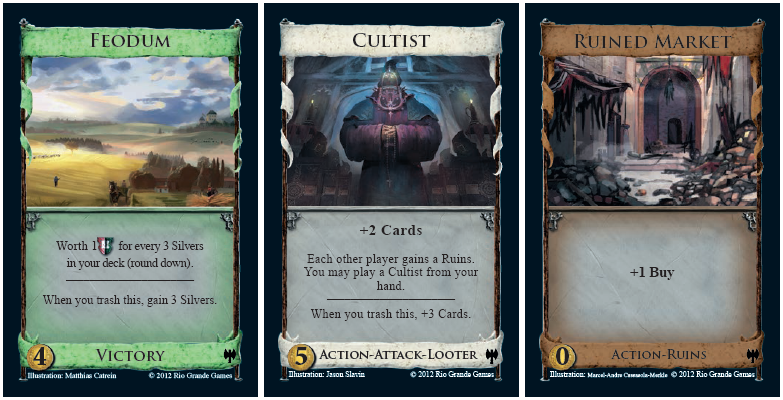
Feodum is the victory card that counts treasures that you always knew I’d make. What you didn’t know is that it would only count Silvers. If Coppers count, man, that’s like a Gardens deck, we built that one already. I mean it’s different but whatever. If Golds count, man, I already wanted a deck with a lot of Gold. So it only counts Silvers. And to help that out, it’s a Silver piñata. You might even buy one just to crack it open, with no plan of really going for Feodums.

Feodum does something when you trash it. There are a bunch of cards like that in this set. There’s really only so much you can do with the trash directly, like Graverobber, but you can do tons of things based on cards getting trashed. And if you are the kind of person who likes card combos, these cards are for you. For example you can just Remodel a Feodum into a Feodum, for the 3 Silvers. Look at that.

Cultist also does something when you trash it. Those of you who were waiting for a Dominion expansion that let you sacrifice Cultists, finally, here it is. And hey you get three cards when you do it. When you play Cultist, you give people a Ruins, that sounds bad, and you draw two cards, and hey you can play another Cultist. These guys stick together. In fact if your deck’s only actions are Cultists, you can just string them together, like a line of hurtful Laboratories.

Ruinses, it turns out, are a pile of cards like Curses, with three ways to get them, besides just buying them or something. They only show up in games with a Looter, which is a word you may have been wondering about on Cultist. There are five different ones (ten copies each) and they’re shuffled together, I’m not making this up. As with Curses you only use ten total per opponent. Not two of each per opponent, just whatever random mix you got. So when you play Cultist, your opponent will get one of these five cards. You will know which one is on top of the Ruins pile, but not what’s under it. You won’t really care; even though some are worse than others, they’re all bad.

Ruined Market for example just gives +1 Buy. It’s as simple as Smithy! I am betting you can guess what three of the other Ruinses do. The last one will remain a small mystery until next week. Looking at the art, it appears that that Ruined Market was once Grand. It’s hard times for all of us.

Once you get given a Ruined Market, well, it’s pretty bad, but it does do something. You don’t usually want it – though it has a certain charm in a Fairgrounds deck – but who knows, maybe that +1 Buy will come in handy. So it’s like a Curse but more interesting. And really that’s the whole point to them.

Posted in Uncategorized | 53 Comments

Dark Ages Preview #1

This is the first of several previews by Donald X. Vaccarino, introducing the next Dominion expansion: Dark Ages.  The community is discussing these new cards in the Dark Ages Preview subforum.

Dark Ages Preview #1
There comes a time in every man’s life when he must preview Dark Ages cards. On second thought maybe that’s not as universal as I was thinking. Anyway, metaphorically, there comes a time etc. And that time for me is now. Actually it was a few minutes ago, when you were reading the cards. I figured I’d just let you keep reading though. Have your fun. I can wait. Okay then.

Dark Ages has several themes and mini-themes. It’s a big sprawling expansion. I am previewing three cards a day, that’s how big it is. It’s also the crazy combo expansion, and today’s cards demonstrate that without even trying.

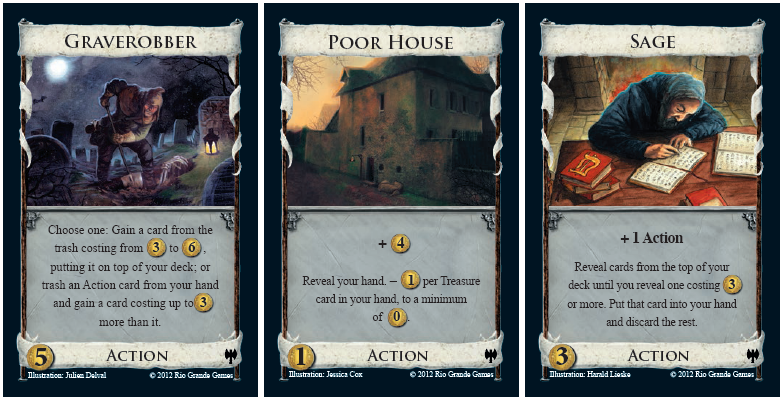
Graverobber is the way to get things from the trash that you always knew I’d make eventually. What you didn’t know is that it would look like that. If you’re gonna take things from the trash, you have to make sure there are good things to get. Graverobber does this by rewarding you for trashing expensive actions – just the kind of thing you’ll want back later. And when you do take a card from the trash, it puts it on your deck, so you’ll draw it before the game is over. Of course if someone else has Graverobbers, maybe they’ll get that card first. It’s a competitive business in these troubled times.

Poor House says, build a deck with no money. Also a Village, no money and a Village. If you can’t trash your money, at least discard it somehow. And it costs $1. Why even have a card that costs $1 – aren’t you usually going to be paying at least $2 for it? Well sure, but you know. Not always. Anyway it’s cool to have a card that costs $1, I don’t know what to tell you.

There’s a tendency to want to show off the most exotic cards, but I don’t want people to think the set will just be non-stop confusion. So I’m also showing off a simpler card, Sage. Dig for a card costing $3 or more, that’s all there is to it. It will turn into something good for a while; then eventually it will start reminding you about those Provinces you bought. And of course sometimes a Sage just wants you to talk to another Sage.

Posted in Uncategorized | 61 Comments

Building the “First Game” engine

The following is a guest article by Geronimoo, who analyzes the steps in designing an “engine”, using one of the most popular Kingdom boards.

You’ve finally gotten your friends together to show them the awesomeness that is Dominion. Trusting Donald X., you carefully lay out the cards according to his “First Game” recommandation in the game rules:

First Game Recommended Set

Click for enlarged link at dominiondeck.com

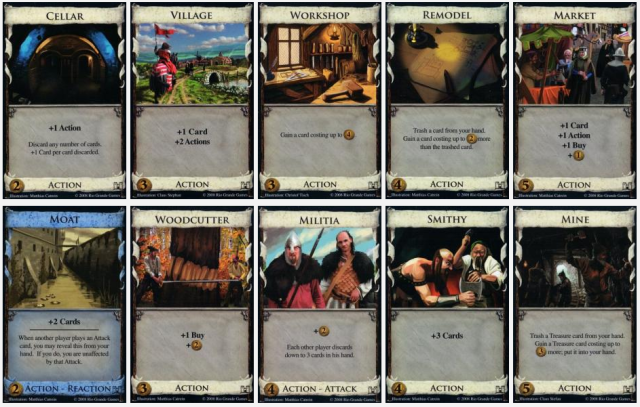
Cellar, Market, Militia, Mine, Moat, Remodel, Smithy, Village, Woodcutter, Workshop

You’ll probably want to show off the two main strategies for this board: Smithy Big Money and the engine centered around Village and Smithy. I’d suggest you play this board twice and start with the Smithy BM deck. You’ll probably crush because your newbie opponents will buy too many actions and have no focus. Now, an observant friend might say this game is badly designed because you only bought one action card and won by a big margin while their cool action cards didn’t really help them much. “True”, you say, “let’s try this again!”

Chances are they’ll copy your strategy from the previous game and you can show off your engine building skills. Now, unless you’re a level +20 isotropic player your engine is not going to beat the Big Money deck. Embarrassing! Your friends decide Dominion is a game dominated by a brainless, broken and boring strategy and you have to resort to the horror that is Settlers of Catan for your IRL gaming fix while those Dominion boxes collect dust in the cupboard…

So, how do you go about building a successful engine for this board that beats the Big Money Smithy deck consistently? It’s not exactly rocket science and we’ll take this step by step. So my little n00b friend, let go of your fears and read on…

Warp or Impulse drive?

The first question you have to ask yourself is what kind of engine you’re going to build? Dominion features many types of engines: see here and here for some discussion. The Village/Smithy archetype should probably aim to draw the entire deck consistently and go for double Province buying turns. Since you’ll be drawing your entire deck, you only need exactly enough treasure to buy what you need. Extra treasures should be avoided because they will only clog up your engine and prevent you from drawing the entire deck. Greening too early is a bad idea because the Provinces/Duchies will clog up the engine like the superfluous treasure, but are also completely useless until the end of the game.

I’m going to use the simulator I wrote to find a good game plan instead of showing you real (isotropic) game logs. The simulator can play most big money strategies as well as an expert human player and even some engines with careful scripting. If you prefer advice from human players, remember that even an expert can make mistakes and unless he’s a Vulcan his brain, like yours, is very bad at probability. 

This phenomenon makes players way too optimistic about how an engine will run while underestimating the power of a big money approach. The variance inherent in Dominion also means one game can never be proof that a strategy is better than another because luck plays such a large role (it’s like saying you’re better than Phil Ivey because you cracked his Aces once in a tournament). It takes tens and often hundreds of real games to find the best strategy and tweaking it to optimal would probably take a lifetime. The simulator does that job in mere seconds! Using this method I will be able to “prove” that a fairly simple engine beats the big money deck consistently in this particular kingdom. (You can download all the strategies in this article here by right clicking and saving, then load them into the simulator via File->Load and select them via “Created by user”).

Basics

Let’s start with the simplest implementation of the engine for this board. We’re just going to buy Villages and Smithies. Once we reach a critical mass we’ll be drawing the entire deck and can start buying Provinces. Since you start the game with 7 Coppers, you need to buy a single Silver to reach the needed $8 (you could even buy a Copper if you open $5/$2). According to the simulator the fastest route to 4 Provinces with this engine goes like this (run the simulation yourself by selecting the “Village/Smithy engine #1” in the simulator after loading the XML-file):

Open Smithy/Silver (or Smithy/Copper), then get a Village and from then on alternate between Villages and Smithies. Buy Province each time you reach $8.

One of the most important things about this type of engine is to get the balance right between Villages and Smithies. If you buy too few Villages you’re going to get a lot of terminal collision, while too many Villages will take you longer to reach the “draw the entire deck” stage. The simulator shows that you should have at least as many Villages as Smithies at all times. This gives the best risk vs reward ratio and the same logic can be applied to most “+actions, +terminal draw” engines.

The 18.5 turns it takes this engine to get 4 Provinces is pathetic compared to the Big Money deck which does the job in 15 turns. And it doesn’t really draw itself consistently (if I let the simulator wait until it does, the number of turns goes up to 20). This deck is so slow because it’s wasting $6 buys on Village and there are a lot of bad things that can happen like the all-Smithy-no-Village hand (terminal collision)

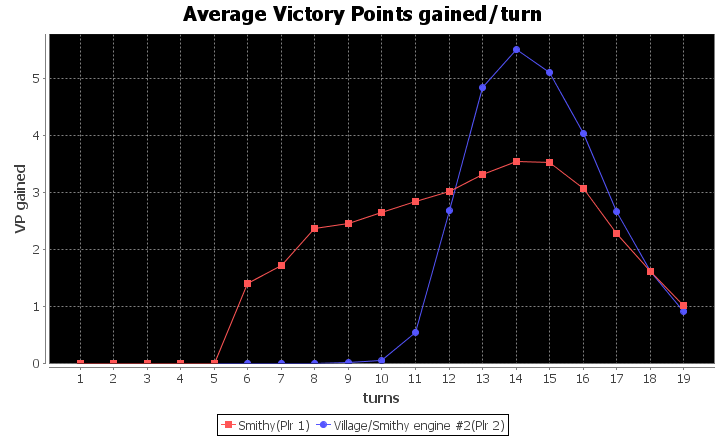
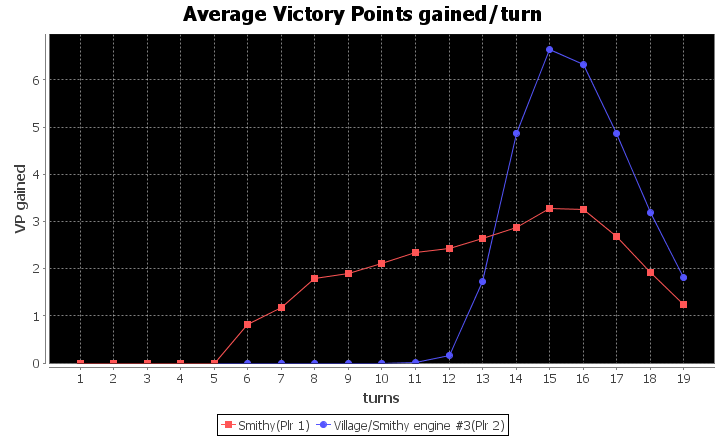
Here’s a view of this engine vs the Big Money Smithy deck (the graph shows the AVERAGE Victory Points gained each turn over 10,000 games which explains why there are no peaks to 6VP):

The Smithy Big Money starts to buy Provinces consistently from turn 6 while it takes the engine a bit longer to set up and has much less success overall getting VP consistently.

Market: The next generation

The engine clearly needs a lot of help! We have to do something about all the wasted economy and that’s where a source of +buy comes in. If we play a Market and have $7 we can buy Village + Smithy which will allow the engine to build twice as fast compared to the version without +buy. The simulator likes the following strategy for the Village/Smithy engine with Markets (select “Village/Smithy engine #2” in the simulator):

Open Smithy/Silver, get a single Gold, then quite a few Markets (5), then focus only on Villages and Smithies (keeping the right balance in mind). Once you have about 4 Smithies your engine should be firing consistently and you can start greening (often you’ll have reached a double Province buying turn by then). Make sure not to buy more than the single Silver and Gold because extra treasure will only clog up the engine.

This strategy is still 1.5 turns slower than the big money deck. Here’s what happens if we let the simulator play this engine against the big money deck (I added a few rules for Duchy and Estate buying of course):

This graph shows how the engine builds up during the first 11 to 13 turns of the game and then explodes with a few mega turns buying Provinces. However, the BM’s early VP lead is too big to overcome and the engine gets crushed winning only 1 out of 4 games. Why is the Big Money strategy so fast and consistent? Well, getting to $8 is very easy with just a few Silvers and the occasional Smithy and/or Gold. On top of that there’s hardly any wasted economy and no dead turns because of colliding terminal actions.

Shields down? Attack!

Instead of trying to speed up the engine, we could try to slow down the Big Money deck. Slower games means attacks and luckily Donald included a decent attack for this first game in the form of Militia. Here’s the engine + attack plan laid out:

Open Militia/Silver, get a single Gold, then Markets (stop at 5), then get the Villages and Smithies (you probably want an extra Village here because Militia is a terminal action). I also added Cellar (buy only if you have $2 to spend and don’t buy more than two) which adds some crucial filtering to counter the possible terminal collision and also speeds up deck cycling so your recent buys become available more rapidly. Once you have 5 Smithies start buying Provinces. Duchies should be bought if there are about 3 Provinces left (so a bit later than the Big Money deck because they clog the engine up more than the BM) and Estates when there are about 2 left.

You want to open Militia instead of Smithy because the early attacks hurt the most, often disabling a crucial Gold buy. After a while you’ll be able to play the Militia each turn crippling the Big Money deck even more as is clearly seen in the BM Smithy graph which is a lot flatter than the previous. (select “Village/Smithy engine #3” in the simulator)

According to the simulator this engine is on par with the Big Money deck (it even has a slight advantage winning about half of the games).

The final frontier

Now we have most of the crucial elements of a successful engine in place: +actions, +draw, +buy, filtering and an attack. There’s just one thing that’s holding the engine back. Drawing itself so often means it’s always stuck with the 3 starting Estates. These hurt the engine much more than the Big Money deck which cycles far less often. The Coppers are less problematic, because they provide some economy to buy engine pieces. If only there was a way to get rid of those Estates…. The more astute reader will have figured out by now that this kingdom has the perfect card for us: Remodel. It will transform the Estates into useful engine pieces and can even be used to speed up the end game by trashing Golds into Provinces. Here’s the final engine’s game plan:

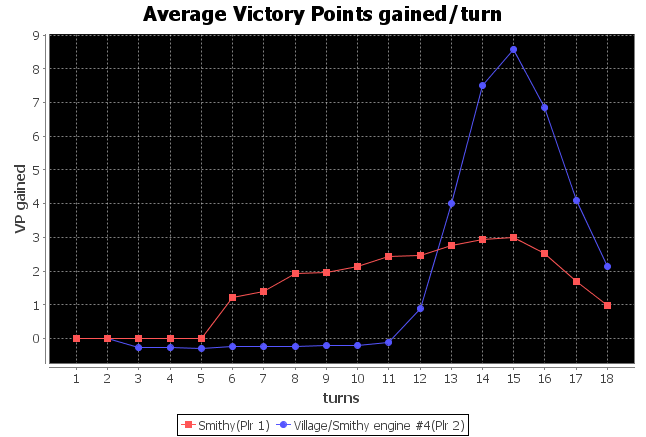
Open Remodel/Silver (or Market/Cellar). Get 2 Golds (these can be Remodeled into Provinces in the end game). Get a single Militia, then again focus on Markets (stop at 4). The Villages and Smithies can be acquired fast by Remodeling Estates and all the +buys from the Markets. Get Cellar at $2 (or Remodel a Copper). Once you have about 5 Smithies your engine is fit for greening. Duchies can wait until there are 3 Provinces left and Estates when 2 are left. If the game is very close to ending use Remodel agressively to transform cards into VP (most notably Gold into Province).

(select “Village/Smithy engine #4” in the simulator) Here’s the buying script that the simulator uses (it is evaluated from top to bottom for each buy):

  • $8 or more to spend: Province (if you have 5 or more Smithies)
  • $5: Duchy (if there are 3 or less Provinces left)
  • $2: Estate (if there are 2 or less Provinces left)
  • $6: Gold (max 2)
  • $5: Market (max 5)
  • $4: Remodel (1), otherwise Militia (1), otherwise Village (if you have less Villages than terminal actions), otherwise Smithy
  • $3: Village
  • $2: Cellar (max 2)

According to the simulator this strategy beats the big money deck almost 3 out of 4 games. The Remodel is really key to put this deck over the top even though the simulator plays the trasher rather poorly (check the “sample games” in the simulator). I expect an expert human player will be able to get at least an 80% win rate against the big money strategy. The bot can be improved with extra buy rules and conditions, but I kept it basic so you can easily copy the play pattern in a real game and be certain of a good outcome. The actual optimal strategy for this board is unlikely to ever be found, but it’s probably similar to what I came up with using the simulator.

So now you know how to play the engine decently for this board you’ll have no trouble convincing skeptical friends and people everywhere that big money is not the be-all and end-all for base Dominion. Even far from it when you add all the expansions!

To infinity!

(this paragraph was added later)

When this article was first published I created a challenge on the forum to give people a chance to find a better bot than what I was able to come up. I expected someone to reach the proposed 75% win rate, but michaeljb surpassed all my expectations and created a bot that gets 89% win rate vs the Smithy bot. That’s huge and knowing the simulator plays some cards suboptimally a human expert should easily win 9 out 10 games using his strategy. How did he do it? It’s complicated, but in short: use Mine to improve Treasures rather than buying Treasures, use Remodel and Workshop to pick up engine pieces, wait until you have a few Smithies to get a Militia, pick up Villages early and often, sprinkle in some Markets, and grab up to 3 Cellars. Check out the challenge on the forum if you want the full detail.

Boldly go where no man has gone before…?

I haven’t touched the case where both players are going for the engine, but that is quite a complex subject and best handled in a separate article (…and then there’s multiplayer which is probably harder than rocket science)

This article shows you an example of how to build a successful engine.  This is just the tip of the engine building iceberg in Dominion, and there are plenty more to explore. If enough ingredients are available and you mix them in the right order you should be able to beat nearly all Big Money decks with them (especially in Colony games). Some of these can be simulated well, while you’ll have to figure others out for yourself or get advice on the forum from expert engine builders like Marin, chwhite or DG. And here‘s some more engine reading.

Ensign Geronimoo signing off!

Posted in Articles | 40 Comments

Prosperity: Contraband

This is a revised version of a guest article by WanderingWinder, originally posted on the forum.

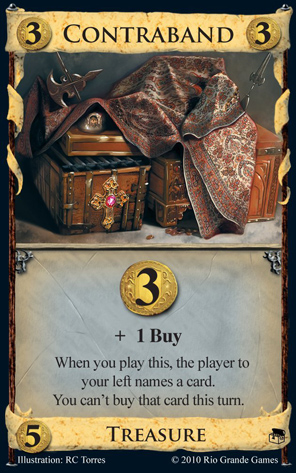
Contraband

Dominion: Prosperity

Contraband needs options.

For example, if you play a standard Big Money-esque game, where all you want is Gold and Provinces, Contraband is very bad.  Early on, your opponent will just block you off of Gold, and later, they block you off of Province, which just makes it very difficult to win. And indeed, in any case where you’re really needing one card, it’s not going to be good for you.

Contraband is also rarely good in multiples, because if one thing doesn’t totally block you, two much more likely will – each Contraband you play means a new thing your opponent can block.  So oddly enough, this Treasure tends to be best in an “engine”, where you play a lot of different Actions, because those tend to have the most different cards that can help you, can make use of the buy, and proscribing one card just isn’t as big a deal.

Because of the enormous complexity of choices, the card doesn’t simulate so well. So unlike most of my articles, there’s no simulation data backing this stuff up. But lots of thought and experience.

Before we go any farther, I think it’s important to note a couple of tactical items about playing Contraband. The first is that you don’t have to play it! Many times, in the endgame, you need to be buying a particular card – say a Province. Well, if you can afford the thing anyway, just don’t play the contraband!

Second, if you do play the Contraband, play it first, before your other treasures. The less information you give to your opponents, the better, as they can’t know what to proscribe nearly so well. The exception is if you want to trick your opponents — play three Coppers, say “oops”, and then play your Contraband.  Your opponent will block Gold, thinking you only have $6, and then you play another two Coppers to buy a Province.

A corollary to this is that Contraband is not so good with the handful of cards that reveal your hand to your opponent. Menagerie might be the biggest exception here, especially when it goes off, but even it can have some weakness. But cards like Hunting Party, Crossroads, and an engine that draws your whole deck are really bad for Contraband, because it gives your opponent a solid insight into what you’re trying to buy with the Contraband.

Playing against Contraband

To play Contraband, you first need to know how to play against it.  The most basic way to shut down a Contraband player is to block Gold then Province.  This is Contraband’s most fundamental weakness: if you spent $5 on Contraband, that probably means the power $5’s (Laboratory, Hunting Party, Witch, Wharf, etc.) aren’t out, so you really need to get to $6’s to be able to buy Provinces.  Being stuck with a whole bunch of $3’s and $4’s is not the route to Provinces, generally speaking.

In other words, as DG notes, as long as Gold is prohibited, the player remains dependent upon the Contraband for coins and might find it difficult to buy essential cards whilst the Contraband is essential currency. As soon as a player has Gold the Contraband is no longer essential currency.

Sometimes, though, another card is more powerful than Gold early on.  This is most common if they are playing an engine deck that needs a lot of Actions: in those situations, you’d rather cut them off from the KEY card they need in their action deck: maybe they’re lacking in Smithies or other +Cards, +Buy, or perhaps Villages.

Contraband is even more painful in the endgame, however, especially if the Contraband player is behind.  Blocking Provinces is the most obvious, which works regardless of whether you are ahead or behind.  But more importantly, there can really come times where Provinces don’t cut it, and they’re going to need a lot of Duchies. Block them from Duchy. I cannot stress enough how important this can be. If they’re going to need lots of Silk Roads to come back, block them from that. In a great twist of events, if they’ve played six Goons with their Contraband, you probably want to block copper.

Here’s an example by chwhite where, going into the final turn, his opponent is down 36-43 and plays Contraband with two Colonies remaining.  chwhite blocks Province, because if his opponent double-Provinced, the opponent would be up in a PPC situation.  Instead, the opponent is forced to take the penultimate Colony and a Duchy, leaving chwhite free to buy the last one instead.

Here’s a game against -Stef- where he uses a Contraband together with his Apothecary engine as… basically his entire economy (mine is not so much stronger).  The key here is that Apothecary is very very fast, but doesn’t have tons of staying power.  So, early on, I block Gold, which is standard.  However, I continue doing this for quite a while – indeed, there were multiple occasions where he drew his ENTIRE deck, played Contraband, and I knew he was holding $10p, and I block… Gold.

Now, why do I block Gold instead of Province when he has $10p to spend?  Well, I could block Provinces later on. More importantly, all the money in his deck was $10p, and $3 of that was tied up in Contraband, meaning he couldn’t possibly buy a Province without one.  If I had blocked Province instead, -Stef- would be able to buy Golds and no longer rely on Contrabands; by blocking Gold, the nature of his engine means he ends up stalling out.

Then we get to the really interesting part of the game, where I start blocking him on Duchies. He’s behind and needs Duchies to come back.  In particular, on Turn 22, I blocked Duchy—he might have had enough for a Province, but if he did, and I blocked Province, he would have won anyway by buying Duchies and Estates.  So this is another principle to keep in mind: if you need good luck to win, play for that luck.

Similarly, when playing from behind, in a situation where they can end the game on three piles, you absolutely need to be able to use that Contraband prohibition on that third pile that they are trying to run out.  I’m pretty sure I’ve blocked Curses before (though it’s very hard to look for that kind of log). In these situations, you’re very often lost either way, but you need to at least give yourself a chance.

More generally, beyond the simple “Block Gold Block Province”, you should just keep careful track of your opponent’s potential buying power.  If they remake 2 cards, play Contraband, well, they only have 1 card left in hand, and if it’s early enough in the game, there’s a good chance you KNOW they don’t have a Gold – so don’t prohibit a 6-cost, as you already know they can’t buy it.  Similarly, if they reveal their hand, for Menagerie, for a Bureaucrat, for whatever, pay attention. If they put back a card, pay attention to what that is. Pay attention to where they are in their reshuffle, and what they’ve already played/discarded. Most important, pay attention to what’s in their deck. You want to know what they have, so you know what they’re capable of, and you want to know what they want to get, so you can stop them from getting it.

Playing with Contraband

Now that you know how to shut down Contraband, how do you play it?

The biggest thing is that you need here is, as I said, options.  In particular, you need options at the $6-$7 level.  Nobles, Harem, Hoard, Goons, etc. will all defeat the standard anti-Contraband strategy of blocking Gold every time.  Of course, later on, the main thing to block is province, so alternate VP can help a lot too. The important thing here is that you need to maintain some flexibility. If you buy Contraband and then lock yourself into a Gardens strategy, well, your opponent is just going to block Gardens and the fact that you could buy Province or Gold isn’t very helpful.

There’s one particular alternate VP synergy I’d like to highlight: Fairgrounds.  Not only is it a nice $6 target, and a good source of alternate VP (potentially exceeding a Province, so even if you are blocked from it you can still buy a Province), but with Fairgrounds you also want to buy pretty much every card on the board. So no matter what they block, there’s going to be something for you to pick up, and the +Buy really, really helps.  Here is a game where I use contraband with a bit of an engine, mostly a big potpourri of stuff, to pump up fairgrounds and help me win a long game against ddubois. Of course, it also features Nobles, so it’s really a model game for contraband being a nice card.

Likewise, Vineyard works well too.  The +Buy helps you grab the Vineyards, you can frequently buy Vineyards on non-Contraband turns, and on Contraband turns you can pick up your choice of Actions.

Another way of getting “options” is with those buy-one-get-another-free cards: Border Village and Haggler.  Black Market functions similarly by giving your opponent three more choices to block, and has the added benefit of getting your Contraband played super early.

So in general, Contraband needs options.  Either this means you have multiple $6 cards to choose from, or it’s not such a big deal that you can’t get one particular card.  In an engine, in particular, you often find yourself needing two cheap cards rather than one expensive card.  (But the $5 cost is usually a big deterrent, because if you have $5 to spend, why not spend it on an engine part?)

The other nice kind of card to help Contraband is a trash for benefit card. Stopping you from getting Gold is pretty harsh in the early game, but the real drawback to Contraband is the endgame blocks. I mean, usually, you’re able to pick up a couple components to help you if they block that Gold – two Silvers at least.  But losing out on that Province is particularly painful.  With a trash-for-benefit, you can get some good use out of Contraband early on and then trash it in the endgame.  Its high cost becomes a boon: Salvager, Apprentice, Expand, etc. all perform nicely with Contraband for fuel.

Overall, it’s not a very good card, but a lot better than the plague some people tend to think it is, in the right circumstances. And the kind of game it can create is a lot of fun, and can make for quite a lot of skill, and a kind of skill you don’t get out of many other Dominion cards.

Works with:

  • Flexibility!
  • Trash-for-benefit: Apprentice, Upgrade, Salvager, Expand
  • Options at the $6-$7 level: Hoard, Harem, Nobles, Goons
  • Alternate VP: Fairgrounds, Vineyards
  • Engines where you aren’t drawing your whole deck and you aren’t stuck to needing one particular component

Doesn’t Work with:

  • Strong $5’s
  • Hand-revealers: Hunting Party, Menagerie, Crossroads
  • Getting stuck needing one thing (a la a lot of Big Money strategies), especially games where you need Golds
  • Other Contrabands (if you are having problems with your first Contraband, the answer is not more Contrabands!)
  • Venture (which can force you to play it at an inopportune moment)
Posted in Prosperity | Tagged | 19 Comments

Dominion: Mine

This is a revised version of a guest article by greatexpectations, incorporating additional analysis from LastFootnote, originally posted on the forum.

Mine

Dominion

A Favorite Card of Mine
Let’s be honest here: Mine is probably most famous for being the card everyone confuses with Mint.  A similar name, similar Treasure-related behavior, and the same $5 price point will do this.  Unfortunately, Mine’s reputation doesn’t get much better past that, considering:

  • It comes from the largely bland Base Dominion set, achieving the honor of being arguably the worst trash for benefit card of the set.
  • Council Room’s Popular Buys ranks it as the 28th worst card by Win Rate With, and the 8th worst at the $5 price point.
  • The forum user base ranked it as one of the worst cards at the $5 price point.

Mine is very often an ignorable card, but as with many other middling/bad cards, in the kingdoms where it actually is useful it can be the star of the show. Much of Mine’s intrigue is due to its fairly unique ability of gaining a card directly in hand. It is this ability which likely bumps Mine from the $4 to the $5 price point. This allows you the benefit of not only improving your deck but also improving your current hand.

The first thing to note, most obviously, is that Mine is mostly best in “money” games, as opposed to “engine” games where you rely on Actions to generate your money.  Of course, a Mine can be a nice supplement to an engine, to boost your additional buying power and allow you to spend your buys on engine parts rather than Treasure, but it is generally a side luxury at best.

Repeated Play
Mine is typically at its best when it can be played repeatedly.  You can achieve this with Caravan/Laboratory stacks, Hunting Party/Golem decks, KC/TR, or conventional large draw decks.  Besides the obvious improvements to your deck in the long run, repeated play offers the benefits of not having to waste your buys to improve your economy. Because the upgraded card goes directly into your hand, you can not only improve your economy you can do so immediately.

One way to think about this is that Mine improves all of your future reshuffles.  The more reshuffles you will subsequently have, the more valuable Mine becomes in the long run.  In the extreme case, at the end of the game, Mine is little more than a Copper.  In the best case, at the start of a game, Mine offers tremendous long-term potential.

Therefore, to maximize Mine’s benefit, you either need to play it multiple times each reshuffle (using King’s Court or Throne Room), or accelerate your reshuffling (with Caravan/Laboratory, Hunting Party, etc.).

The very best way to repeatedly play Mine is with sifters like Cellar and Warehouse.  They are cheap, do not necessarily enable alternative powerful engines (like King’s Court or Hunting Party), and enable a lot of deck reshuffles quickly, so you can get your newly Mined Treasures that much faster.  But they have a second big advantage…

When a few Gold is more desirable than a lot of Silver
In the absence of special Treasure cards, Mine does two things. It turns Copper into Silver and it turns Silver into Gold. As has been pointed out before (I believe by WanderingWinder), Copper isn’t a terrible card in big money games. Moreover, Silver is easy to obtain. You start the game being able to hit $3 very reliably. So trashing a Copper in order to gain a Silver is pretty mediocre.

Gold, on the other hand, is harder to obtain. If there’s one thing that Mine does well, it’s fill your deck with Gold. Therefore as Gold becomes more desirable, so does Mine. Given a big-money type game, there are three basic things that make Gold more desirable: the availability of sifters, discard attacks that allow you to choose what you discard, and trash-for-benefit cards that allow you to convert Gold into Provinces.

Sifters are the big one. Cellar, Warehouse, Cartographer, Stables, etc. all allow you to play your Mine often and then allow you to pick the Gold you’ve accumulated out of the Coppers and Estates left in your deck. Laboratory variants can also help you play Mine more often, but that alone isn’t enough reason to choose Mine over other terminal Actions. You want to play almost all of your power terminals as often as possible. Mine does “stack” more than most terminals, gaining more benefit the earlier and more often you play it, like a Curse-giver. But that alone may not be enough reason to buy it. On the other hand, Lab variants and sifters complement each other very well, so if Mine, a sifter, and non-terminal draw are all available, that’s even more reason to consider Mine.

Your opponent’s discard attacks are the next big reason to buy Mine. In a big money game with Militias being played, Gold becomes much more valuable: a hand of Silver-Silver-Silver-Silver-Estate can’t buy a Province after being Militia’d, but Gold-Gold-Silver-Estate-Estate can.  At the same time, however, Militia makes Gold much more difficult to obtain. Mine helps you amass Gold quickly without having to hit $6 in hand. In a 2-player game, you can’t just ignore Militia in favor of Mine. If you don’t slow your opponent down, they’ll usually win despite your Mine. However, a combination of the two cards can work. Also, if you’re playing a multiplayer game and your opponents are both buying Militias, Mine becomes much more desirable as you can let them snipe at each other while you accumulate Gold.

Perhaps Mine’s biggest tragedy is that these two enablers are mutually exclusive. If your opponents are buying discard attacks, you don’t want sifters.

As for trash-for-benefit cards, I don’t think that needs much explanation. Mine supplies you with the Gold, and with Remodel or Governor, you can quickly convert them into Provinces.

Alternate Treasure Cards
Both Platinum and Potions can give Mine a huge boost.  The jump from Gold to Platinum is massive, and because of this Mine will always be more attractive on Colony boards than Province boards. Similarly, as this article points out, Mine is useful on Alchemy heavy boards because of its flexibility into and out of the race for Potion cost-cards.  For example, in an Alchemist chain, you can convert your Treasures to/from Potions as needed to keep the chain going.

Mine’s power can be extended to most other alternate treasure cards as well. Horn of Plenty, Venture, Hoard, and Harem are all very attractive targets for Mine with a Silver in hand. Additionally, Hinterlands was very kind to Mine, offering both Ill-Gotten Gains and Fool’s Gold.  Mine lets you turn silver into IGG, IGG into another IGG, or IGG into gold, all of which are strong options.  Mine/Fool’s Gold is a pretty solid (+4) opening according to Best/Worst Openings, allowing Mine to turn your early copper into a Fool’s Gold in hand.

How To Play Mine
Mine can offer some tricky decisions when it comes to choosing what exactly you want to upgrade.  Should I swap Copper for Silver, or Silver for Gold? In general, Silver to Gold is probably the better move. Here are a couple of guidelines for helping to make that decision:

  • If it is a Colony board, you should prioritize upgrading S->G over C->S.  Your ultimate target is Platinum, so you will want the best chance of later upgrading Gold->Plat
  • If it is a board with discard attacks, you should prioritize S->G over C->S. You will be working with smaller hand sizes and you will want the larger bang for your buck.
  • Swindler makes things difficult.  You don’t want to lose your coppers to curses, but at the same time Gold is often immune to the Swindler attack. This will be board dependent.
  • C->S should probably be prioritized on Jester boards. You do not want to be fed more copper, but you also do not want your opponent to grab free gold.  A similar suggestion can apply with Smuggler.
  • In general, S->G is better for your deck, but C->S maximizes the number of potential Mine targets.  I rarely find myself without a target for my Mine, so unless there is a good reason otherwise, I will usually upgrade to the highest cost Treasure possible.

Conclusion
Mine’s real problem is that it is an assistant for a relatively slow strategy.  On many boards, there is often a more explosive strategy that will beat out Mine’s long-term benefits.  But given the right conditions, Mine can give you a long-term buying power advantage over your opponent.

Works With

  • Sifters
  • Repeated Play (Caravan, Lab, Hunting Party, Golem)
  • Alternate Treasure (especially Platinum, Venture, and IGG)

Conflicts With:

  • Heavy Trashing
  • Strong Engines
  • Other Strong $5 Terminals
  • Copper Based Strategies
Posted in Dominion | Tagged | 13 Comments

DominionStrategy US Nationals Qualifers Semifinals

DominionStrategy US National Championships Qualifier — Semifinals

Day 1 qualifiers: knaacku, Pirate Ship Economist, Cielo Azor, Personman
Day 2 qualifiers: toaster, zxcvbn2, allfail, WanderingWinder
Day 3 qualifiers:
Mic Qsenoch, jtl005, Richard, r0n1
Day 4 qualifiers: Kayo, Fading, ednever, Mazwa

Each day’s qualifiers will play each other in a semifinal.

Day 1 finalist: Personman
Day 2 finalist: WanderingWinder
Day 3 finalist: jtl005
Day 4 finalist: ednever

WanderingWinder withdrew from the final.  In the six-game three-player final, jtl005 prevailed but was disqualified after he declined to attend Nationals.  ednever takes first place instead.

Posted in Uncategorized | 3 Comments

DominionStrategy Qualifying Day 4 Pods

Continue reading

Posted in Uncategorized | Leave a comment