Guest Article: The Fallacy of Cycling

This article is written by yaron.  He is the Round 6 Champion of the BoardGameGeek Dominion League.

Suppose I have 9 cards in my draw deck: 3 Golds and 6 Victory cards.  What is the probability of my next draw being a Gold?

Well, that’s an easy one: 3/9 = 1/3.  You have a 1 in 3 chance of drawing Gold.

Now, suppose my right hand opponent played a Tribute, putting the top 2 cards of my deck into my discard pile.  What is my probability of drawing Gold now?

Still 1 in 3.  The third card from the top (which is the one you draw after being Tributed) is just as likely to be a Gold as the first one.

Doesn’t the answer depend on the specific cards discarded by the Tribute?

Sure.  But coming in, no one knows what these cards will be.  Averaging over all possible outcomes, your chance is still 1 in 3.  The Tribute didn’t help or hinder your position.

Okay.  Now suppose I played a Loan last turn, finding my first Gold and discarding it.  What are my chances of drawing Gold now?

Just like before, 1 in 3.

Wait, that can’t be true!  I’ve just discarded a Gold!

That’s true.  However, you’ve also discarded some Victory cards on the way to that Gold.  Your deck has 2 Victory cards for every Gold, so you discard an average of 2 Victory cards before discarding the Gold, leaving the proportion of Gold in your deck 1 in 3.

Okay, but that’s because I have a lot of junk.  If my deck had more Gold and less victory cards, playing the Loan would definitely be bad for my next draws, right?

Wrong.  If you had less junk, then yes, you would discard less junk on the way to your Gold.  But you would also have less junk remaining in your deck afterwards.  If 2 out of every 3 cards in your deck were Gold, then after playing the Loan, there would still be an average of 2 Gold for every 3 cards in your deck.

So the desirability of cycling has nothing to do with the quality of my deck?

Exactly.  In a good deck, you’ll cycle away some good cards, but the cards you draw in their stead will be just as good.  In a pile of Curses, you’ll cycle away a lot of junk, but the cards you end up drawing will be just as junky.  It just doesn’t matter.

As an example, let’s look at the Adventurer.  Which is a better buy, Adventurer or Gold?

The answer depends only on the Treasures in your deck.  If your average Treasure is bigger than $1.5, and you have actions to spare, then Adventurer might be better for you than Gold.

However, the answer emphatically does not depend on the amount of Curses in your deck.  If the average Treasure in your deck is worse than $1.5, then no matter how many Curses your deck has, the Adventurer is not worth it.  The Adventurer’s cycling effect has no inherent advantage in a Cursy deck.  The proportion of Curses drawn will be just the same, whether you play an Adventurer or not.

What if I track my discards, and realize that my best cards have yet to be drawn?

Sure, if you know that the one undrawn card in your deck is your only Platinum, it would make sense to skip playing the Loan.  On the other hand, if you know there’s a Silver there, but there are Platinums in your discard pile, play the Loan to skip the Silver and get at the Platinum.

Note, however, that these considerations depend on the quality of your remaining draws compared to the rest of your deck.  They have nothing to do with your overall deck quality.  There’s no general reason to avoid playing your Loan when your deck is brimming with Gold and Platinum—your Loan is no better and no worse than a Copper.

How about cycling in order to draw my new acquisitions faster?  Is that a good idea?

It is.  In the early game and mid-game, you are adding cards to your deck that are better than your existing average.  Cards that cycle your deck will make you reshuffle faster, getting your newest and best cards into your hand.  However, in the late game, most of your new acquisitions are Victory cards.  Cycling your deck becomes a bad idea at that point, because you’d rather not draw these new cards.

Again, this has nothing to do with overall deck quality.  A trimmed monster that’s buying multiple Grand Markets and Platinums each turn can benefit from cycling, because the cards bought are even better than the existing average.  On the other hand, you should try to avoid cycling when buying Estates with your pile of Gardens and Curses.  The cards you are cycling away are bad, but the new Estates are even worse.

Posted in Guest Articles | 32 Comments

Alchemy: Possession

Possession

Dominion: Alchemy

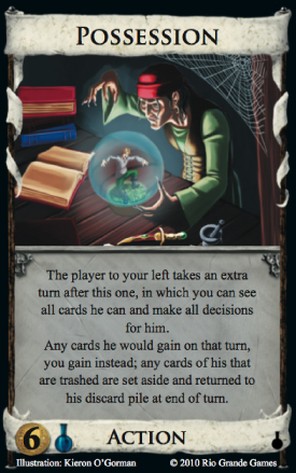
Possession is quite possibly the most hated card in the game.  This article is divided into three segments: how to play Possession, how to counter Possession, and when to go for Possession.

How to play Possession

In building your own deck, there are a couple tactics you can use to maximize the effect of the Possession.  Throne Room and King’s Court are absolutely incredible when paired with Possession; it is the only way to get multiple consecutive turns other than Outpost, and even Outpost only gives you a 3-card hand.  Drawing the golden hand of KC + KC + Possession + Possession + Possession should basically guarantee you the win, since you have 9 turns in a row to either win on piles or build an insurmountable lead.  In addition, multiple Possessed turns eliminates one of the primary counters to Possession, since you can safely play Duration cards and other cards that improve the draw deck.

Council Room also synergizes with Possession.  Play your Council Rooms, giving your opponent a bigger hand, then Possess it.  (As noted below, playing a Possessed Council Room is even better.)  Vault works similarly, though a canny Opponent that smells a Possession coming might just discard his good cards.  And Golem is a great way to keep playing Possession.  Golem’s main weakness is that it discards so much of your own deck, but who cares when you’re hardly using it anyway?

Your own attacks tend to anti-synergize with Possession.  Curse-giving attacks are always strong, of course, but it somewhat decreases the power of the average Possession turn.  (And if your opponent buys them, they’re one of the strongest counters to your Possession.)  Handsize reduction attacks are more mixed; usually you wouldn’t want to Militia your opponents and then Possess them, but if you do it consistently enough, you can start to scare your opponents into discarding good cards to the Militia.  Spies and Scrying Pools can be useful: keep good stuff on your opponent’s deck if you plan to draw those cards while Possessing them.

When actually Possessing your opponent, you should have two goals in mind: getting the biggest benefit out of the Possessed turn, and crippling your opponent’s future turns.  Accomplishing the first goal is relatively easy: play turns like normal, keeping in mind that trash-for-benefit cards are a godsend.  Normally those cards are limited by a desire not to trash expensive cards.  But under Possession, when you can trash without consequence, they become impossibly powerful.  Apprentice Colonies to draw 11 cards!  Remodel a Colony into another Colony for yourself!  Salvage Colonies for +$11!  Mine a Platinum into an extra Platinum for yourself!  Note that cards that provide benefits to opponents are great as well; courteously allow yourself to draw an extra card from a Possessed Council Room, or discard some cards via the Vault.

Accomplishing the second goal (crippling your opponent’s future turns) is a little more tricky.  Be on the lookout for cards that involve choices.  Like Lookout, which can be used to rearrange the top of the Possessed player’s deck to be as terrible as possible.  After you’re done with Treasuries and Alchemists, decline to return them to the top of the deck.  Even better, if your opponent has built a card-drawing engine with Cellar, you can often manipulate his deck by discarding junk cards, then selectively triggering a reshuffle so his draw deck consists of nothing but junk, ensuring several crappy turns.

Also look for cards that can pseudo-trash.  Ambassador and Masquerade are most powerful: return two Colonies to the supply with Ambassador and generously help yourself to one to boot.  Island is great as well: maybe his Platinums feel like taking an extended tropical vacation.

How to counter Possession

The converse of the above advice suggests that in order to deal with Possession, you should construct a deck that can gain cards useful to yourself but not your opponent, and you should avoid cards that, if Possessed, will destroy your deck.  So no Ambassador, no Masquerade, no Island.  Try building Gardens, Vineyards,  or Duchy/Duke decks, since your opponent may be unwilling to gain those cards if he is going for Colonies or Provinces.

Prosperity offers another full-fledged counter: VP chips are always earned by the Possessed players, not the Possessor.  Therefore, a deck built around Monument/Goons/Bishop, not aiming for Provinces, has the benefit of not only denying him his Provinces, but also providing you with VP chips.

The most common way to counter Possession, though, is with unconditional attacks.  Your Possessing opponent will be unwilling to play Sea Hags, Witches, and Saboteurs against himself.  This is especially true with Golem, since your opponent will be hesitant to play your Golems for fear of hurting himself.  Attacks that involve choices are less good: Possessed Swindlers are little more than a nuisance, and Possessed Minions will only help him.

Other cards involving choices are also much worse when you get Possessed.  Treasuries and Alchemists won’t get returned to the top of your deck.  Envoy becomes much better in the Possessor’s hands than your own, especially in 2-player games.  Herbalist and Navigator (and Courtyard, to a lesser extent) become massive liabilities, essentially guaranteeing you will have junk on top of your deck after the Possession.  Loan, which you might ordinarily decline to play in the late game, becomes every bit as bad as you always feared.

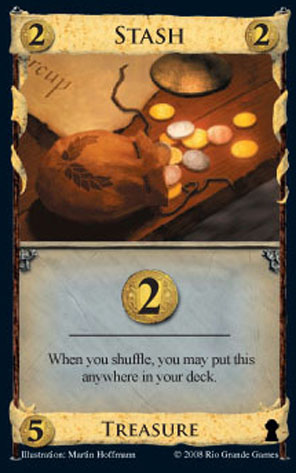
A special note on Stash: Stashes are particularly vulnerable to Possession because the Stash cards have identifably unique backs.  Drawing several them in hand (possibly from a Chancellor/Stash combo) is just begging to be Possessed.  In addition, if your opponent Possesses your deck on a reshuffle, your Stashes are going to the bottom of the deck.

Durations are tricky.  They’re great to have in your hand when being Possessed, since your opponent will be unwilling to improve your future turns.  At the same time, playing Durations on the previous turn telegraphs to your opponent that you have a good hand to be Possessed.  (For instance, if my opponent was going for Tactician, I would simply Haven my Possession from one to hand to another until she plays Tactician to discard her hand.  Then I’ll gladly take the 10-card Tactician hand for myself.)  The one Duration that is completely unaffected by Possession is Outpost, since your Outpost turns are never going to be Possessed.  EDIT: See comments for discussion on how Possession and Outpost interact.

Finally, try to predict when the Possession is coming.  Sometimes you can tell for sure, like when your opponent played a Scout on the previous turn, or you played Cutpurse or Bureaucrat on this turn.  Even when you can’t, you can usually have a pretty good guess.  Have you not yet seen it on this reshuffle?  Is your opponent cackling with delight and a particularly vicious glint in her eye?  Maybe you should junk up your next turn.  Play the Adventurer even though you already have $11 in hand; leave some Victory cards on your deck with the Spy; use Navigator to discard good cards coming up; move your Stashes elsewhere; don’t put your Alchemists/Treasuries back on the deck.

When to go for Possession

Possession is a ridiculously expensive card—consider that, all else being equal, if you had bought a Silver instead of a Potion, every turn you buy Possession you could have bought a Province instead.  Add to that the negative effects of having drawn Potions instead of a Silvers, and there are many situations where the best counter to Possession is not to get a Possession.

In the absence of Colonies and/or other worthwhile Potion cards, then I’m unwilling to buy an early Potion just for Possession.  But if my opponent builds a deck particularly vulnerable to Possession (e.g., Alchemist/Herbalist, or Ambassador), then in the mid-game I will sneak in a Potion to try to play a Possession right as his engine peaks.

If Colonies are present and/or the board seems to call for me to get Potions anyway, then I will look to get Possessions, partially as a counter against my opponent’s Possessions.  Colony games make Duchy/Duke, Gardens, and Vineyards decks (the main counter to Possession) less viable.  In addition, Throne Room and King’s Court are so incredibly strong with Possession that if I will be buying them anyway, then I will certainly go for Possession.  But if my opponent starts to stock up on unconditional attacks or Victory cards, then I will shift to another strategy.

In summary, Possession is not quite a must-buy card.  But more than any other card, its availability considerably warps the strategy of the board.  You don’t have to buy Possession, but you do have to plan for its effect.

Works with:

  • Your Throne Rooms / King’s Courts
  • Opponents’ Ambassadors and Masquerades
  • Opponents’ trash-for-benefit cards (Salvager/Apprentice/Remodel/Mine, but not Bishop)
  • Opponents’ Islands
  • Opponents’ Stashes
  • Opponents’ cards that involve choices (Envoy, Treasury, Alchemist), including attacks (Minion, Swindler)
  • Opponents’ cards that affect the rest of their deck (Lookout, Pearl Diver, Navigator, Courtyard, Herbalist, Loan)
  • Opponents’ cards that involve choices
  • Both your opponents’ and your own Council Rooms
  • Your Golems
  • Opponents’ duration cards (so long as you avoid playing them during the Possession)

Conflicts with:

  • Opponents’ unconditional attacks (Sea Hag, Witch, Militia, Saboteur, Possession), especially when coupled with Golem
  • Opponents’ junk decks (Gardens, Vineyard, Duchy/Duke)
  • Opponents’ VP-chip decks
  • Opponents’ Outpost
  • Possession itself is a good counter to Possession, especially in 2-player games

Posted in Alchemy | Tagged | 30 Comments

Prosperity: Hoard

Hoard

Dominion: Prosperity

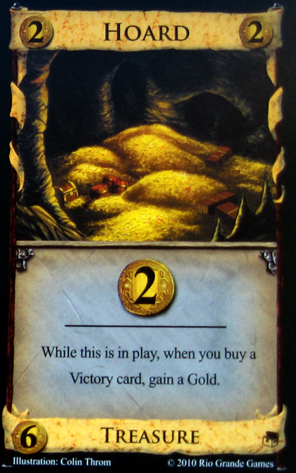
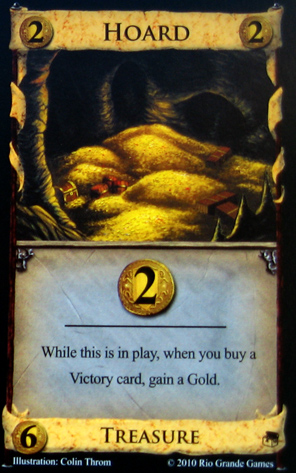
Hoard is strong.  Very strong.  So strong, in fact, that when Hoards are present, you usually don’t need to buy Gold if you can just draw your Hoard often enough.  And you really don’t need more than one or two; with Hoard, your deck will be quite a bit stronger than it usually is after the VP-buying starts.  This means that with $6, you can start buying Duchies much earlier than you normally would.

Hoard is most powerful with the mixed Victory cards (Great Hall, Island, Nobles, and Harem).  It’s also a great way to run a Duke/Duchy strategy, since picking up a couple Hoards before buying the Duchies and Dukes is usually enough to keep your deck producing $5 even after you saturate it with Victory cards.  The same principle applies to Gardens strategies, though you should keep in mind that most Gardens strategies depend on fast endings, and building up to $6 for the Hoard might be too slow.

Hoard is also the rare card that benefits from a ton of extra Buys, especially with the Bridge.  And Watchtower can turn this into a devastating combo: stack up on free Estates, optionally trashing them as they come in, while top-decking your Golds.  Add in a Herbalist for further ridiculousness.

In general, if there isn’t another viable buy, then you should always try to use Hoard to buy a Victory card, even if that means buying an Estate or Duchy before your first Province.  This is especially true when there are trashing cards available, and even more true when those trashing cards provide benefits.  Salvager works best with Hoard, since it gives you a +Buy for all those Golds, but Apprentice and Bishop are almost as good.

So when would you pass up Hoard for Gold?  Well, Hoard naturally works very badly with Treasury.  Hoards are also less effective when Platinums are available; cutting out the Hoard and bootstrapping from Gold to Platinum can get you to Colonies faster, since it’s difficult to get to Colonies with just Hoarded Golds.  And there’s not too much point to Hoards late in the game; for instance, if you have Royal Seal or Watchtower, you might choose to buy and top-deck a late Gold rather than a Hoard, so that you can get to the last Province/Colony sooner.

Works with:

  • Great Hall, Island, Nobles, Harem
  • Salvager / other trashing cards that provide benefits (Bishop, Apprentice) (sample game with Bishop)
  • Duke/Duchy or lategame Gardens strategies (sample game)
  • Watchtower
  • +Buy, especially Bridge
  • Herbalist
  • Explorer, which encourages early Province buying
  • Mine, which can convert late-game Hoards into more useful Golds or Harems
  • Mint, since you’ll have a plethora of good Treasure to duplicate (sample game)

Conflicts with:

  • Treasury
  • Platinums
  • Strategies that depend on few Treasure (Minion, for instance)
Posted in Prosperity | Tagged | 1 Comment

Combo of the Day #17: Chancellor/Stash

This combo is a triumph of two otherwise mediocre cards.  If you can collect four Stashes, then each time you play the Chancellor, trigger a reshuffle and place your Stashes on top of your deck for a guaranteed Province next turn.  Repeat each time you draw your Chancellor.

One major advantage of this combo is that it doesn’t depend on trashing ability like most other combinations.  True, it works better if you have no Estates and Coppers and can be assured of drawing your Chancellor quickly, but the Chancellor takes care of the usual issue of having to get through your deck.  Similarly, it’s quite resistant to Curse-giving attacks, so long as you have enough Chancellors to draw one reasonably early in your deck.

However, the combo gets completely wrecked by handsize-reduction attacks (Militia, Goons, Torturer, Ghost Ship, Minion), as well as Masquerade, if played on your 4x Stash turn.  Likewise, Possession can destroy this deck: either by Possessing your 4x Stash turn (by playing Possession on the turn after you play Chancellor), or by Possessing your Chancellor turn (and then sending your Stashes to the bottom of your deck).  Note that everyone else can tell when you have your Stashes in hand!  (In real life, the Stash cards have a different back; on the Isotropic server, the Stash cards are visible when you click Info.)

Moreover, the combo is incapable of buying Colonies.  And the fact that both Chancellor and Stash are pretty terrible cards means that your engine will be quite weak until the combo is completed.  (Compare to an engine built on Festival/Library: tricky to consummate, but still pays off handsomely even when incomplete.)

A Golem can be substituted for the Chancellor, but it’s more difficult to purchase.  In addition, it’s more inflexible, since it requires that you have no other Actions in your deck.

Sample Game

Demonstrates a “Province rush” strategy on a Colony board.  The Peddler is a decent option for a non-terminal that doesn’t stop you from drawing to your Chancellor, which is by far the most important card in your deck.

Posted in Combo of the Day | Tagged , , | 13 Comments

Dominion: Market

Market

Dominion

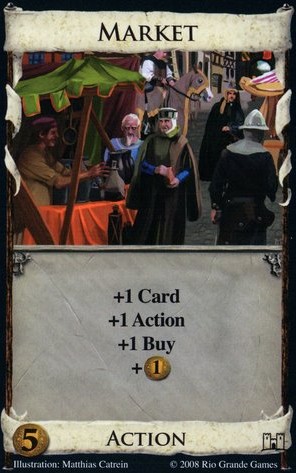
It pains me to say this, but Market is one of the worst $5 cards in the game.

Don’t get me wrong: Markets are definitely good, as a non-terminal Action that provides +$1 and +1 Buy, and therefore readily spammable.  But the problem is its opportunity cost.  At the $5 level, there are some seriously amazing cards that you’d be passing up for the Market.  The $5 Attacks in particular are so ridiculously strong that you will usually fall behind quickly if you can’t keep up with the Mountebanking or the Witching.  Market, on the other hand, is essentially equivalent to having played a Fishing Village on the last turn, except with the +Action traded for a +Buy.  Zzzz.

Not to mention that Market has a ton of similarly-priced clones (Peddler, Bazaar, Treasury, Grand Market), all of which are superior unless you have a pressing need for a ton of +Buy.  Of Actions, Cards, Coins, and Buys, Buys are the least helpful resource—the Market’s abundance of extra Buys are almost always wasted because the quality of cards is superlinear; a $6 card is better than 2 $3 cards or 3 $2 cards. (This is why Tactician is a good card.) With the exception of certain situations involving Goons, Peddlers, Bridge, and Hoard (3/4 of which are Prosperity cards), you very rarely want more than 2 or 3 Buys.

Of course, if there are no other non-terminal $5 Actions, then you’ll mostly be buying Markets with your $5.  But it won’t be ideal, and with two Buys at $10 you’d probably rather purchase $6/$4 or Province/$2 instead of two Markets.

Market, therefore, is best deployed as a supplemental card when superior alternatives for +Buy (e.g., Grand Market, Festival, Goons, or even Worker’s Village) are not available.  A card to pick up along the way so your Laboratory/Alchemist chain doesn’t look foolish spending $20 on one Province (or worse, one Woodcutter).  But rarely as a card to build your deck around, and one of the first to be sacrificed to the Salvager or Forge.

Market’s strengths and weaknesses are best illustrated by comparing it to Laboratory.  It trades an extra card for +$1 and +1 Buy.  Accordingly, it does best in extremely dense and/or fully-drawable decks, where the $1 and the Buy outweigh the disadvantage of drawing one fewer card.  It does worse when cards like Cellar and Vault are available, which take better advantage of increased hand sizes.  And its lack of deck-drawing power makes it much more vulnerable to opponents’ attacks.  You’d rather have 3 Laboratories and 1 Market over 4 Laboratories with no +Buy, but 2 Laboratories and 2 Markets usually leaves you with wasted extra Buys and wishing you had another card in hand instead.

Works with:

  • One of the better (but not the best) sources of +Buy
  • Very dense decks and/or fully-drawable decks
  • Cards that call for +Buy (e.g., Goons, Peddlers, Vineyard)

Conflicts with:

  • Its superior alternatives
  • Opponents’ attacks
Posted in Dominion | Tagged | 3 Comments

Intrigue: Saboteur

Saboteur

Dominion: Intrigue

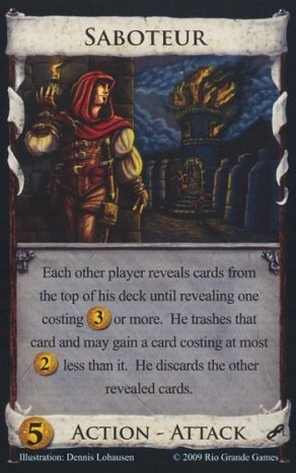
The ultimate spite card, and on the surface, seemingly ridiculously powerful.  But on a closer look, considering its cost, Saboteur is one of the weakest attacks in the game.

First, Saboteur is one of the two attack cards (along with Sea Hag) that provides zero benefit to the attacker, which is a much greater liability than it might seem.  $5 represents an elite tier of Actions, so buying Saboteur means passing up some very strong alternatives.  And the fact that it is terminal means that you can’t exactly load up on Saboteurs without doing even more harm to your own deck.

Second, the attack does benefit your opponents in a way: because it skips all the $0 and $2 cards, it might let them cycle through the junk in their deck.  I would be completely fine with my opponent discarding all my Coppers, Curses, and Estates just to trash a Silver.  (It’s for this reason that Saboteur also anti-synergizes with your Cursing attacks.)

Third, an opponent can sometimes take advantage of the Saboteur to exchange an expensive card for a card they’d rather have — converting $7 cards into Duchies; Golds into Gardens or Estates.  And not being able to buy the winning Duchy because you trashed your opponent’s Peddler into the last Duchy is a pretty painful thing.

Fourth … it’s just not that strong.  The best case scenario is hitting an opponent’s Colony/Province, which either just gets “un-Remodeled” into a Platinum/Gold, or gets bumped down into a Province/Duchy.  The possibility of a 3-4VP difference is therefore hardly that much better than buying a Duchy with the $5.  And your opponents can counter Saboteur pretty strongly by filling their deck with cheap, expendable non-terminal Actions (boo hoo, you trashed my Wishing Well), or hiding their valuables with Island or Native Village.

Nevertheless, Saboteur is still good in certain situations.  If you have an abundance of Actions, there are certainly worse terminals to purchase.  (I’m looking at you, Chancellor.)  It really benefits from gaps in card costs: for instance, a lack of $4 Actions means that a Sabotaged Gold has to drop by $3 instead of $2.  Similarly, Saboteur’s effect is effectively amplified if the only available cards at a certain price level totally suck (how many Talismans do you really want or need, past early game?) and/or are terminal and incompatible with the rest of the set.

Like most other attacks, Saboteur is more powerful early on, when discarding Coppers still hurt, and a couple lucky draws can really hamstring your opponent’s upward progress.  And also like most other attacks, Saboteur becomes wildly powerful with Throne Room and King’s Court, which lets you really pore through an opponent’s deck, making it much more likely that you’ll hit a Victory card.  (You’ll also be trashing his cards much faster than he can replace them.) It’s also a common last-minute desperation gambit if you have no other realistic way to catch up to someone ahead of you in Provinces.

All in all, though, Saboteur looks much more powerful than it actually is.  The best counter to Saboteur is probably not getting one.

Works with:

  • Throne Room / King’s Court
  • Spy
  • Opponent’s Possession

Conflicts with:

  • Opponents that flood their decks with expendable non-terminal $3/$4Actions
  • Your other attacks
  • Peddler
  • Opponents’ Remodel/Expand
  • Opponents’ Gardens decks, since the Saboteur slows you from getting your Provinces before the game ends, while trashing Gardens into Estates accelerates the end of the game and trashing Workshops doesn’t really matter
  • Opponents’ junk decks in general (decks that primarily rely on cards costing under $3: for instance, Counting House)
  • Opponents that hide their Victory cards with Island or Native Village
Posted in Intrigue | Tagged | 34 Comments

Prosperity: Grand Market

Grand Market

Dominion: Prosperity

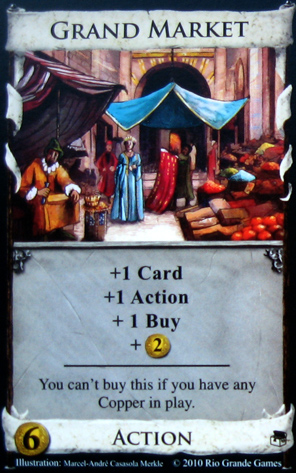
Grand Markets are almost always preferable to Golds.  So long as the average card value in your deck is greater than $1, the self-replacing, non-terminal Grand Market is monetarily superior.  The +Buy is always nice, and unlike Golds, Grand Markets are affected by Throne Room and King’s Court.

Unfortunately, it’s difficult to buy Grand Market, since only quite strong decks are able to produce $6 without relying on Copper.  There’s several ways to do so before your deck gets to that point.

The first, and most obvious, way is with Actions that give money.  Unfortunately, it’s difficult to get enough of them together; it normally takes quite a while to draw 3 Festivals in one hand.  Grand Markets themselves are great for grabbing more Grand Markets, though.

A better way is with Secret Chamber or Vault, because it basically lets you use Coppers without having to play them.  Of course, Vault is better than Secret Chamber for this purpose: because it gives +2 Cards, it guarantees at least $6.  In this game, by going Vault/Chapel instead of Torturer/Chapel, I get my Grand Markets out much sooner than he does.

Quarry also helps; it lets you buy the Grand Market when paired with either two Silvers, a Gold, or another Quarry.  (If you use the Black Market trick to play the Quarry during your Action phase, you can use Ironworks to gain it as well.)  And the Copper restriction on Grand Markets doesn’t apply when you gain the card with Remodel/Expand/Upgrade.

Of course, if you trash your Coppers, buying Grand Markets isn’t a problem.  Nor is it a problem if you have a ton of Silvers in your deck, either from Bureaucrat or Trading Post, but having so many Silvers can be a liability, a sign that you’re not ramping up your deck quickly enough.

In all other respects, Grand Markets have the pretty much the same advantages and disadvantages as Peddlers and Markets (though of course beefed up considerably): they are most valuable in dense decks with high average card value, and are vulnerable to small handsizes.

Works with:

  • Secret Chamber/Vault
  • Moneylender/Loan
  • Bureaucrat/other Silver-gaining cards
  • Actions that give +$ (especially Conspirator)
  • Trashing cards (both to clear Coppers and for a denser deck)
  • Remodel/Expand/Upgrade
  • Quarry

Conflicts with:

  • Coppersmith/Counting House
  • Opponents’ Mountebanks
  • Attack-heavy opponents in general
  • Bank, because it depends on large numbers of Treasures, typically Coppers
Posted in Prosperity | Tagged | 13 Comments

Guest Article: Reading the Board

This article is written by Curses.  He is the Round 5 Champion of the BoardGameGeek Dominion League.

One of the keys to playing Dominion well is not only playing your card in your deck well (tactics), but also knowing what and when to buy (strategy).  A great strength of Dominion as a game is its immense replayability.  With 116 cards to fill 10 card slots, which I call the board for a lack of a better term, there are many interesting, difficult, and occasionally frustrating options for building your deck.  Once you decide upon a strategy for building a deck, then you need to use your tactical aptitude to play your deck.  Dominion seamlessly integrates strategy and tactics, but the focus of these articles will be upon the strategy of creating the best deck based upon the board.

A card’s value in Dominion is relative to the other cards available on the board.  A popular card like Minion may be the best option and board and lead to a race to see who accumulates more, but the same Minion loses some strength on boards with curse-giving cards and/or high economic output with Colonies.  However, a Colony board with a King’s Court may make the Minion strong enough to incorporate it into your strategy.  The same can be said of cards like City, Torturer, Festival, etc.  Even boring Silver may hold an edge over 4 cost cards on different boards.  How do we determine the strength of a card?  There is no definitive way to determine the ‘best’ strategy for every board before a game, but there are some fundamental concepts that can give you an advantage over your opponent.

Step One: Pause a Moment to Plan your Deck

This concept has drastically improved my decks and my wins.  I know the idea is basic, but we must master the fundamentals before we attempt complex maneuvers.  We have the urge to start buying as soon as the game starts, and we can overlook combos which would be apparent if we slowed down!  Before the game starts, ask yourself some questions.  How is my deck going to win me the game?  Which victory cards and/or VP gaining cards will seeking?  Will it be Big Money, action heavy, a draw engine, or a hybrid?  What cards do I want in my deck?  How many of each card do I want in my deck?  If you pause before you play, you can save yourself from running two incongruent strategies.  I try to follow the advice of chess master Emanuel Lasker, “When you see a good mover, look for a better one.”  I’ve amended the Carpenter’s Rule of “Measure Twice and Cut Once” to the Dominion Rule of “Think Twice and Buy Once.”

Sample Game 1: FAIL

I wanted to provide a game where I didn’t follow my own advice.  This was the third game of a league series, and I became emotionally involved in the game.  I glanced at the board and thought, “Ambassador, Quarry, Nobles, Treasure, Win!”  I did not take the time to view each card, nor did I pause to visualize my deck.  If I had been patient, I would have seen that a Scout would be incredibly powerful for fetching Estates to Ambassador and drawing Nobles.  I would have also realized that a single Witch could help slow my opponent with curses and help me with some card advantage.  I blundered on Turn 5 when I missed the Scout buy, and the game deteriorated from that juncture.

Sample Game 2: Good Plan and Great Draws

This was the third game in a BGGDL series against a Division 1 opponent.  I fought my reflexes and took some time to assess the board.  I wanted to buy a Bishop initially, but I purposefully viewed each card.  I realized that a Salvager provided a +Buy, and if I could use action cards like Lookout and Pearl Divers, I could buy several Peddlers in turn, leading to the potential of mass Grand Markets.  When my opponent bought a Bishop, I could trash Estates or Coppers to thin my deck.  I did have some amazing draws that allowed me to rapidly thin my deck and snowball my engine, but the process of pausing and planning my deck made that engine possible.

To be continued…

Posted in Guest Articles | 1 Comment

Combo of the Day #16: Hoard/Salvager

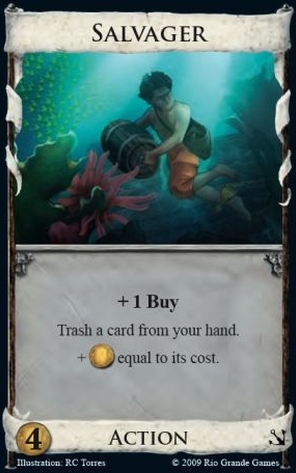
Salvager is a great opening buy, but it tends to stall once you run out of targets.  (This is true of most trashing cards other than Steward.) Salvaging Coppers is just not worth the effort; you’re essentially Cutpursing yourself for a +Buy.

This is where Hoard comes in; it supplies your Salvagers with a constant stream of Victory cards.  You can grab Estates and Duchies to pick up free Golds, then crunch the Victory cards into cash with the Salvager.  And you’ll have so much Treasure in your deck that you can later afford to start trashing your Golds and Hoards for +$6, which is $3-$4 better than playing them (not to mention the +Buy).

Of course, this works just as well with Bishop and Apprentice in place of Salvager, but they don’t give you a +Buy to make use of all those Golds.  (This is especially problematic with Apprentice, since you don’t need to draw all your Golds if you’ll just buy a Province anyway.)  With Forge, Remodel, and Expand, it’s a little more difficult to make use of the Victory cards, though it could be more viable with +Actions.  And Talisman can also substitute for the Hoard, but it’s obviously not nearly as good.

Sample Game

The presence of Platinum/Colony makes this slightly less viable, but the early Duchy trashings are quite powerful.

Sample Game

Despite falling behind early on, repeatedly trashing Duchies (and later, Gold) with Bishop lets me catch up in VPs.

Posted in Combo of the Day | Tagged , , , , , , , | 2 Comments

Prosperity: Peddler

Peddler

Dominion: Prosperity

Without the variable pricing, Peddler should probably be priced at $4, as a Market without the +Buy.  With the variable pricing, it’s a steal at $2 or $0, and you should try to set up a deck with spammable non-terminal Actions to take advantage of it (e.g., Caravan, Spy, Treasury).  Peddlers themselves are also good ways to get more Peddlers.

But Peddlers are best if you can get them down to $0 and then use them to soak up extra Buys.  For example, the easiest way to grab Peddlers is with Worker’s Villages, which provide free Actions as well as ample +Buy.  Past 4, each Worker’s Village represents an additional free Peddler.  Markets can also work, though those are harder to get, as well as Pawns, which are not as effective.

The biggest problem, in fact, is that after a certain point cheapness doesn’t matter any more.  When you’re regularly pulling in $6–$8 per turn, buying Peddlers is a bit of a waste without +Buy.

Peddler’s variable pricing also makes it work extremely well with cards that depend on its cost.  You can:

  • Remodel or Forge it into a Province;
  • Upgrade it to a Platinum;
  • Expand it to a Colony;
  • Bishop it for 4 VP;
  • Apprentice it for +8 cards;
  • Salvage it for +$8.

It also defends against Swindlers extremely well, since once you run out the Peddler pile, an opponent’s Swindler becomes very dangerous to play for fear of turning your Peddlers into Provinces.  Peddler is also one of the few cards that defends against Smugglers, since it’s cheap to buy but un-Smuggleable.

Works with:

  • Worker’s Villages/Markets/non-terminal +Buy
  • Conspirators/other Peddlers/Caravan/Treasury/spammable non-terminal Actions
  • Cards that depend on other cards’ cost (e.g., Remodel, Forge, Apprentice, Salvager)
  • Opponents’ Swindlers
  • Opponents’ Smugglers

Conflicts with:

  • Lack of +Buy
  • Lack of non-terminal Actions
Posted in Prosperity | Tagged | 20 Comments