
Dominion: Hinterlands
No one saw it coming.
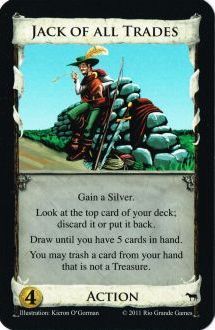
It seemed so innocent. Gain a Silver, it said. OK, but didn’t someone say Silvers weren’t that great? Inspect the top of your deck, it said. Like a half-Spy, who cares. Draw up to 5, it said. So it replaces itself, but doesn’t give me an Action. Big whoop. Trash a non-Treasure card, it said. So I get to use it three times for my Estates and that’s it? What is the point of this card?
Jack of All Trades shares characteristics with many cards. It has Library‘s ability to replenish your hand after you get hit with Militia — but, befitting its name, isn’t great at it. It spies, it trashes, it gains you Treasure, but does none of those as well as other cards.
And yet it doesn’t need to. As it turns out, the card Jack is most similar to is Envoy, because like Envoy, all you need is Jack (two to be precise), and you’ve got an engine that beats pretty much every bad strategy out there. But unlike Envoy/Big Money, DoubleJack/Big Money crushes attacks. Sea Hag? Trash the Curse. Militia? Draw back up. Rabble? Chuck the Victory card. And all throughout it’s gaining Silver. Attacks barely matter at all to DoubleJack: in the simulators,* it obliterates Sea Hag/Big Money and DoubleMilitia, solidly beats ChapelWitch and ChapelMountebank, and goes toe-to-toe with DoubleMountebank and DoubleWitch.
DoubleJack threatens something that no other mindless Big Money bot threatened before: an engine viable enough to beat attacks. The cruelest part about this is that like Envoy/Big Money, you can’t add anything to DoubleJack. Maybe Hamlet, or Treasury, or a few other cards would help the engine, but just about everything else you can think of only gums up the engine. So it’s not even like you can use it as a launching pad onto other strategies; you’re playing suboptimally if you do. Zzz.
DoubleJack isn’t unbeatable. It fares poorly against mega-turn decks, and in multiplayer games, you aren’t going to get far with it with three Mountebanks pounding you in between each of your turns. But it raises the Big Money baseline in an unprecedented way: it’s not significantly faster than Smithy/Big Money, but it sure is a lot harder to stop.
The real lesson to be learned here is that being able to do multiple things at once in the early game is really, really helpful. Masquerade is the top $3 card in the game because it improves your buying power AND thins your deck. Only the truly insane single-use cards (Chapel, Sea Hag) can compete with cards that accomplish multiple early game objectives. And Jack does it all: it trashes, it gives you a full turn, and it adds in a Silver for good measure. On a mediocre board, there’s not much that can stop two Jacks of All Trades.
Works with:
- Hamlet, Market, Treasury: non-terminals that either disappear from your hand or provide some other meaningful benefit AND do not increase your hand size
- The key here really is the $5 cards, since you don’t really want Silver but you can’t afford Gold. Most of the $5 cards will hurt, but some won’t get in the way.
- See yaron’s post in the comments
- Another copy of Jack
Conflicts with:
- Multiplayer games
- Caravan, Lab, other handsize-increasers (oddly enough)
- Very strong, very fast combinations
- Mega-turn strategies like Native Village/Bridge
- Colony games hurt, but do not completely cripple DoubleJack
* The power of Jack (specifically, the DoubleJack bot) is definitely one of the biggest discoveries yet from the simulators, and it’s one that certainly would not have been immediately obvious to human players.





 Dominion Strategy