
Editor’s note: This is a guest article by rinkworks, originally posted on the forum.
tl;dr: Playtest your fan cards. That’s 10,000 words condensed down to four!
Continue reading
Editor’s note: This is a guest article by rinkworks, originally posted on the forum.
tl;dr: Playtest your fan cards. That’s 10,000 words condensed down to four!
Continue reading
This is a revised version of an article written by WanderingWinder, originally posted on the forum.
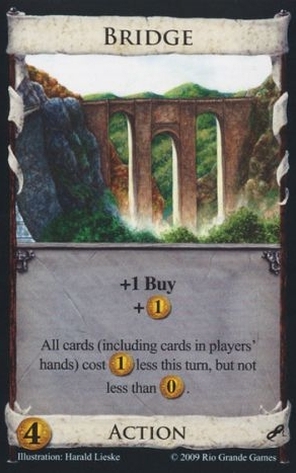
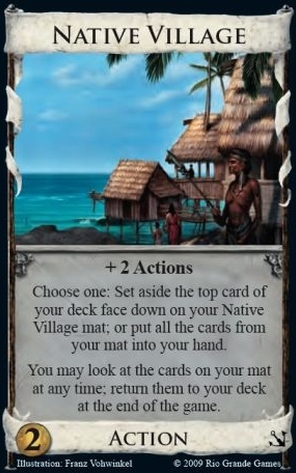
We all know that KC-KC-Bridge-Bridge-Bridge is a killer, killer combo. But it’s so hard to pull off. There is, however, another extremely reliable way to get many Bridges played in the same turn, and that is through the use of Native Village.
This is more of a total-game-strategy rather than just a little combo. You want to start NV-Bridge (you can do this on either 5/2 or 4/3, which is nice), and then simply keep buying those cards, and more or less only those cards, for the rest of the game.
Every time you play Native Village, always choose to set aside the card. What you’re going for eventually is to pick up a massive Native Village mat, play a ton of bridges (fueled by the actions from NV itself), and win.
There are a few ways you can look to win, and you really need to watch your opponent for that. If they’re going for a rather conventional strategy, like Big Money, you want to hold off on “going off” for quite a long time, so that you can get like 6 bridges (or maybe even more) in one turn and just scream through the Provinces and win.
In a mirror matchup, you have to be VERY careful about the game ending on piles and/or be ready to set the combo off prematurely in order to three-pile and win. In general, three piles are something you always have to watch out for, as the Native Villages and Bridges themselves are going to go pretty quickly, and with so many extra buys, you can easily run out even a fairly full pile pretty quickly.
This combo is very powerful and pretty fast, but it has some limitations. First of all, it’s somewhat vulnerable to curse-givers and other deck-bloaters (see Ambassador), but you can counter this pretty hard by increasing your NV’s a little. Curses don’t really matter if they’re all on your NV mat!
It’s more vulnerable to Swindler when there are bad $2’s and $4’s out there. NV/Bridge works nicely, but NV/Cutpurse does not.
As for speed, it can be crushingly fast. It beats Chapel, Ambassador, and most Cursers. For instance (and this is not uncommon with this combo), your chapelling opponent has 5 Provinces, a Chapel, and money, and you pull the trigger on your combo. If you can get 6 Bridges played in a turn, that’s enough, even without any money, to buy 3 Provinces and 4 Duchies, which is as much VP as the 5 Provinces, and your 3 Estates will win it for you.
Disclaimer: Dominion does a really great job of balancing its Kingdom cards. Pretty much every card has some situations where it shines, and some situations where it doesn’t. Nevertheless, some cards just end up being flat-out better than others, either because they are more useful more often, or just ridiculously good when they are useful. Don’t expect this list to be objective.
Dominion: Hinterlands
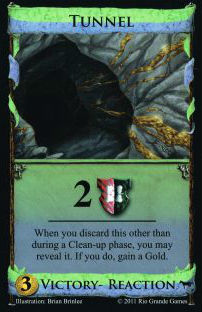
Honorable Mention: Tunnel
Even if it had no Reaction ability, the fact that it’s $3 for 2VP is enough to make it a common late-game buy. The Reaction doesn’t seem like much at first, until you realize just how many cards it comboes with. Much like Menagerie, Tunnel’s strength is going to depend on what expansions you have; with all the expansions in play, you’ll almost never find a board without at least some kind of Tunnel synergy.
It’s still normally a dead card while in your hand, and usually not a good opener, but it is not hard to build a strategy around Tunnel that ends up emptying the Gold pile.

Dominion: Seaside
5. Warehouse
The ability to draw before you discard is why this card is on the Best list and Cellar was on the Worst list. It makes combos like Treasure Map/Warehouse possible, and makes it a meaningful play even when your hand is already good (to clear out the top of your deck and cycle a bit faster).
About the only time you won’t want Warehouse is if you literally have no bad cards in your deck to discard. It’s strong throughout the whole game: early on, it lets you keep playing your key Actions or combos by cycling and sifting your deck; in the late game, it bypasses your Victory cards and keeps your deck alive. Warehouse thrives with high-variance decks and Action combos, when you want two good cards rather than four mediocre cards.
Dominion: Cornucopia
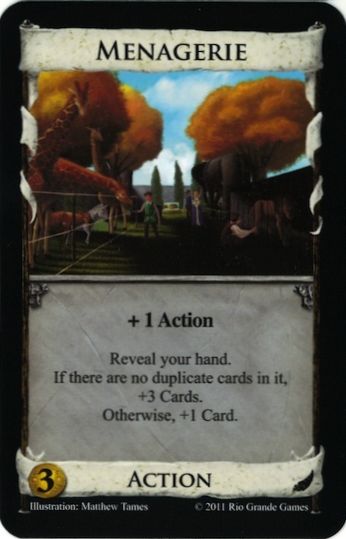
4. Menagerie
Menagerie takes a little work to set up. The most obvious way of making it work is to buy tons of unique cards, but if you try that approach you’ll spend most of the game raging at your “bad luck”. (Not to mention how a deck full of hodgepodge cards won’t get anywhere.)
A better option is to trash your duplicates, which in the early game, basically means Copper. On the other hand, if your deck is that small, the Menagerie is not as meaningful.
The best option, and the reason it’s on this list, is to discard your duplicates as they come up. There are many cards that now allow you to discard cards for some benefit: Warehouse, Hamlet, Vault, etc. Even better, your opponent might discard your cards for you: Menagerie is a vicious counter to Militia and Goons. With this many options, you’ll almost always be able to find some kind of Menagerie synergy on the board, and then it’s basically a double-Lab that costs $3.
Dominion: Seaside
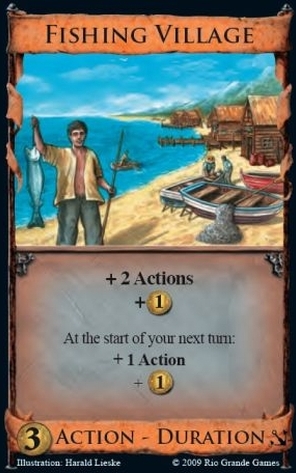
3. Fishing Village
Heavy Action chainers must have thought they died and went to heaven when they saw this card. +2 Actions this turn and the next? And money to boot? With good terminals, this is one of the few cards you’ll see people double up on on the first two turns, just to make sure they grab their share before it runs out.
If there aren’t good terminals, this card becomes quite useless; it’s essentially a Copper this turn and an extra Copper the next. But its sheer power in the presence of +Cards, Goons, Bridge, or any other good terminal makes it far and away the best +Actions card in the game. You feel almost guilty using it: it lets you indulge in massively over-investing in terminal Actions like we did when we first got the game and Big Money was a Wheel of Fortune catchphrase rather than a fun-destroying heuristic. Action chains are the most fun part about Dominion, and Fishing Village is all about accepting that fact. It is so wrong, and yet at the same time it is so very, very right.
Dominion: Intrigue
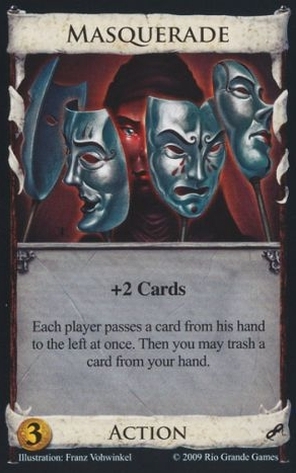
2. Masquerade
Time to eat crow. The first Best $3 Cards list left this off entirely, and boy was that a mistake. Masquerade is an elite opener, and a hard counter to all sorts of junking attacks.
What makes it so powerful is its ability to avoid the midgame slump so common to deck-thinners. Cards like Chapel and Ambassador, though powerful, suffer from the fact that they don’t improve your buying power when you draw them. By drawing 2 cards, Masquerade combines solid buying power with its deck-thinning, thus allowing you to improve your deck along two axes at once.
But unlike other elite openers, it keeps its power into the midgame. The +2 Cards means that you’re almost always going to be passing a card equal to or worse than your opponent, and Masquerade is absolutely brutal when combined with discard attacks like Militia.
The fact that it’s the key component in the most powerful combo in Dominion doesn’t hurt either.
Dominion: Seaside
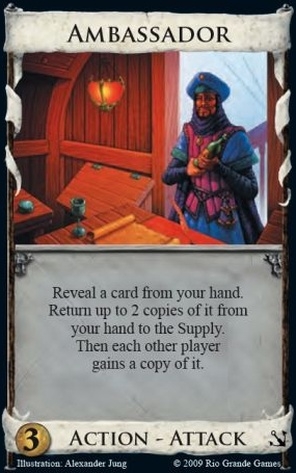
1. Ambassador
How good is this card? So good that with 5/2, I’d often rather open Ambassador/nothing than fall behind in Estate tennis. It “trashes” like a Steward, it attacks like a Jester that always hurts, and for the low low cost of $3! If you trim your deck enough, you can turn Ambassador into a Witch by buying a Curse. It’s one of the most brutal attacks in the game; the fact that it’s available on the very first turn dramatically alters the strategy space of any game it’s in.
But Ambassador suffers from one critical weakness: it’s too slow. Bizarre, considering that its primary function is to slow your opponent, but if you can’t transition out of Ambassador into an engine, you’re often left flailing with very little time left. Against cards like Jack of All Trades, or Vault, the Ambassador player will end up with a very thin deck and not enough green cards to buy. In other words, it’s the Chapel effect, only exacerbated: you trade early and mid-game power for a late-game surge, but an opponent that pushes Provinces quickly can survive the junk and get enough. This isn’t to say that Ambassador can be ignored on most boards, only that you need to have a plan afterwards that is better than just Big Money with a small deck.
The author of this guest article is Donald X. Vaccarino, who probably knows a thing or two about Dominion. It’s an excellent overview of the major different attack types in Dominion, and how to counter them without simply buying up all the Moats. Originally published over a year ago, it’s still relevant today.
Some people play with Moat in every game. Gotta have some defense! Is what they’re thinking. Otherwise, what do you do about attacks? Well there’s a ton you can do. Moat usually isn’t even the best option. It’s an option though. I better mention it. You can Moat attacks! And Lighthouse them. And sometimes Secret Chamber them or Watchtower them or Trader them.
Now let’s consider every attack.
1. Attacks that make you discard
Militia, Goons, Cutpurse, and Minion all put you down cards in hand. Your turn ends up not playing out as well as you thought it was going to.
The first thing is, a few cards draw you up to a particular hand size – Library to seven, Watchtower to six. These can make you actually happy that the attack was played against you – you tossed your worst cards and got well perhaps better ones. Menagerie is a special case solution, as is Tunnel.
These attacks make you need to have good hands consisting of not many cards. One approach is to have good cards and weak cards but not cards that are in-between. A hand of five silvers turns into a hand of three silvers when they play Militia, but a hand of two Golds a Silver and two Duchies keeps the cash and still buys Province. Well it’s easier said than done to get those Golds in the face of Militias beating down on you, but it’s a plan.
Getting the good cards may be work, but it’s easy getting the bad ones. Strategies that involve having lots of junk in your deck, i.e. Gardens, are fine vs. Militias.
Another thing is, sometimes playing a single action can be enough to have a decent turn. Workshop a Gardens, buy a Copper, that’s good enough. Expand is another good example, for the late game at least.
Minion is a special case in that it’s essentially a random discard. You’re just as likely to toss good cards as bad ones. Secret Chamber can send cards down the line for you, though you have to guess which way they’ll use the Minion. Cutpurse is also special, since it only hits Copper. You can fight it by trashing your Coppers.
What you don’t want vs. these attacks is well cards that get worse with a smaller hand. You probably just discard that Cellar when they Militia you; it’s not doing much. Cards that require a combo, like Remodel, are worse early on – a turn of “Remodel an Estate, buy Silver” becomes “Remodel Estate, done.” Even Chapel gets weaker vs. Militia.
2. Attacks that trash your cards
Thief, Pirate Ship, and Saboteur all trash your cards. Your precious cards!
The first thing you can do is, you can gain cards – Ironworks, Talisman, etc. You break even vs. just one other player; with multiple people trashing your cards, it may not be enough. When multiple people are trashing cards though, they are sometimes trashing the cards that trash cards, so gaining extra cards can still be good. +Buys are another way to gain extra cards, but since you also have to have that extra money, they don’t typically work fast enough.
Thief and Pirate Ship only trash treasures, so the easy out there is to do without ’em. There will often be an action out that makes money, and that will do. If Thief isn’t being played too often, you can sometimes just ignore it. It will steal some good cards from you eventually; oh well, they are down money in hand the turn they play Thief and you have no such burden. It’s not so bad. If lots of Thieves are being played though, you can just run out of cash. In the unusual situations where you can’t make up the difference in actions, you’ll want to fall back on gaining extra cards, even with +Buys. Also, end the game before they can get the upper hand this way.
Now when Thief hits Copper, you’re glad and they aren’t and that’s that. When Pirate Ship hits Copper though, everyone’s happy. You don’t want the Copper and they want the token. You don’t want them to get the token. In a two player game, trashing your Coppers first can help here. With more players, you probably can’t get everyone to slow down the Pirate Ship enough. Instead, just coast to victory by building your own efficient Copper-free deck, courtesy of them stealing those Coppers for you. Pirate Ship can cause some groups problems, I think because it’s an answer to itself – Pirate Ship makes you want an action that makes money, and hey Pirate Ship is one of those. So everyone plays Pirate Ships and Pirate Ship seems unbeatable. It is so beatable though. Trashing your Coppers is normally something you give up several turns to do; having it done for you leaves you in fine shape. And you don’t even have to do without money – eventually the Pirate Ships will stop attacking. You can even feed Pirate Ships by gaining Silver – say, with Explorer – and it can all work out.
Saboteur is the anti-Remodel – it turns a card into a worse one. One general approach to fighting it is to spend all of your money each turn. Normally when you have $6, it may be a decision as to whether to buy Gold or some strong action for $5. Get the Gold! And when you have $8, get that Province, don’t wait. You want the more expensive cards because they devolve into better cards. It takes multiple hits to wipe expensive cards clean out of your deck, so it’s no trouble staying ahead with card-gainers. You can even fight it with Remodel. When they do trash a Province late in the game, take a Duchy, you’ll be sorry if you don’t. Peddler provides a unique defense against Saboteur; you probably paid from $0-$4 for it, but you get something for $6 when it gets hit. Cards that are mostly just good in the early game, like Moneylender, are nice in that Saboteur will clear them away for you.
Deck-thinning cards get worse when your stuff is being trashed. You only have so much stuff. How much you care really depends on how much attacking is going on though. Deck-thinning is of course fine vs. Saboteur, since it was just skipping past those Coppers and Estates anyway.
3. Attacks that give you junk
Witch, Ambassador, Familiar, and Mountebank all directly give you Curses or other junk. Your turns become bad and you sit there trying to claw your way up to Duchies.
The first thing you think is, how about trashing those Curses? This is almost a sucker bet. It can be okay, depending on what it’s costing you on those turns. Masquerade and Ambassador are great ways of getting rid of a Curse. Steward, for example, not so great. You spend your turn just trashing junk, and they spend their turn giving you more junk and also buying something. I mean if you bought Steward for some other reason and then draw it with two Curses, man, why not trash them. Just don’t make it your game plan.
Alternatively, maybe you trash it before it even gets to you. Watchtower and Trader will do this for you. Trader especially can be scary for people playing Mountebanks: I get $2, you get two Silvers.
Some cards let you just deal with having a bad deck. Vault lets you toss those Curses for $1 each; in fact a hand with Vault and four random cards will get you at least $6.
A few cards reward you for having junk. A Gardens deck wants as much junk as it can get, and is already expecting lots of cash-poor hands; it’s not like you want to buy Curses for it, but it’s not so bad getting handed them. Counting House puts any Coppers you got from Mountebank or Ambassador to good use.
And of course you want to set your sights lower. You may simply not be able to get to Province this game (let alone Colony). And hey that Witch is already running out the Curse pile; run out the Duchies and there’s just one more empty pile needed to end the game.
Since Curses are limited, you can fight fire with fire. Every Curse I give you is a Curse you aren’t giving me. This is more relevant when fewer people buy the Witches.
And finally, Witches are the attacks that most reward you for actually going for Moats. The attack is pretty significant in how much it hurts you, and if you are actually leaving the Curse in the pile (rather than trashing it with Watchtower), that’s a Curse someone else may end up getting.
Card-drawing gets a lot worse in the land of Witches. Except for things that skip past those Curses, like Adventurer. Villages also get worse, since you don’t draw your actions and Villages together as often. What, all combos get worse.
4. Attacks that muck with your deck order
Man these don’t sound too scary. Spy, Scrying Pool, Rabble, and Bureaucrat do this.
The main effect of a Spy is to make your top card weak. It also may make your good cards go by. That’s annoying but people tend to overrate how much that hurts them. Anyway there’s not much you can do about that. You can get through your deck faster, such as with Chancellor.
The basic defense is to change the top of your deck yourself, without drawing that top card. Spy doesn’t fight Spy, because you draw that weak card they left for you. Well you might see their Spy and make them discard it. But you know. However there are ways to just get rid of that top card. Venture, Loan, and Adventurer dig for treasures, meaning any victory card left on top just goes by. Chancellor flips your deck, getting rid of even a multiple-card pile-up, such as from Rabble or multiple Bureaucrats. Farming Village skips Victory cards. Golem digs for actions. Scrying Pool has you Spy before drawing, so it does actually fight itself and Spy. Lookout trashes cards directly from the top of your deck, or flips them over. Scout draws the victory cards from the top four, although you need another piece to that combo to make that worthwhile.
Spies prey on the tendency of decks to have both weak cards and strong cards. If your deck is more medium, that’s a defense of sorts. You are going to have victory cards in the long run, but in the short run you can trash your junk in order to weaken Spies, especially Rabble and Bureaucrat. You can also play one of those Gardens decks you hear so much about; they leave a Gardens on top and well whatever, your hand wasn’t going to be good anyway.
Sometimes you will be able to draw your whole deck on most of your turns. In those cases you are not too hurt by the top card being a victory card, or by seeing your good cards get flipped over. You’re drawing them anyway.
I included Bureaucrat in this category even though it’s also discard-based. The discard part just isn’t that relevant normally. Sure it makes Cellars worse. You can fight it with Library or Watchtower, although it’s not like you’re so thrilled to draw those victory cards again.
These attacks are on the weak side (the attack part I mean), so you won’t always feel obligated to put up much of a fight. You’ll just do whatever you were doing. Still, every little bit counts. Maybe you were eyeing that Venture already; now you definitely get it.
Chaining actions are especially hurt by Spies. That Village that was at least getting you the next card down, now gets you an Estate they left for you. You would have been better off with Silver.
5. Combination attacks
Fighting one attack is usually straightforward. Fighting multiple attacks is a lot harder. What if they’re playing both Thief and Witch? Man. It’s a tough spot. So naturally some attacks are packages of two different kinds of attacks. Let’s see you get out of this one.
Swindler is a trasher and a junker. It turns a card into a worse one at the same cost. Some games there’s only one card at a particular cost – especially, only Gold at $6 or only Province at $8 – so those cards become more desirable. Cards from Alchemy with potion in the cost often fall into this category. The junk you are getting isn’t all cheap, so cards in the Remodel / Salvager families are good defenses. They turn your $5 into a Duchy; you Bishop it away. Peddler is a ridiculous defense if the Peddler pile sells out; they have to give you a Province.
Sea Hag is a junker and a mucker. That Curse goes on your deck, ready to be drawn. Lookout is a special-case solution; otherwise, just use a mix of anti-Witch and anti-Spy tactics, heavy on the anti-Witch.
Torturer either makes you discard or gives you a Curse in hand. The fact that the Curse goes to your hand makes it easier than usual to fight with ways to trash Curses. With Trading Post in hand, you could actually be happy to get that Curse to trash. The big thing though is, since the choice is yours, you can fight the side of Torturer you’d rather fight. If Torturer gets played a lot then okay, you can’t just discard to nothing, you’re gonna have to fight the Curses. But you know, sometimes there’s just one here and there.
Ghost Ship is a discard mucker. So was Bureaucrat, but again, that only made you discard stuff that’s usually dead anyway. Ghost Ship gets rid of whatever. The fun way to fight Ghost Ship is with combos. Cards like Throne Room and Fool’s Gold and Treasure Map are no good without a partner, but if you get Ghost Ship’d and don’t have the combo, just save the combo card for next turn. If you do have the combo, keep it. Since you’ll be putting bad cards on top a lot, anti-Spy cards are good here.
6. Attacks, any attacks at all
However you’re getting attacked, you want to fight it from turn one. Sometimes there’s that guy in your group who always attacks if it’s at all possible; sometimes you just know, you are dealing with some Goons fans, or whatever it is. Sometimes you don’t really know of course. But as soon as you can, get to beating that deck.
Attacks slow the game down, while also making 3-pile endings more common. Don’t be the last one to sigh and go for Duchies. Get in there.
Attacks can fight attacks. Muckers like Spy can flip over attacks, stopping you from getting hit by them as often. Card trashers like Saboteur and Swindler will sometimes get to trash attacks. Junkers like Mountebank slow down the pace of opposing attacks, as they have to wade through the Curses and Coppers to draw their attacks. And discard-based attacks can slow down the attacks that don’t produce immediate resources – such as Sea Hag, Thief, and Saboteur – since if they hold onto the attack, they now only have two cards left to actually buy stuff with.
Sometimes, the guy with the attacks is just not going to beat you. You know. He went heavy into Thieves and it’s a bad board for it; so much for him. If it’s a two player game, that’s that; if it isn’t, there are still those other guys. Fighting the attacks better than they do may make all the difference.
The Dominion Strategy Blog will be on a limited posting schedule during the holidays. We will resume regular publication in the new year.
Happy holidays and merry Dominioning!
Disclaimer: Dominion does a really great job of balancing its Kingdom cards. Every card has some situations where it shines, and some situations where it doesn’t. Nevertheless, some cards just end up being flat-out better than others, either because they are more useful more often, or just ridiculously good when they are useful. Don’t expect this list to be objective.
Promotional Dominion Cards
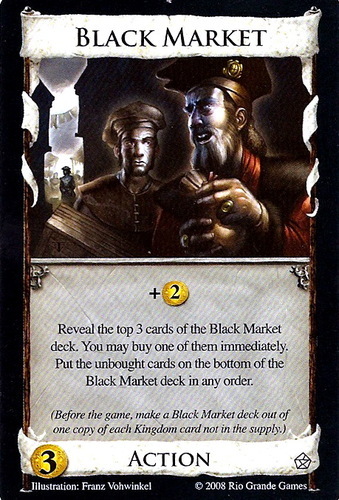
Honorable Mention: Black Market
Sometimes cards end up on this a “Worst” list because they are genuinely bad, and sometimes they end up here out of spite, because of how annoying they are.
Black Market qualifies for both. It’s bad in that you can’t really assemble a coherent strategy when you don’t know what cards you’re going to get, and a hodgepodge of random cards (1 copy of each) is not really going to get you anywhere unless Fairgrounds is in play. Not to mention the fact that even when you draw good cards, they don’t always come out at the right time. You can get a Turn 3 Chapel, but as it turns out, Turn 3 Chapels are pretty terrible. Or you might get a Turn 3 Grand Market, which you are totally unable to afford.
But when everything does line up, oh how annoying it can be. Your opponent grabs a Mountebank on Turn 3, and a King’s Court on Turn 5, and then on your turn you get to choose from Treasure Map, Peddler, and Fool’s Gold. It’s like a stark reminder of why you stopped playing Ascension.
If you can be disciplined, and buy from it sparingly, Black Market is really not that bad. It’s just a terminal Silver with some fun tricks (e.g., Black Market/Tactician), and can sometimes give you a leg up by giving you access to a card no one else has. But it tempts us all into bad decisions.
Dominion: Cornucopia
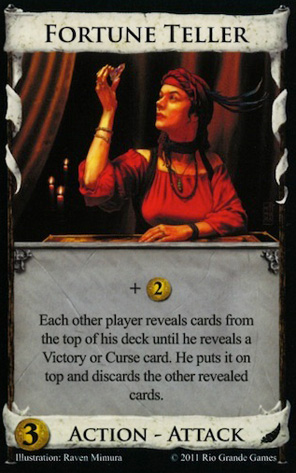
5. Fortune Teller
Hello, players. Look at your Fortune Teller. Now to Ambassador. Look at your Fortune Teller, now back to Swindler, now back at Fortune Teller, now back to Ambassador. Sadly, your Fortune Teller is nothing like Swindler or Ambassador. Look down, back up, where are you? You’re winning a Tournament thanks to your opponent’s Fortune Teller. What’s in your hand, back to me. I have it, it’s your Coppers, now they’re in my deck. Look again, the Coppers are now Curses. Anything is possible when your $3 attack actually does damage instead of just cycling your opponent’s deck. I’m on a Trusty Steed.
Dominion
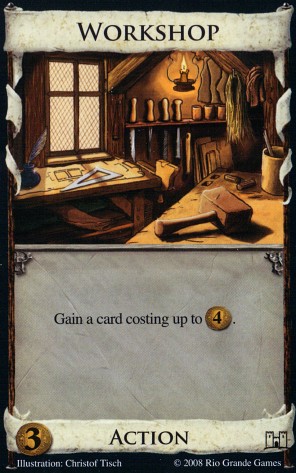
4. Workshop
University can be amazing, Workshop can’t. The difference? $5 Actions are actually useful, to the point where you probably want as many of them as you can in your deck because of how much they boost your deck quality. That just doesn’t hold true for $3 and $4 Actions. Most of them are terminal and intended strictly for early-game use. And few of the non-terminals actually improve your deck in a meaningful way. About its best use is for Great Halls and Caravans, but even then, it’s far outclassed by Ironworks. Of course, it’s good for Gardens, and if in a Cursy game, or in a game overflowing with Actions but without +Buy, Workshop might be worth it to pick up some Caravans or Great Halls if Ironworks isn’t around. But that’s a lot of if’s. 90% of the time, it’s far more important to ramp up your engine instead of dilly-dallying at the $3/$4 level. Even if you gain every Great Hall and every Spy with your Workshop, you still haven’t made any progress whatsoever towards reaching $8, or even $6 per hand.
One of the ways you can tell someone is getting better at Dominion is when they stop buying Workshops and start appreciating the importance of tempo. A deck built on Workshopping $3’s and $4’s is usually just too slow to compete with someone who ramped up their engine with Silvers instead of Workshops.
Dominion
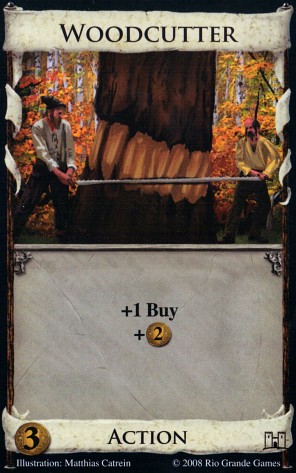
3. Woodcutter
No one purchases a Woodcutter unless they have no other choice. If you’re very prescient, I can see the appeal of opening with Woodcutter if you know you’ll be setting up long Laboratory chains. But you’re never happy to do it, and there better be basically no other terminal on the board to justify such a move. Woodcutter ranks worse than Workshop because it’s not even the best card in the one situation where Woodcutter shines. (Though I concede this is a debatable point.)
Plus, even the Woodcutters in the picture give you a hint as to how bad they are. Look at poorly they’re sawing that tree! Of what use could such incompetent Woodcutters be to your glorious Dominion?

Dominion
2. Chancellor
Most players’ first impression of Chancellor is that it’s crap. Then you start second-guessing yourself; you wonder whether or not you’re giving it short shrift. Maybe this is one of those “expert-level” cards that only good players can appreciate, you think to yourself. You start trying it out, faithfully trying to manipulate deck variance in your favor.
Then you realize it’s still crap.
Nevertheless, Chancellor holds the unique title of “most overrated underrated card”. That is, you will continue to see people extolling its virtues, coming up with exotic scenarios that justify using a terminal Action on deck reshuffling. The long and short of it is that although Chancellor offers a benefit, it’s a marginal and uncertain one. If you really want, you can get most of its benefit (and then some) from Watchtower/Royal Seal/Navigator anyway. And unlike just about every other card, there is never a board where you need a Chancellor in order to succeed. Yeah, it works nicely with Stash and Counting House, but the fact that Chancellor’s best combos involves investing in other bad cards really should end up counting against it.
Dominion: Hinterlands
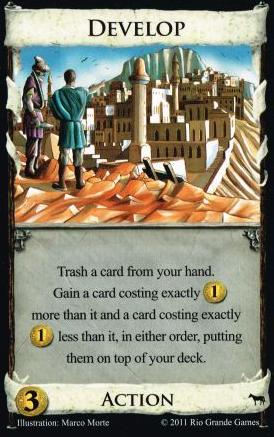
1. Develop
Welcome to the worst early-game trasher yet. Trashing one at a time is so painfully slow that Develop is just not worth opening with, even with the possibility of top-decking Silvers. At least Trade Route turns into a juggernaut in the late game; Develop is so awful at deck-thinning you’re better just sifting with Warehouse and the like.
But wait, you say. Couldn’t you use Develop for awesome mid-to-late-game interactions? Develop an Ill-Gotten Gains into a Caravan and Border Village, gain another Ill-Gotten Gains! Develop a $5 into Goons/Throne Room!
Yes. But — and it’s a huge but — how often are those combinations actually on the board? How often are you going to draw the right card with your Develop? And realistically, you’re going to need some +Buy too, or else where do you find the time to get a spare $3, then wait for it to come back around? In the time you spend setting this up, why not just buy Provinces instead?

Dominion: Intrigue
Baron is one of those cards whose benefit is immediately apparent to beginners, but also includes some more subtle rewards for more advanced players.
The early game benefit is pretty apparent: it’s a huge amount of buying power this early in the game, and can even lead to a Turn 3 / Turn 4 double Gold buy. The drawback is just as apparent: if you miss the Estate, you’re pretty much DOA, since you have one gimped hand with a dead Baron, and another gimped hand full of Estates. And like Moneylender, this will happen more and more as the game goes on, since you’re less and less likely to draw the Baron with the Estate.
The question is, then, when is the Baron risk worth it? Compared to, say, Horse Traders, Baron more reliably gets to $6, but less reliably hits $5 on Turns 3 and 4. So in games with critical $5’s (e.g., Witch), I would take something like Horse Traders or Silver instead, sacrificing the $6 chance for more guaranteed $5’s by the first reshuffle. (Especially since Baron, like all combo cards, is much worse with Cursers out.) But without good $5’s, you’re better off shooting for an early Gold, especially if there are worthwhile $4’s (Caravan). Good cheap cards in general will soften the blow of missing your Baron.
Baron somewhat conflicts with trashers (if you’re Remaking your Estates, you won’t have any for your Baron), but even then can sometimes be worth it. Baron/Chapel, for instance, gives you a pretty strong chance at a Gold/trash 4 cards scenario; if there are no good $2 cards, drawing them together doesn’t actually hurt, since it wouldn’t have done anything even if it was a Silver. With trashing, Baron is more likely to connect with the Estates. And like most other opening cards, Baron meshes nicely with trash-for-benefit like Salvager or Apprentice, since you can get rid of it after your Baron odds drop too low.
At a more advanced level, Baron retains some of his power past the opening. Unlike Moneylender, you can incorporate Baron as a cash generator in total draw decks. The fact that he discards rather than trashes Estates becomes an advantage, since you can keep triggering Barons with the same Estate for a ridiculous amount of coin per Action. He’s very helpful in a double-Tactician deck with +Actions, since it’s hard to do better than +$4 per Action. And the +Buy is quite convenient, especially if you’re playing multiple Barons per turn.
Hunting Party is, as always, a good alternative to a total draw deck, and works quite well with Baron since you only need 1 copy of the Estate and the Baron. It has the advantage of starting with 3 copies of its combo card, and Baron and Hunting Party can start reliably churning +$4. Add in a Gold, and with a few Hunting Parties you can consistently generate $8 each turn (with each hand ideally being Copper, Gold, Estate, Baron — you can even swap the Gold out for Silver if you think you can draw an extra Copper each time). Like most combo cards, Baron responds well to most hand-discard attacks but not to cursing attacks.
You should almost never take the Estate with the Baron. It’s a useful consolation prize in the extreme late game, and makes Baron slightly less awful then, but gaining additional Estates with the Baron early on will slow you down too much. Though of course, in Silk Road or Gardens games, his Estate gain is quite powerful and further boosts his own power somewhat.
Works with:
Conflicts with:
Disclaimer: Dominion does a really great job of balancing its Kingdom cards. Pretty much every card has some situations where it shines, and some situations where it doesn’t. Nevertheless, some cards just end up being flat-out better than others, either because they are more useful more often, or just ridiculously good when they are useful. Don’t expect this list to be very scientific.
Dominion: Intrigue
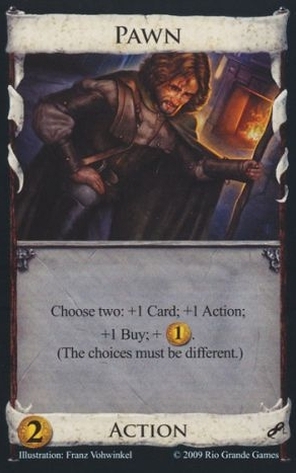
Honorable Mention: Pawn
This is one of the most all-around useful cards in the game. It’s great early when you can afford to blind draw (e.g., +1 Card / +$1), it’s an easy way to get a non-terminal Buy, it’s ridiculously cheap, it’s a great disappearing source of money (good for Library, Minion, Grand Market), and yes, if all else fails, it’s +1 Action / +1 Card…
It’s lost a bit of its luster now that there are more cheap ways of getting +Buy, but rarely is a deck actually hurt by including a Pawn or two. Unless, of course, you’re playing on Isotropic, in which case your opponent will probably die of old age before you finish playing every single one of your King’s Courted Pawns.

Dominion: Intrigue
5. Courtyard
I considered placing this above Haven, but ended up ranking it just below. It’s decent (but not great) in a +Actions/+Cards chain (as befitting a $2 card), but it’s really nice even when you don’t have any +Actions. In many ways it’s actually superior to Smithy, since placing a card back on top is like a mini-Haven, and it saves you from drawing dead Actions.
But it ranks below Haven simply because it doesn’t feed on itself well: you can’t play multiple Courtyards since it’s terminal, and even if you have +Actions, playing multiple Courtyards on top of each other is not that great, since it misses out on the true point of Courtyard. And not every deck is improved by a Courtyard.
Dominion: Seaside
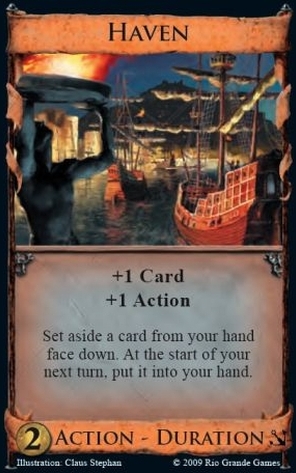
4. Haven
I really, really like this card. Probably more than it deserves. But it’s saved my bacon many times: literally every engine combo benefits from a Haven, making those lovely massive Action chains that much easier to put together. In particular, it gets rid of those situations when you draw your King’s Court all by itself, even though you have like a million other Actions in the deck, but your stupid opponent lucked into his stupid King’s Court with his stupid Mountebank and now you’re pretty much dead on arrival because of a random number generator.
In other words, Haven is great. It’s like a poor man’s Scheme, except it increases your hand next turn and works on Treasures too, helping you smooth out your late game $7’s and $9’s.
Dominion: Seaside
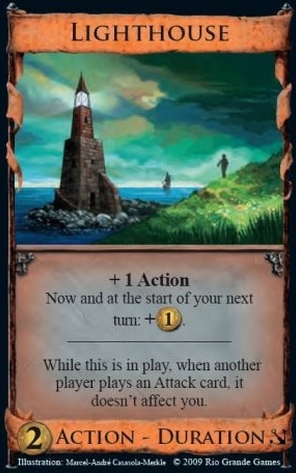
3. Lighthouse
We like to casually use “Reaction” to mean “Reaction to attack”, but it’s worth remembering that the best defense against attacks doesn’t even say “Reaction” on the card. Lighthouse is the only “Reaction” worthwhile in a 2-player game, since you’re basically unattackable once you’re able to keep a Lighthouse in front of you consistently every turn.
The key is really that it’s non-terminal, so when you draw your Lighthouses with your Mountebank you aren’t just forced to play one and not the other. Its benefit is not too shabby either; obviously it’s not as good as a Silver, but it’s good enough for a spammable Reaction, and heck, I’ll take +1 Action / +$1 with $1 next turn over +2 Cards any day.

Dominion: Cornucopia
2. Hamlet
A strong contender with Fishing Village and Border Village for the best “Village” in the game. It doesn’t have Fishing Village’s crazy Actions, or Border Village’s free $5 card, or even the word “Village” in its name, but it does offer +Buy, a critically underrated component of an +Action/+Cards engine.
The fact that you have to discard means that Worker’s Village is technically usually better, but since you’re mostly building an engine around Actions, the forced discard is rarely an issue: the whole point of Action combo engines is that you don’t need all the cards in your hand — just a few key ones. Sometimes it even works to your benefit (e.g., Tunnel, Library). The key, though, is the price: Hamlet’s price makes it easy to grab two with $4 and two buys. And where do you get those buys from? Oh, right, the Hamlets. Self-synergy is generally a surefire recipe to the top of these rankings.

Dominion
1. Chapel
Six expansions later, Chapel is still the best card in the game. In fact, it is likely the most powerful Dominion card that will ever be printed relative to its cost.
That’s not the same as it being bad for the game, though. On the contrary: Chapel enables players to explore an entirely different kind of Dominion: a Dominion where card combos are free to run wild, without getting gummed up by Coppers and Estates. A game where engines thrive and Big Money stumbles, where you get to immediately reshuffle in your new purchases instead of waiting many agonizing turns to see your cards again.
As more and more trashing options are introduced with each expansion, Chapel’s uniqueness has faded. In some games, it’s arguably no longer even worth purchasing. But Chapel remains the defining card of small-deck Dominion, a card whose legacy speaks for itself.
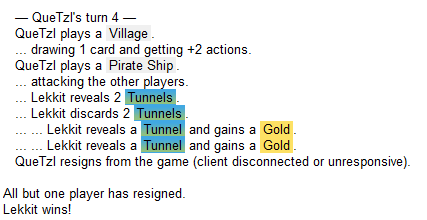
Turn 4 Pirate Ship fail
Submit your own great moments!
Eight months ago, we published what is still, to this day, my favorite DominionStrategy.com post of all time: Greatest Isotropic Moments, Vol. I.
Well, it’s time for Volume II. We’re putting out an open call for your great Isotropic moments of all kinds — funny, incredible, unlucky, and epic fails. It doesn’t matter if they’re good games or bad games: as long as they have something hilarious or unique, we want to see them!
The one restriction? The game has to have been played in 2011. That’s it.
Submit games by posting in this forum thread. Use CouncilRoom’s game search feature (or your own player page) to help find that crazy game. Feel free to go through everyone else’s submissions: last time we had tons of hilarious submissions, but only had room for 10.
Submissions will be open until December 31, so as to capture all of 2011’s great Isotropic moments. We’ll go through all of them and pick out the funniest, the most epic, and the least epic to showcase on this site.
Disclaimer: Dominion does a really great job of balancing its Kingdom cards. Every card has some situations where it shines, and some situations where it doesn’t. Nevertheless, some cards just end up being flat-out better than others, either because they are more useful more often, or just ridiculously good when they are useful. Don’t expect this list to be objective.

Dominion: Hinterlands
Honorable Mention: Duchess
Duchess is almost certainly worse than all the other $2’s, because it’s the only card that you get for free by buying something else. On the other hand, it’s also the only card that you get for free by buying something else. It’s a little unfair to judge it on its power alone, since the whole point of the card is that you can get it without having to spend coins or a buy on it. As a freebie, it’s not bad: Duchy strategies don’t need more than Silver anyway, and if half your deck is Duchies then the fact that it’s terminal doesn’t really matter, and the Spy is more likely to help you than your opponent.
On the other hand, if you’re actively buying it, then Duchess is pretty awful. Its main appeal is +$2 for just $2, but the fact that it’s $2 and not $3 rarely matters. About the only time it really matters is on a 5/2 opening split, but you’re committing a terminal Action for +$2 and not much else. You’d have to have Actions to burn, or else have literally nothing else worthwhile on the board.
The real nail in the coffin is that even when you can get it for free, you sometimes don’t want it. When you won’t even take it into your deck for free, at a point when you’re already greening pretty heavily, that doesn’t bode well.

Dominion: Seaside
5. Pearl Diver
The first time you buy it, you conjure up all these images of the great cards buried on the bottom of your deck, to be brought back to the living by Pearl Diver. But then you hit an Estate on the bottom, and you start to realize, hey, this card is basically useless as soon as you hit a bad card. Sure, there are certain situations where you might want to bring Victory cards to the top, but even when you’re bringing good cards up, it’s not really a net positive unless you can draw it immediately. And oh yeah, it’s self-replacing, except that it’ll trigger reshuffles, which can be a royal pain. Pearl Diver subscribes to the “out-sit rather than out-play your opponent” school of winning. Even the Village Idiot at least gets extra Actions; all Pearl Diver offers is a dreadful amount of AP. About the best thing that can be said for this card is that it can feed into a (very) poor man’s Conspirator chain. God help you.
On the other hand, since the first edition of this ranking, quite a few cards have been released that don’t necessary explicitly combo with Pearl Diver, but are slightly aided in some way by it. Pearl Diver boosts Horn of Plenty, aids in triggering Menagerie, and is not an actively bad target for Haggler. So it gets to move down the list.

Dominion
4. Cellar
Cellar is a card to buy only if its superior alternatives (Warehouse, Crossroads, Vault) are not available. The fact that you discard before drawing makes it considerably worse than Warehouse, and giving up a potential Silver for a chance at redrawing up to 4 other cards in your hand is just not worth it. It’s nice in very big draw decks, because it keeps your engine flowing, but it implicitly depends on bad cards in your hand (and not just in your deck) in order to truly succeed. Against hand-discard attacks in particular, it completely collapses and leaves you with unpalatable options all around.
Nevertheless, unlike the cards above it, Cellar still sees quite a bit of use in 2-player games. You’ll wish it was a Warehouse instead, but in big draw decks, and towards the end of the game, you’ll grudgingly take the Cellar nevertheless.
Dominion
3. Moat
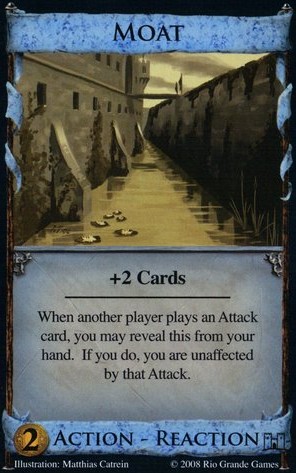
A tough call, putting a Reaction card on this list, since if you’re under fire from Mountebanks and Witches, you are pretty happy to have one of these in your hand. Among Reaction cards, Moat has the best all-around Reaction ability against attacks—but in exchange for having the worst non-Reaction ability. And its Reaction ability is no longer unique; Lighthouse does it better, and you’d probably prefer something like Watchtower or Horse Traders against other attacks.
Most telling, though, is that if there is no attack in the game, then no one buys Moat. (The +2 Cards is so pathetically weak that you should probably just not bother building a +Actions/+Cards engine around it.)

Dominion: Alchemy
2. Herbalist
This works best with Alchemist and Hoard. Other than that, this is a classic “Actions to burn” buy; there’s no point to it unless you have more Actions than you know what to do with, or if you desperately need +Buy.
Sure, you can come up with situations where it’ll be helpful. But it’s usually just too situational to justify taking up a slot in your hand.

Dominion: Intrigue
1. Secret Chamber
Reactions already get a bad rap, being so bad in 2-player and all, and being the worst reaction out there just makes matters worse. It works great against deck-inspection attacks, but no one ever lost because they got Spied on too much. And against the attacks that matter most — the Cursers — Secret Chamber really drops the ball. Yeah, it’ll let you discard them for money, but you need to draw at least two Curses in hand with it to make it better than a Silver. A deck that’s 40% Curses and 20% Secret Chambers is going nowhere fast.
Its non-Reaction ability is not awful, strictly speaking, and has its uses in double-Tactician decks, but the fact that Vault does the same thing, but so much better, is just another strike against it. Secret Chamber is a Reaction that’s not really all that meaningful plus an Action that is strictly dominated by another. For that it earns the Worst $2 Card spot.

 Recent Forum Posts
 Dominion Strategy