This Secret History was written by Donald X and originally posted to the Dominion Strategy Forums.
Going into work on this set, I had two plans. First, to see what I could do with States. States showed up in Nocturne, just as a way to deal with tracking for a few effects; I had put no work into trying to see what I could do with them, and well probably I could do something with them. Second, to try to do more with the coin tokens from Guilds. They were popular and it seemed like maybe I could actually do more with them.
Along the way I added a third goal: to make a set that was much simpler than the last few sets. The expansions naturally get more complex as you go along, since you run out of new simple things to do. I felt like things had gotten too complex though, and wanted to swing things back the other direction as much as possible. So the set intentionally has a bunch of off-theme cards, which is to say, cards that don’t involve any of the new mechanics; and I limited myself to text that would fit with the large font, and for the landscape cards, text that would fit with the large font on two lines (then Innovation needed three during layout due to the expansion symbol). And the set tried to stay simple in other ways too.
Initially I did two things with States: I had ones that one player could have, and ones that every player got a copy of. The ones that every player got could turn over; one side would have a rule that let you upgrade it. We liked these a lot.
One of the two-sided States was a lot like the Journey token from Adventures – it was, some cards flipped it over, but when it flipped over one way nothing happened, and the other way gave you +1 Action. So some cards essentially had +1 Action half the time you played them. This was cool. But wait: maybe I could just have +1 Action tokens, to go with the +$1 tokens. And I switched to that and it was even better.
So… +1 Buy tokens? I had them in the set for a bit there. And there was a 4th mat, unrelated to the others. In the end I felt like, we were eating up so much table space with mats, and hey what about being simpler. So there are just Coffers and Villagers. And they got those names and notation and then since we were updating Guilds for reprinting it got the Coffers mat too.
The other two-sided States, they were good times, but did not go well with the idea of a simpler expansion. Here, read this extra card, now turn it over. They turned into Projects: you pay to put a cube on a card, and now you have that ability. This is not only simpler – no second side to read, no text to explain how to upgrade it – it also means only one card per Project, rather than six (for six players) per two-sided State. So I could fit way more of them into the set, hooray.
The one-sided States persisted, but somewhere along the way I realized I should use a different name for them, to clarify that only one player got them. So they are Artifacts. The Artifacts were tricky; you want them to move around but not every turn, and they want to be attractive but not have the game hinge on them. I thought there might be 8; there are 5, and I struggled to get those.
Coffers tokens were also problematic; when you have a giant pile of those tokens, it’s pretty demoralizing for the other players, and sometimes it’s even a good strategy. So only one card gives +2 Coffers each time it’s played, and some only sometimes produce +Coffers, and some do it when-gained. Villagers tokens had no issues. Go ahead and get a bunch if you want.
So, I think that covers it: Coffers, Villagers, Artifacts, Projects, and cards that do none of those things.
It turned out Ben King had been working on a Dominion program as a fun project, and he programmed in Renaissance and we playtested it some there. Thanks Ben! He also wrote some bots to demonstrate how powerful some particular cards were.
Cards
Acting Troupe: Here you go, some villagers. At first this gave +5 Villagers. Too many.
Border Guard: For a while this had no Artifacts. I wanted more Artifacts and saw that I could add one here, which was Lantern. Then I needed to put another Artifact somewhere and saw that this could have two Artifacts, so it got Horn.
Cargo Ship: The concept debuted on a 2-sided State, limited to Treasures. The first version as a card set aside all gains, and doled them out at one per turn, like Archive. Then it was just one card, and that was better but weak – it cost $5. I tried it with +2 Coffers, then just lowered it to costing $4 and then $3.
Ducat: A late card. I needed a $2, and a +1 Buy card. Matt suggested making it a Treasure and there it is. It didn’t change, but it did get argued about. Adam felt like it was “strictly better” than Candlestick Maker. I am pretty sure it isn’t. What feels better is when you trash a Copper with it… which effectively costs you $3. But any which way, one is a Treasure and one an Action, and various things make those categories matter. It and Candlestick Maker are more similar than most pairs of cards, and well, twelfth expansion, trying to have simple cards, no regrets.
Experiment: We tried several versions of this. After a bit as a Smithy (based on another card that died), it switched to a Lab, because that way there’s usually no tracking (it uses an Action but gives +1 Action, so when it vanishes your play area still tells you the whole story, yes unless you Throne it or something). For a bit they both went to the same place – e.g. if you used Sculptor to gain Experiment, both Experiments went to your hand. That was too confusing for how often it came up. There was a version that was two different cards, the first gained you a copy of the second (the second being non-supply); there was a version that was three one-shot Labs instead of two; there was one that was like Border Village, it got you a cheaper card instead of another Experiment. In the end it’s two one-shot Labs, which it was early on, but with a better wording.
Flag Bearer: Originally you took the Flag when you played it. Well at some point maybe you are drawing your decks and you just pass it back and forth. That isn’t so great. I briefly tried only getting the Flag if Flag Bearer was your first play of the turn; then if you’re drawing your decks it just sits there on the player who got lucky. Also bad. Changing it to when-gain/trash fixed it up every which way; anyone could take it on their turn, so it’s not “those two are fighting over that, let them,” and yet the cost varies (maybe this turn you have $5) and gets higher over time (how many of these Flag Bearers can my deck really handle).
Hideout: One of the first cards in the set, and it never changed.
Improve: Ben and Steveie requested I make a new card that gave you card progression reminiscent of Procession. At first it cost $4, and triggered when discarding a card from play. It shifted to the start of Clean-up in order to avoid having it be possible for every effect in Dominion to happen in the middle of discarding your cards.
Inventor: One of the 2-sided State cards was a Workshop that could get you a Scheme-a-turn that turned into Citadel (but it worked on Treasures too). For some reason I added a Bridge effect to it, while it still used a State. Then I decided the State needed a different card, but kept the Workshop plus Bridge card sans States. We also tried it at $5 with the bottom part of Silk Merchant, but that was too helpful. Inventor does mega-turns, and ideally you don’t always have just what you need there.
Lackeys: Originally it was +2 Cards, turn over your thing that gets you +1 Action half the time. It went straight from that to the final version.
Mountain Village: The last card added. An early village with a negative Artifact didn’t work out; then I made a new village with two Artifacts that also didn’t work out. I decided the move was to just try to have a cool village, and not care about the Artifact being tacked-on, and this was the stand-out from the things I tried. At first you got an Artifact if your discard pile was empty; then I tried giving you the Artifact and +1 Card, and finally moved the Artifact to Recruiter (not what it did, but just, having an Artifact) (and of course Recruiter didn’t keep it).
Patron: The first version had a two-sided State (it was a Cathedral that turned into a Cargo Ship for Treasures if you trashed a $5+ card). When those went away, I preserved the top and added the reaction. I fiddled with the wording some, to try to make it clear, but the idea stayed the same.
Priest: This started out giving you an Artifact if you trashed a card costing $3 or more; the Artifact had you draw a card each time you trashed a card. Sometimes the Artifact felt really important, and it sucked to have to eat your deck to fight over it. I tried changing the condition to “if you trashed a card that hadn’t been trashed yet,” then dropped the Artifact, and switched to getting a bonus per trash right on the card. The bonus was +$2 first, but I also tried +1 Coffers for comparison. It gets rid of some tracking but I liked +$2 better.
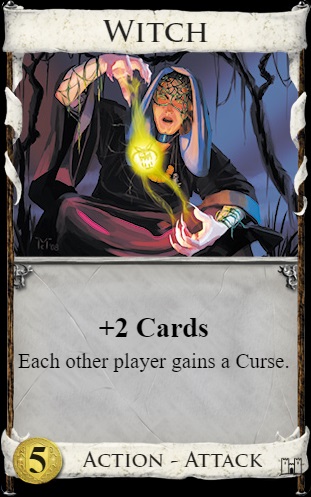
Old Witch: For a while the set’s Witch was “Choose one: +3 Cards; or take the Evil Eye; or each other player gains a Curse.” The Evil Eye was an Artifact that had you Curse the other players whenever gaining VP. We had fun with it for a while. Going for Evil Eye early and hard didn’t work, but when someone did take the Evil Eye at a reasonable time, they would suddenly hand out so many Curses. Another issue was, wait, if you Moat this, they can’t take the Artifact from you? Matt suggested it not being an Attack, which would have had a certain something – Young Witch has a built-in Moat, Old Witch is un-Moat-able. In the end I gave up on it and replaced it with this, the Witch that only temporarily gives you Curses.
Recruiter: I tried trashing a card for +Coffers, and for a mix of +Coffers and +Villagers. It turned out to be too good of a strategy by itself – just madly convert your cards into tokens. But +Villagers by itself wouldn’t have that problem, so I made that card and it was great. A kind of inverse Apprentice. Then at the last minute it got an Artifact, in order to not have the Artifact on Mountain Village. Then at the very last minute I moved the Artifact to Border Guard. We’d been happy with Recruiter, and this way I avoided having another card with multiple mechanics.
Research: Gradually, the set developed an at-first unintentional trash-for-benefit theme – cards that do something when gained or trashed, plus nice ways to trash them. So when I was filling the last few slots, I tried to get in some more of that. This is like Apprentice, but you get the cards next turn, and since they’re set aside you have to have cards left to set aside for it.
Scepter: A way to replay actions was an old idea. Well Royal Carriage does it but you know, as a card you played. Royal Carriage happened, but this did not, because what if this game there’s no card with +1 Action? You couldn’t play your after-the-fact Throne Room. A fix is to make it a Treasure, and that card tried out for Nocturne. Well first it was a Night card, and both the Night and Treasure actually returned you to your Action phase, so that most effects would be meaningful. I didn’t feel like it was adding much, and changed it to a Treasure that didn’t change phases, which meant that many cards were now no good with it. Which I liked; it made it more of a combo card. It was a poor fit for a set with a lot of Night cards though. It made a list of cards to try in the next set, and when the time came, we tried it again, and then I made it both weaker when strong and stronger when weak, by changing it from always making $1, to either making $2 or replaying a card.
Scholar: This never changed. A poster child for the set being simple.
Sculptor: One of the first cards in the set. It used the “+1 Action every other time” thing like Lackeys, then switched to +1 Villager, and that’s that.
Seer: At first it got you cards costing $2 or less, but that was too strong early on. Then $2 or $3, then $2-$4.
Silk Merchant: Briefly this was like a Pawn when gained/trashed, only with tokens in place of +$1 and +1 Action. I always like the idea of a when-gain that can draw cards, but it never survives, for the same reason: in the default situation, you don’t want the cards. And then the triggered +1 Buy was problematic. So, no choice, it just gives you the other two.
Spices: Briefly there was a treasure that gave you your choice of a mix of 2 tokens when you played it – Coffers, Villagers, or the +Buy mat. Then, a treasure worth $2 that gave you +2 Coffers and +1 Buy mat token when gained; this was somewhat inspired by a card of Matt’s. Then I got rid of the +Buy mat, but moved the +Buy to the top of the card.
Swashbuckler: An early poster child for the 2-sided States gave +3 Cards and added a token to the State (or took it if you didn’t have it); when one side got 3 tokens it flipped over and gave you +3 Villagers, and when the other side got 3 tokens it flipped over and got you +3 Coffers and 3 Golds. It was called Jungle Explorer, and the state was Base Camp / Ancient Ruins. When the 2-sided States died, I tried to capture at least some of the spirit of the card, and this is how I did it.
Treasurer: Initially this couldn’t get stuff from the trash. That change gave it combos and was great. Late in the going I wanted to try to have more Artifacts and squeezed the Key onto this. It didn’t need it to be good enough; it was just a place that I could reasonably fit an Artifact.
Villain: I tried a few different Militias before getting here. When it got close to what it is, there were versions that looked for cards costing $3+ or $5+, versions that made you discard all copies of what you discarded, and versions that only attacked if you had enough Coffers tokens.
Projects
Academy: Unchanged, though there were many unrelated cards called Academy.
Barracks: One of the first Projects, and it never changed.
Canal: Unchanged. A lot of these ideas were just fine from the get-go.
Capitalism: There was a thing that made your Silvers be Peddlers in your Action phase, then a thing that tried making your Treasures into Actions. It just isn’t useful often enough. Once I hit on this, it was a question, should it be “+$ amounts” or specific ones, e.g. “+$2 or +$3.” We tried it both ways.
Cathedral: This started as the front of a 2-sided State, that turned over if you trashed a card costing $5+. Once it became a Project, it didn’t change.
Citadel: This also started as part of a 2-sided State, though it was the harder-to-get 2nd side. It originally replayed your first play each turn, which could be Action, Treasure or Night; this was just too confusing though, everyone just mentally thought it only worked on Actions. Spelling it out was poor, so, it just works on Actions. So much for the sneaky Throne Room for Night cards.
City Gate: The last Project. Unchanged.
Crop Rotation: This was $5 and “discard an Action,” then $5 and “Victory,” then the final version.
Exploration: At first this gave +2 Coffers. Ben demonstrated that it was too strong with a bot.
Fair: Another early Project that never changed.
Guildhall: Unchanged.
Fleet: This started and ended at $5, but went up to $8 in the middle. I messed with the wording so that the turn order would be natural.
Innovation: This started at $5.
Pageant: This cost $2 at first, but a Project can’t cost $2 (unless it has a penalty) – you just automatically buy it sometimes.
Piazza: Unchanged. Werothegreat suggested doing a one-card Golem Project; Matt pitched it as a Vassal; there it is.
Road Network: Unchanged.
Sewers: Unchanged.
Silos: Unchanged.
Sinister Plot: Early on I had a Duration card that sat there accumulating Coffers tokens until you popped it. There were a few versions. It’s no fun seeing a giant pile of tokens on the other side of the table, so these died. Then I brought it back as the same thing but for +Cards. Somehow way more tolerable. So one day, you’d have a big turn. This was in the set for a while. Then I turned it into a Project, which only takes one card instead of eleven. As a Project there’s the concern of, can we all keep our tokens separate, and well, we always managed.
Star Chart: We tried several versions of a card that gained you a card each time you shuffled. It had problems every which way. This was a better fit for “thing to do when you shuffle.”
Outtakes
Continue reading →






 Dominion Strategy